WTI breaks the $100 mark, last reached in 2014, though retreats to $96.00 as Ukraine/Russia war escalate
- WTI gained up to 7.60% in the day but retreated to $96.00 as bulls take a breath.
- Ukraine – Russia woes keep grabbing market players’ attention, so WTI’s could resume its rally in any moment.
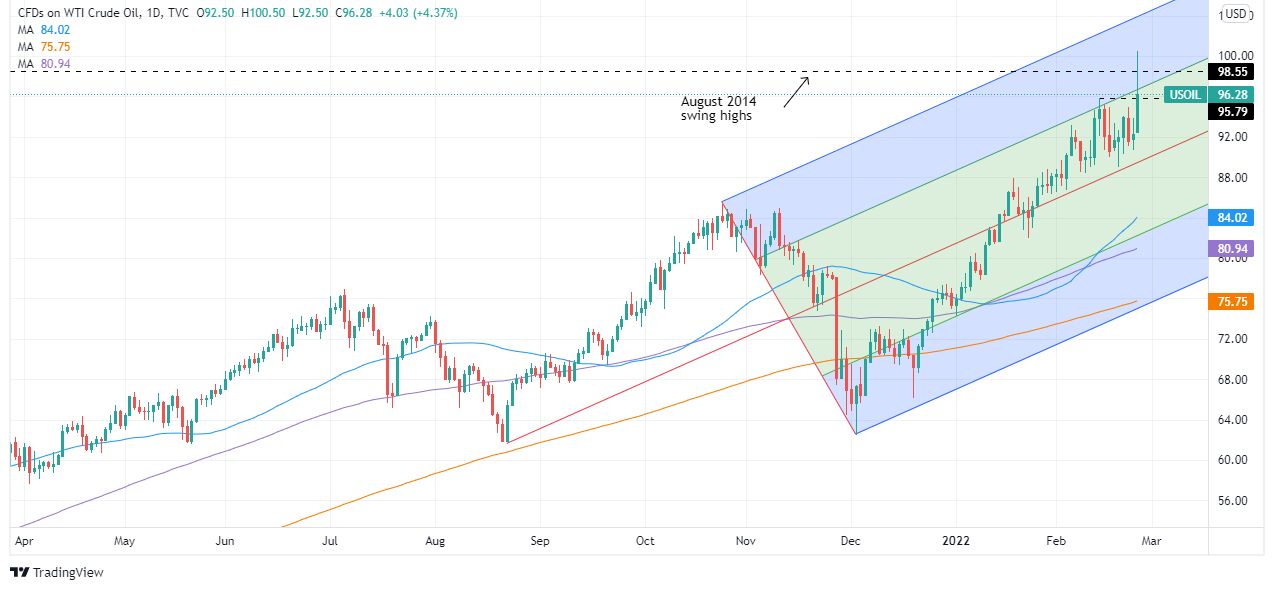
- WTI Technical Outlook: If WTI bulls keep prices above $95.79, they could have a second chance towards $100.

The US crude oil benchmark, Western Texas Intermediate (WTI), is rallying 5% during the day, but at one time, it broke the $100 barrier for the first time since July 2014. At press time, WTI is trading at $96.28.
The market sentiment remains downbeat, attributed to Russia’s invasion of Ukraine, grabbing news headlines around the globe. During the Asian session, Russian President Vladimir putting announced that a special military operation in Ukraine was underway. The military deployment by Russia were bombers loaded with weapons, special forces, and the launch of missiles to Ukrainian command centers.
As the invasion grows, Western and NATO countries condemned the attack from Russia to Ukraine and are expected to impose another round of sanctions, harsher than the previous ones. Some of the sanctions that could be imposed are: freezing assets in the EU and blocking Russian banks to EU financial markets, while UK’s prime minister is pushing for Russia’s ejection of the SWIFT payment system.
Putting Ukraine/Russia’s woes aside, Iran Nuclear talks have improved, as reported by Iran’s top security official, that said that it is possible to achieve a good agreement regarding a nuclear deal, as reported by Reuters.
With the latest developments crossing the wires, the US is working on a plan with the International Energy Agency over a combined release of additional crude from strategic petroleum reserve, per Reuters sources.
Meanwhile, the US Energy Information Administration revealed its weekly report. They said that “working gas in storage was 1,782 Bcf as of Friday, February 18, 2022, according to EIA estimates. This represents a net decrease of 129 Bcf from the previous week. Stocks were 209 Bcf less than last year at this time and 214 Bcf below the five-year average of 1,996 Bcf. At 1,782 Bcf, the total working gas is within the five-year historical range,” as reported by the US EIA.
Market’s reaction to Putin announcing the invasion of Ukraine
WTI’s rallied from the $92.78 region towards $100.50, close to an $8.00 move, followed by a retracement towards the $96.20 area, as American traders got to their offices.
WTI Price Forecast: Technical outlook
WTI daily chart depicts the US crude oil benchmark is upwards, despite retreating from daily highs around $100.50. Nevertheless, to further extend the rally, WTI bulls will need a daily close above February 14 daily high at $95.79. If that is achieved, then WTI bulls would remain hopeful for a second attempt to breach and sustain the $100.00 mark.
Therefore, WTI’s first resistance level would be $96.00. Breach of the latter would expose crucial resistance levels. The next one would be $97.00, followed by August 2014 cycle high at $98.55, and then an attack towards $100.00.
Author

Christian Borjon Valencia
FXStreet
Markets analyst, news editor, and trading instructor with over 14 years of experience across FX, commodities, US equity indices, and global macro markets.