Winners and losers of 2024, as the FTSE100 underperforms again


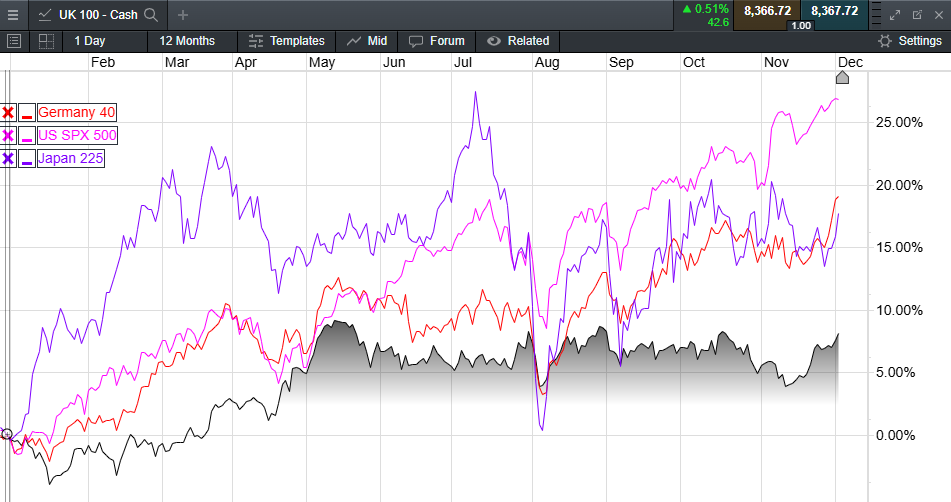
For the FTSE100 it’s been yet another year of underperformance, barely eking out a gain in 2023, at least this year we’ve seen the UK benchmark index break above the 8,000 level and achieve a new record high in the first half of the year.
The performance since that record high has been symptomatic of the FTSE100 over the years, a brief pop to new highs and then the rally fizzles out and the index slips back into a range again.
On the plus side, since the new record highs, we haven’t seen the index move below the 8,000 level with any dips being bought into.
Nonetheless the FTSE100 has still been left behind by its peers, the DAX, S&P500 and the Nikkei225, although it should be once again reiterated that the FTSE100 is not a total return index in the way that the DAX is.
On a total return basis, the FTSE100 has done much better keeping track with the DAX, nonetheless it can’t disguise the fact that the UK stock market appears to be suffering from a significant lack of enthusiasm on the part of global investors, especially when you look at its performance relative to its peers.
Since the end of 2022, we’ve seen gains of over 40% in the DAX, S&P500 and the Nikkei 225, while this year alone the S&P500 has pushed through 6,000 to be over 25% higher, although most of that has been driven by the strong gains seen in the so-called Magnificent 7 set of companies which include Nvidia, Microsoft, Apple, Amazon and Meta Platforms.
Strip them out and the picture isn’t so rosy, however the small cap Russell 2000 has played catchup in recent weeks, posting new record highs in November in the wake of the election of Donald Trump as US President. This contrasts to its 2023 performance which saw it lag the performance of the S&P500 and Nasdaq 100.
This year’s strong performance of stock markets has been undoubtedly helped by the belated start of the central bank rate cutting cycle which finally began in the summer, with the ECB getting the ball rolling followed by the Federal Reserve and the Bank of England, with the bigger question being how many more cuts we can expect to see as we head into 2025.
The performance of bond markets in recent weeks suggests that the end of the cycle could be closer than we think given that in the wake of the last set of cuts, yields went higher which suggests that bond markets have been paring back rate cut expectations in 2025.
We’ve seen that illustrated quite notably in the UK in the wake of the recent budget at the end of October, which saw UK yields rise across the board, and by more than the amount the Bank of England cut rates by.
Record high for FTSE100, but once again lags behind
Source: CMC Markets
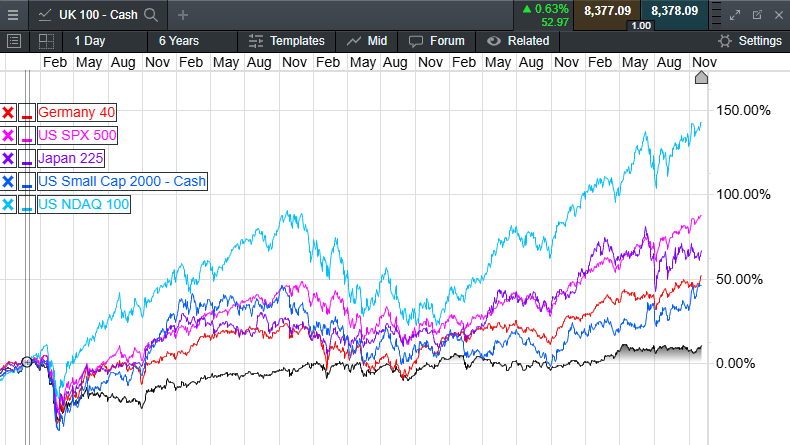
The FTSE100’s underperformance has been a consistent issue for years; however, the gap has accelerated sharply since 2020, compared to the likes of the DAX, S&P500 and Nikkei all of whom have seen gains of 50% and more, and should really be something that the new government might want to get to grips with.
Sadly, there is little evidence they want to do that, which means when it comes to UK companies’ investors will have to continue to be much more selective, assuming that these companies want to stay listed here in the UK.
This year alone we’ve seen the departure of the primary listings for CRH, Flutter Entertainment, and Darktrace, soon to be followed by Ashtead and Hargreaves Lansdown, raising the question as to who might be next?
Could it be Shell, one of the UK markets biggest listings?
There has been chatter about the possibility, and while management of the oil major ruled it out earlier this year, that doesn’t mean the subject won’t come up again given the UK government's attitude towards business.
FTSE100 (black line) underperformance since 2020
Source: CMC Markets
Despite this serial underperformance for the UK’s benchmark blue chip index, we have seen some notable winners on the FTSE100 this year including the likes of Rolls-Royce, which has seen its share price almost double, as has Marks and Spencer as both companies build on their 2023 turnaround stories. We’ve also seen strong performances from the likes of Barclays and NatWest which have made the top 10 best performing UK stocks.
The wooden spoon however belongs to the likes of JD Sports, B&M European Retail and housebuilders Vistry and Barratt Redrow where we’ve seen declines more than 20%, most of the weakness coming in the second half of this year.
The fall from grace for Vistry is particularly striking given that at one point this year the shares were up over 50%, however an accounting issue that caused it to restate its accounts from previous years, as well as issuing two profits warnings, one in October, followed by another in November, caused the shares to plunge.
The November warning saw a further downward adjustment to profits for 2024, 2025 and 2026, taking the total impact to £165m, because of a review across the entire business which saw that costs were higher than previously categorised. Consequently, the profit targets for the next 3 years have been cut by £105m in 2024, £50m in 2025 and £10m in 2026.
On top of the malaise engulfing the wider sector with respect to higher costs, as well as scepticism that the sector will be able to get anywhere close to the new government's ambitions to build the number of homes promised.
We can see this scepticism reflected in the recent numbers from Barratt which saw the housebuilder report a sharp drop in its revenue and profits when it reported its full year numbers in September. Home completions fell 18.6% to 14,004, while revenue fell 21.7% to £4.17bn. Profits before tax also declined sharply by 75.8% to £170.5m. Gross margins also took a hammering, slipping to 12.2% from 18.3%, while operating margins also collapsed by 910bps to 4.2%.
On the outlook, completions for 2025 are expected to come in between 13,000 and 13,500.
It’s not been all doom and gloom with Rolls-Royce and Marks & Spencer continuing their success of 2023 into 2024.
Rolls-Royce has seen a remarkable turnaround since incoming CEO Tufan Erginbilgic described the company as a “burning platform” indicating a determination to make the company more efficient very quickly. In cutting thousands of jobs and focussing on the core business, with engineering technology and safety being rolled up into one division. This focus on costs has seen the business consistently beat expectations on profits and revenues, helped in no small part by the continued recovery in its civil aviation business.
This recovery in Rolls-Royce’s fortunes has seen it regain its investment grade credit rating at the start of this year, which was one of the key goals outlined by Erginbilgic when he took over.
At the most recent trading update, expectations for underlying profit were kept unchanged at between £2.1bn and £2.3bn, along with FCF guidance of £2.1bn and £2.2bn.
Large engine flying hours have now fully recovered and are at 102% of 2019 levels for the year to date.
Defence is also doing well with testing on the F130 engine for the new US Air Force B52J Stratofortress.
On the SMR Rolls-Royce was named as preferred supplier by the Czech Republic, while in the UK the government here continues to drag its heels.
High street retailer Marks & Spencer has also maintained the momentum from 2023 as the brand continues to reconnect with its customers. A 5.7% increase in statutory revenue in H1 to £6.48bn, and a 34.7% increase in profit after tax to £278.6m was driven by both sides of the business, both general merchandise and food, alongside cost savings of £500m by 2028 has helped revive the brand.
In summary, having managed to break above the 8,000 level earlier this year, there is no reason to suppose that stock markets won’t continue the current momentum seen over the last few years. If we are able to hold above the recent lows between 7,950 and 8,000 there is no reason to suppose we can’t move through the highs this year and head towards 9,000.
Author
Michael Hewson MSTA CFTe
Independent Analyst
Award winning technical analyst, trader and market commentator. In my many years in the business I’ve been passionate about delivering education to retail traders, as well as other financial professionals. Visit my Substack here.