|

Will Nvidia stock hit $200 this week?

Ahead of its anticipated earnings call on Wednesday, Nvidia’s (NVDA) stock is trading at $190.00 to start the week. With expectations for a blockbuster report, could we see a surge above $200.00? 

The chipmaker is expected to report revenue of $65.60 billion for Q4, 2025, with earnings of $1.53 per share. This would be a 14% increase of Q3’s revenue figure of $57 billion, setting a new quarterly earnings record. 

NVIDIA’s recent growth comes after the company confirmed multiple partnerships with Meta, Anthropic, and OpenAI for its Blackwell and Rubin GPUs. Additionally, towards the end of 2025, the Trump administration allowed the sale of the H200 GPUs to "approved customers" in China, in a bid to ensure that the world’s AI dependency comes via an American company. 

Despite this growth, industry speculators have labelled Nvidia’s growth as a result of a wider AI bubble. The big short investor Michael Burry confirmed he was holding a bearish position against NVDA worth around $187 million.
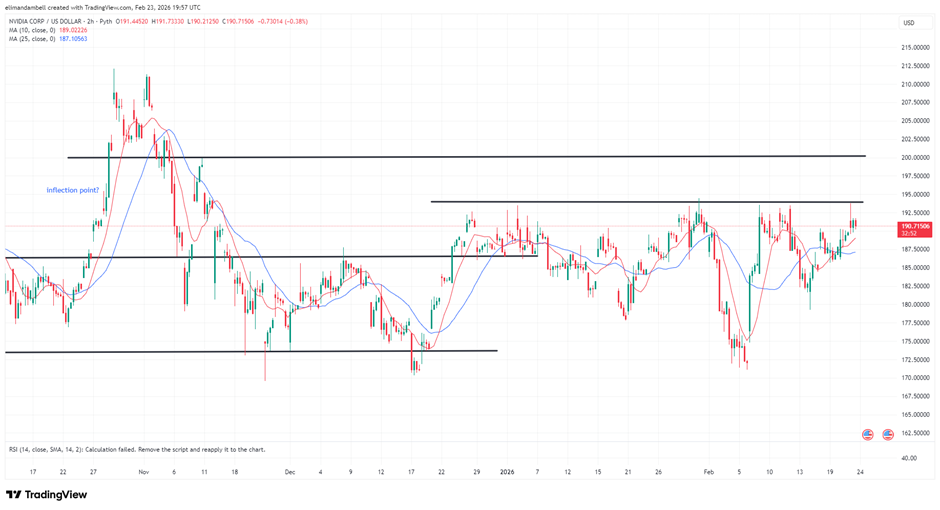
For those trading this week, the key price point to look at is the recent resistance level of $193.00. The last time we saw a true breakout of this level was in October 2025, with the stock going to reach an all-time high of $212.19. 

As a result of this, you will likely see traders placing pending orders above the aforementioned price ceiling, with initial take profits marginally above the $200.00 mark. This will coincide with the recent upward cross of the 10-day and 25-day moving averages, which signals a pending bull run. 

At the time of writing, $NVDA continues to hover at $190.00.

Author

Eliman Dambell

With over a decade in financial markets, Eliman brings an experienced and diversified point of view to market analysis. He covers current and historical macro trends to give insights on Metals, FX, Stocks, and Crypto.


More from Eliman Dambell
Share:

Editor's Picks

AUD/USD bulls regain control above 0.6950 amid USD retreat

AUD/USD regains traction and extends the previous day's bounce from the weekly low, aiming for 0.7000 in Asia on Friday. The overnight pullback in US bond yields keeps the US Dollar below an 18-month high, which in turn offers some support to the pair. Meanwhile, hawkish RBA expectations also keep the major underpinned.

USD/JPY holds gains near 158.00 after Japan's weak Household Spending data

USD/JPY clings to gains around 158.00 after data showed on Friday that Japan's Household Spending fell for the ninth straight month, undermining the Japanese Yen. Meanwhile, the US Dollar remains depressed as the overnight fall in US bond yields counters a hawkish Fed and geopolitical uncertainties, could cap any downside in the pair.

Gold remains range-bound below $4,200

Gold has given up some ground after an initial bullish attempt to reach weekly highs, returning to below the $4,200 mark per troy ounce on Friday. The US Dollar’s strong upside momentum, combined with rising US Treasury yields across the curve, seems to keep further gains in the yellow metal under scrutiny.

Has Bitcoin really escaped the macro forces it was built to fight?
Over 17 years ago, Satoshi Nakamoto designed Bitcoin (BTC) on the back of a global financial crisis as an alternative to the global monetary system outside the control of central banks, governments and traditional intermediaries. This raises a key question: has Bitcoin really become independent of the macroeconomic forces it was built to challenge?
The Euro is not the sick man of Europe. France's bond market is
EUR/USD remains under pressure, near the 17-month low of 1.1161 reached on Monday. The pair has lost more than 7% since its yearly peak, as concerns over France's public finances increasingly weigh on the single currency. But behind the weakness of the Euro (EUR), the problem does not necessarily lie with the European economy as a whole.
Has Bitcoin really escaped the macro forces it was built to fight?
Over 17 years ago, Satoshi Nakamoto designed Bitcoin (BTC) on the back of a global financial crisis as an alternative to the global monetary system outside the control of central banks, governments and traditional intermediaries. This raises a key question: has Bitcoin really become independent of the macroeconomic forces it was built to challenge?














