Why Japanese equities look attractive in 2026 – Part one

Asian markets opened 2026 with remarkable momentum, as indices from Japan, Singapore and South Korea climbed to fresh record highs on Tuesday, January 6th. Despite geopolitical turbulence—including the U.S. capture of Venezuelan leader Nicolás Maduro, global investors appear increasingly focused on opportunities beyond American shores, as sentiment toward U.S. equities cools.
Concerns about tariff uncertainty and elevated tech sector valuations prompt many investors to look abroad for better risk-adjusted returns in 2026. Among international markets, Japan emerged as a standout performer and a compelling investment option. The surprise election of Sanae Takaichi as prime minister last year ushered in a new era of fiscal support, while the country’s phased shareholder reforms continued gaining traction. The Nikkei 225 surged more than 27% in 2025 and many analysts believe that this momentum can continue in 2026.
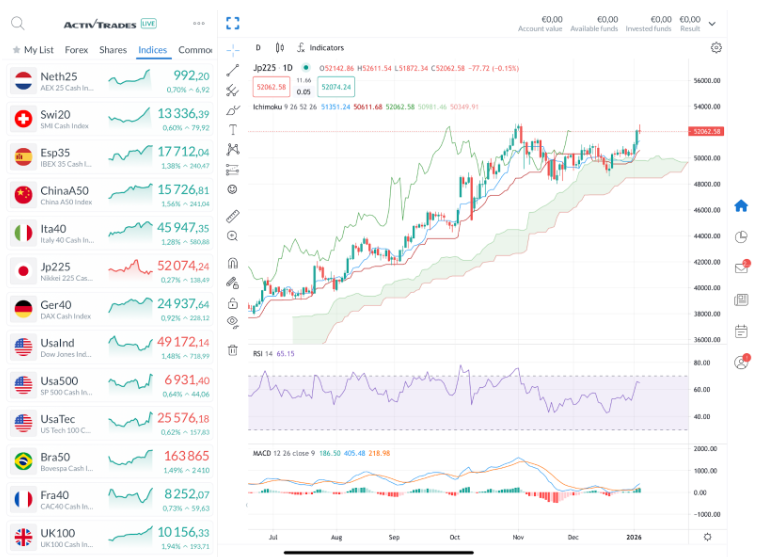
This two-part series examines the key factors behind this bullish outlook. Let’s dive into the first two drivers:
Japanese equities look relatively cheap
For over a decade, the narrative of global finance was synonymous with U.S. exceptionalism. But 2025 marked a turning point. As the performance gap between U.S. and international markets narrowed, investors began rotating capital into overlooked opportunities abroad in search of better returns.
The Japanese equity market emerged as a primary beneficiary of this shift, with the Nikkei 225 surging over 25% in 2025—outstripping the S&P 500’s 17% gain. Seasoned investors might instinctively dismiss such performance as another synthetic rally, where a depreciating yen flatters exporters’ earnings while eroding returns for dollar-based portfolios. However, the 2025 rally told a fundamentally different story.
Despite the Bank of Japan’s pivot toward monetary policy tightening—raising rates twice during the year to reach a 30-year high of 0.75%—the yen remained remarkably stable against the dollar. This stability signals something more substantial than currency-driven momentum. Investors appear to be betting that Japan’s transition into a virtuous cycle of growth and inflation represents a structural shift rather than a temporary phenomenon.
A key driver of optimism for continued Japanese equity strength in 2026 lies in the market’s relative affordability. The 12-month forward price-to-earnings ratio reveals a valuation gap across global markets. This metric shows how much investors currently pay for each dollar of a company’s expected future earnings, providing a clear benchmark for comparing whether markets are relatively cheap or expensive.
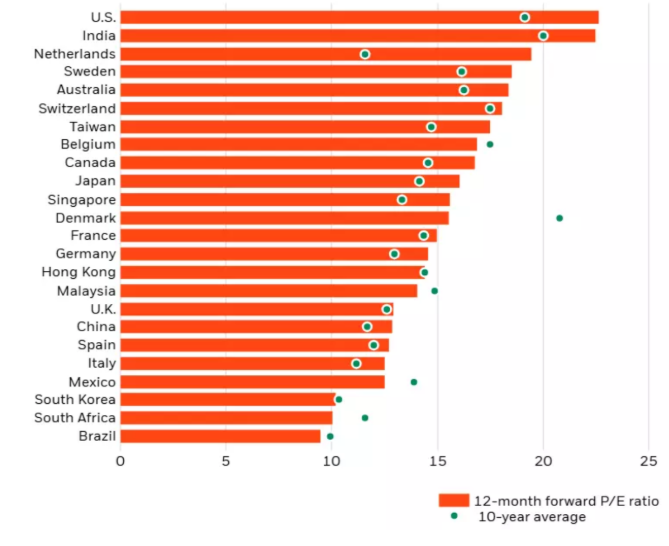
Equity Valuation by Market - Source: BlackRock Investment Institute & LSEG Datastream data as of December 16 2025
According to BlackRock Investment Institute data as of December 16, 2025, Japanese equities trade at a forward P/E ratio slightly above 15. While this sits marginally above Japan’s own 10-year historical average, it remains remarkably attractive when viewed through a global lens. U.S. equities, by contrast, command a forward P/E ratio of around 22—meaning investors are paying a 47% premium in the U.S. markets for future earnings compared to their Japanese counterparts.
The elevated U.S. ratio reflects extreme optimism already embedded in prices, leaving little margin for error if corporate earnings disappoint. Japan’s lower ratio suggests either that assets remain undervalued or that the market has yet to fully price in the country’s corporate governance reforms and successful exit from decades of deflation. Given the structural improvements underway in Japanese corporate culture, the latter interpretation appears increasingly credible.
This valuation opportunity has not gone unnoticed by institutional investors. BlackRock expects continuing investor interest in Japanese markets through 2026. A BlackRock client survey conducted as of November 24, 2025, indicated that approximately 40% of respondents planned on increasing their exposure to Asia Pacific equity markets heading into the first quarter of this year. The combination of attractive valuations, structural economic improvements, and growing institutional conviction suggests that Japan’s equity outperformance may have room to run.
Japan’s role in tech supply chain is likely to keep supporting the country’s growth
While headlines often celebrate Silicon Valley’s AI revolution, Japan has positioned itself as an indispensable player in the global technology supply chain. The country has been able to capture some value of the AI boom without the extreme valuations that characterize its American counterparts.
Japan’s strength lies in the essential components that make cutting-edge technology possible. The country dominates critical segments of semiconductor manufacturing equipment, advanced materials, and precision components that artificial intelligence systems depend upon.
Companies like Tokyo Electron and Screen Holdings supply the sophisticated machinery required to create the chips powering AI data centers. Meanwhile, firms such as Shin-Etsu Chemical and JSR Corporation provide the ultra-pure materials and photoresists necessary for advanced semiconductor production. Without these Japanese contributions, it would be difficult for the AI infrastructure driving global innovation to flourish.
This positioning represents a strategic advantage. While investors often chase U.S. semi-conducor companies trading at stratospheric multiples, Japanese manufacturers offer exposure to the same AI growth story through the physical infrastructure it requires. Every new data center, every advanced chip, every robotics application creates demand that flows through Japan’s industrial ecosystem. As global capital expenditure on AI accelerates, Japanese suppliers are likely to capture their share of this investment cycle with considerably less market volatility than some of their peers.
Beyond semiconductors, Japan’s expertise in factory automation and robotics positions it advantageously as industries worldwide embrace intelligent manufacturing. Companies like Fanuc, Keyence, and Yaskawa Electric dominate industrial automation markets, supplying the sensors, servo motors, and control systems that enable smart factories. As AI integration transforms manufacturing processes, these firms benefit from both the installation of new automated systems and the ongoing demand for precision components that make those systems function.
The Japanese government has moved decisively to capitalize on this advantage. With the “Act on the Promotion of Research and Development and the Utilization of AI-Related Technologies” (AI Promotion Act), enacted in 2024, Japan became the second major Asia-Pacific economy to establish comprehensive AI legislation. This framework encourages research and development while providing regulatory clarity that attracts investment. Japan’s intellectual property environment, which balances innovation incentives with practical implementation, further supports AI-related initiatives without the legal uncertainties that complicate development in some other jurisdictions.
This policy support extends beyond legislation. Government-backed initiatives are fostering collaboration between Japan’s traditional manufacturing giants and emerging AI companies, creating ecosystems where hardware expertise meets software innovation. The result is a competitive advantage in areas like edge computing, industrial AI applications, and human-robot collaboration—fields where Japan’s engineering culture and manufacturing heritage provide natural strengths.
Perhaps most importantly, Japan’s role in the tech supply chain provides resilience. Geopolitical tensions have made supply chain diversification a strategic priority for technology companies worldwide. Japan offers political stability, advanced infrastructure, and deep technical expertise—attributes that make it an attractive alternative or complement to other Asian manufacturing hubs. As companies derisk their supply chains, Japanese manufacturers stand to benefit from increased orders and expanded partnerships.
Dominant positions in critical supply chain segments, supportive government policies, and resilience to geopolitical tensions suggests Japan’s technology sector can sustain growth even as the AI hype cycle matures. While software valuations may compress during market corrections, the physical infrastructure enabling AI continues requiring the precision components, advanced materials, and manufacturing equipment that Japanese companies uniquely provide.
Stay up to date with what's moving and shaking on the world's markets and never miss another important headline again! Check ActivTrades daily news and analyses here.
Author

Carolane de Palmas
ActivTrades
Carolane graduated with a Masters in Corporate Finance & Financial Markets and got the AMF Certification (Financial Markets Regulator in France). Afterward, she became an independent trader, investing mostly in European and American stocks/indices.

















