Weekly stock spotlight: Amazon and Dell Shine while SMCI struggles, election trades in focus


Key points
Earnings highlights: Five of the Mag 7 companies reported earnings last week and key watch was the extent and efficacy of the AI spend. High valuation also set the bar very high, and investors were mostly left disappointed. Only Amazon and Alphabet ended the week higher, while Microsoft, Apple and Meta declined.
Key stock movers: Dell was a notable outperformer in US equities last week, as it benefitted from SMCI’s 45% decline due to its worsening accounting red flags.
Election sensitivity: Election trades likely to be a key focus this week. Stocks sensitive to US elections span various sectors, including Big Tech (Meta, Amazon, Tesla), defense contractors (Lockheed Martin, Raytheon), and healthcare providers (UnitedHealth, Pfizer), with potential impacts from regulatory and policy shifts.
With earnings well underway and the US election fast approaching, there has been lots to talk about in markets this week, with various big names making significant moves.
Big tech earnings recap – Massive AI spending bills continue
Last week’s equity markets were all about megacap earnings. In the latest quarter, major players in Big Tech—Alphabet, Microsoft, Meta, Amazon, and Apple—posted impressive revenue beats, but the focus remains on their soaring capital expenditures particularly on AI investments that are not yielding immediate results. Clear outperformers in the Mag 7 space from last week’s earnings were Amazon and Alphabet.
Microsoft's fiscal first-quarter capital expenditures surged to $20 billion, marking a 79% increase year-over-year and a staggering 203% over two years. Much of this spending is directed toward enhancing its Azure cloud computing platform, which has seen a 34% revenue growth driven by AI demand. However, the heavy investments are impacting profitability, and the Q2 guidance for Cloud growth was lower than expected.
Similarly, Meta reported strong earnings but the share price declined due to its rapid capital expenditure growth of 36% year-over-year. Despite the early success of its AI initiatives, investors remain cautious, as the promise of AI revenue is still unfolding and the stock outperformance among the Mag 7 had set the bar too high.
Apple has opted to stay out of the AI arms race, maintaining steady capital expenditures around $2-3 billion per quarter. Instead, Apple is leveraging its vast user base and proprietary chips to manage costs more effectively. A decline in China revenue dampened investor sentiment and focus remains on demand for the iPhone 16 and whether new Apple Intelligence features help juice sales.
Both Alphabet and Amazon also reported significant capital expenditure increases. However, Alphabet benefited from strong search and YouTube advertising performance, with Google Cloud revenue climbing 35%.
Amazon’s advertising business grew 19%, while its AWS cloud segment also accelerated. A strong performance in retail, where execs said shoppers were buying cheaper items at higher volumes, and a sharp focus on cost control had investors cheering.
Market movers: Key stock outperformers and underperformers
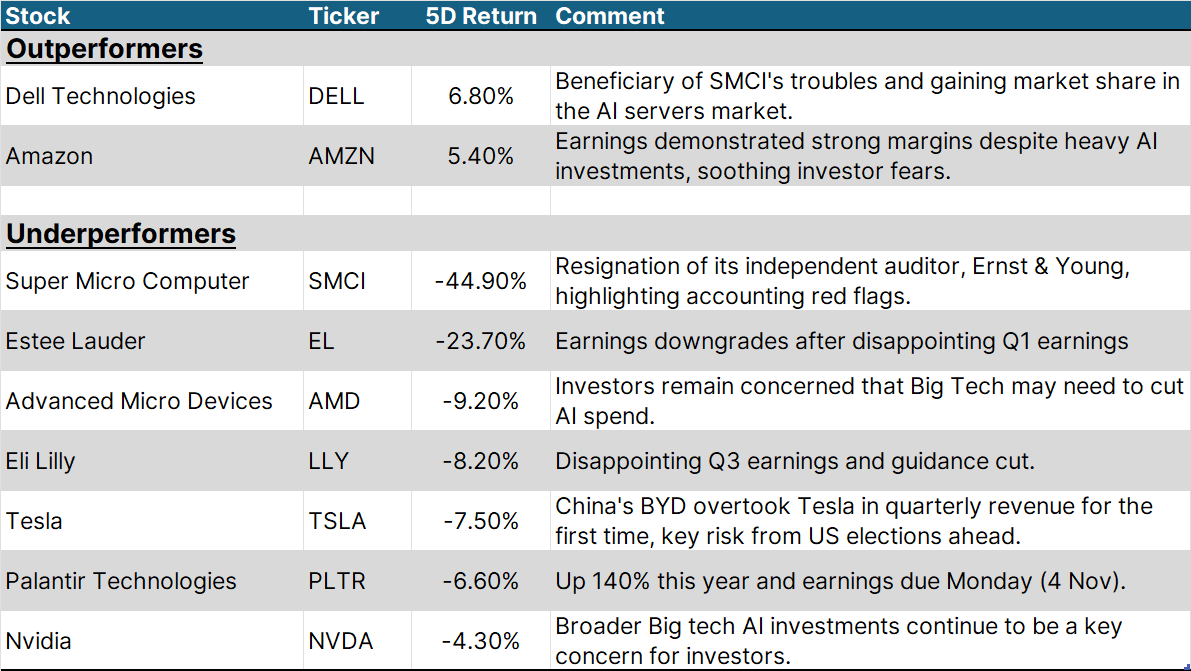
Source: Saxo
US elections trade: Stocks on watch
Single stocks with high sensitivity to U.S. elections tend to be those in industries or with business models that are heavily impacted by government policy shifts, including regulation, spending, and foreign policy. Here are some individual stocks to watch:
1. Tech giants
Meta (META), Alphabet (GOOGL), Apple (AAPL), Amazon (AMZN), Tesla (TSLA): Big Tech stocks are sensitive to elections because regulatory scrutiny often varies based on the administration. A Democratic administration may push for stricter regulation around data privacy, monopolistic practices, and content moderation, potentially affecting profitability. Conversely, a Republican administration may take a more hands-off approach, favoring business expansion.
2. Defense contractors
Lockheed Martin (LMT), Raytheon Technologies (RTX): Defense companies generally benefit from increased military spending, which is typically favored under Republican administrations. Defense budgets are often tied to foreign policy, with certain administrations more likely to approve increased defense budgets for global military presence.
3. Healthcare providers and pharma
UnitedHealth Group (UNH), Pfizer (PFE), Merck (MRK): Healthcare stocks, especially insurers and pharmaceutical companies, are particularly sensitive to elections. Democratic administrations tend to advocate for healthcare reforms that can pressure insurance margins (like drug price negotiation and expanding Medicare coverage). Pharma stocks may react to drug pricing reforms and Medicare-related policies.
4. Renewable energy
NextEra Energy (NEE), First Solar (FSLR), Enphase Energy (ENPH): Companies in renewable energy and clean tech are typically sensitive to Democratic victories, which usually entail incentives for clean energy and climate initiatives. This can lead to increased investments and subsidies for solar, wind, and EV infrastructure, benefiting companies in these sectors.
5. Traditional energy (Oil and Gas)
Exxon Mobil (XOM), Chevron (CVX), ConocoPhillips (COP): Oil and gas giants respond to election outcomes, as Republicans tend to favor policies that support fossil fuel production (reduced regulations, drilling incentives). Conversely, Democrats may impose restrictions or focus on renewables, impacting the profitability of traditional energy companies.
6. Infrastructure and construction
Caterpillar (CAT), United Rentals (URI): Infrastructure and heavy machinery stocks are sensitive to election-driven infrastructure policies. If the winning candidate prioritizes infrastructure spending, as has been a bipartisan trend in recent years, stocks like Caterpillar and United Rentals may see a boost from increased demand for construction equipment.
7. Financials
JPMorgan Chase (JPM), Goldman Sachs (GS), Bank of America (BAC): Large financial institutions are sensitive to regulatory and tax changes stemming from elections. Republicans tend to favor deregulation, which is positive for banks, while Democrats may advocate for stricter oversight, higher taxes, or financial transaction taxes, which could weigh on profitability.
8. Agricultural stocks
Deere & Company (DE), Archer Daniels Midland (ADM): Agriculture companies are sensitive to U.S. trade policies and agricultural subsidies, both of which vary by administration. Tariff policies, especially regarding China, can affect demand and profitability, while subsidies for farmers may impact the agricultural equipment market.
9. Consumer staples
Walmart (WMT), Procter & Gamble (PG): Consumer staples may react to policies impacting the broader economy, such as tax reforms or fiscal spending that affects consumer purchasing power. These stocks are often seen as safe havens and could be in focus especially if the election results are contested.
10. China stocks
Alibaba (BABA), Tencent (TCEHY), JD.com (JD): Chinese stocks are sensitive to U.S. election outcomes due to trade policies and regulations impacting their operations. Changes in U.S.-China relations can significantly affect their performance.
Read the original analysis: Weekly stock spotlight: Amazon and Dell Shine while SMCI struggles, election trades in focus
Author
Saxo Research Team
Saxo Bank
Saxo is an award-winning investment firm trusted by 1,200,000+ clients worldwide. Saxo provides the leading online trading platform connecting investors and traders to global financial markets.