Warren Buffett’s portfolio shifts: Strategic cuts, modest new additions, and a cautious outlook


Key points
-
Buffett’s Q3 portfolio moves continue to reflect a cautious stance: The latest 13F filing by Warren Buffett’s Berkshire Hathaway indicates a significant sell-off in some of the conglomerate’s largest holdings.
-
Reducing major stakes in Apple and Bank of America: Buffett has scaled back Berkshire’s positions in key stocks, including a 25% reduction in Apple and a 23% cut in Bank of America.
-
Short-term bet in Ulta Beauty: Despite adding Ulta Beauty to Berkshire’s portfolio in Q2, Buffett exited nearly his entire position this quarter, marking a rare short-term investment for the value-driven investor.
-
New bets in Domino’s Pizza and Pool Corp: Berkshire added Domino’s Pizza and Pool Corp to its roster, showing Buffett’s interest in consumer-centric businesses.
-
A big seller again in Q3: For the third consecutive quarter, Berkshire was a net seller, selling nearly $36 billion in stocks and buying just $1.5 billion, according to its 10-Q report.
Buffett’s portfolio strategy shows a cautious tone
Berkshire Hathaway’s Q3 filing reveals continued recalibration, marked by strategic reductions in some of Buffett’s largest and most iconic holdings. This sustained selling trend hints at Buffett’s careful approach to maintaining portfolio balance amid market uncertainties.
Scaling back giants: Apple and Bank of America
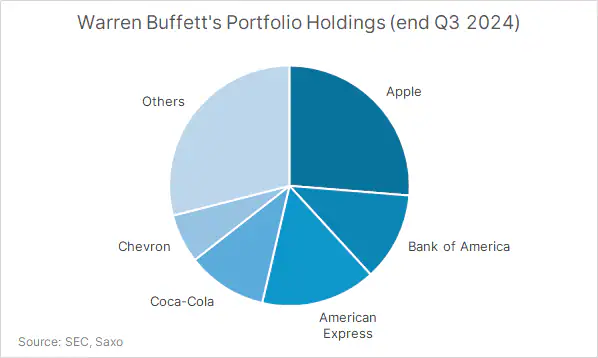
One of the most significant shifts this quarter was Buffett’s additional cut to Berkshire’s Apple (AAPL) stake, which was reduced from 400 million shares to 300 million shares. This is now over two-thirds less than its size since 2023, suggesting a cautious tone toward the tech giant’s valuation. Similarly, Buffett trimmed back Berkshire’s position in Bank of America (BAC) by 23%, reflecting a potential reassessment of the banking sector. Buffett's move could also be a reflection of the bank facing some serious challenges in its bond portfolio, which have resulted in massive unrealized losses and write-offs.
Ulta Beauty’s short-lived spotlight
An unexpected move this quarter was Buffett’s swift exit from Ulta Beauty (ULTA). After only one quarter, he sold nearly all his shares in the cosmetics chain—a departure from his typical long-term investment approach. This rare short-term exit may reflect a reassessment of the company’s growth outlook or an adjustment based on Berkshire’s evolving sector strategy.
Betting bigger, selectively
In addition to the reductions and exits, Berkshire Hathaway showed continued commitment to some of its core holdings by modestly increasing stakes in Sirius XM Holdings (SIRI) and Heico Corp (HEI). Buffett added 3.77 million shares of Sirius XM, raising his total stake to over 105 million shares—a 3.72% increase. This suggests Buffett’s confidence in Sirius XM’s strong market positioning and reliable cash flows, which fit well with his preference for stable businesses. Additionally, Berkshire increased its position in Heico Corp by 5,445 shares, bringing the total to nearly 1.05 million shares. This incremental boost indicates Buffett's growing interest in the aerospace and defense technology space, where Heico has maintained a resilient foothold.
New faces: Domino’s Pizza and Pool Corp
While Buffett trimmed several holdings, he also added a few fresh positions. Berkshire’s investment in Domino’s Pizza (DPZ), with a 1.28 million-share purchase, showcases Buffett’s interest in consumer-facing companies with strong brand recognition and cash flow. In a surprising addition, he also took a stake in Pool Corp (POOL), acquiring 404,057 shares. This move into the pool equipment sector highlights Buffett’s search for unique investment opportunities with niche market potential.
A big quarter for selling
According to its 10-Q report, Berkshire continued to sell more than it bought in Q3, with net stock sales amounting to approximately $36 billion against $1.5 billion in purchases. This consistent trend of heavy selling aligns with Buffett’s comments about tax considerations and portfolio rebalancing, though it has fueled speculation about his broader market outlook.
Notable reductions and exits
Several other holdings saw significant cuts:
-
Charter communications (CHTR): Berkshire reduced its position, selling one million shares and ending the quarter with 2.8 million.
-
Nu holdings (NU): Buffett reduced his stake in this Brazilian financial firm by 20.7 million shares, retaining 86.4 million shares.
-
Capital One Financial (COF): Berkshire trimmed this position by 719,000 shares, leaving it with 9.1 million shares.
Berkshire also fully exited its position in Floor & Decor (FND), a flooring retailer, selling off all four million shares—a move that reflects Buffett’s decisive adjustment in the consumer discretionary sector.
Understanding Buffett’s evolving investment strategy
Buffett’s portfolio adjustments illustrate his classic value investing principles with a renewed focus on balancing risk and opportunity:
-
Selective diversification: While Berkshire continues to hold iconic names like Coca-Cola, American Express, and Moody’s, Buffett’s adjustments show selectivity in reducing overexposure to individual sectors.
-
Opportunistic adjustments: The addition of consumer-oriented stocks like Domino’s Pizza and Pool Corp underscores Buffett’s strategy of focusing on resilient businesses, even while shedding higher-risk or fully valued positions.
-
Risk management and patience: Buffett’s steady reductions in high-exposure holdings reveal his discipline in preserving capital and managing concentration risks, aligning with his longstanding commitment to prudent, long-term investment.
As investors analyze these moves, Buffett’s actions provide valuable insights into the mindset of one of the world’s most respected investors during a period of market flux.
Read the original analysis: Warren Buffett’s portfolio shifts: Strategic cuts, modest new additions, and a cautious outlook
Author
Saxo Research Team
Saxo Bank
Saxo is an award-winning investment firm trusted by 1,200,000+ clients worldwide. Saxo provides the leading online trading platform connecting investors and traders to global financial markets.