|

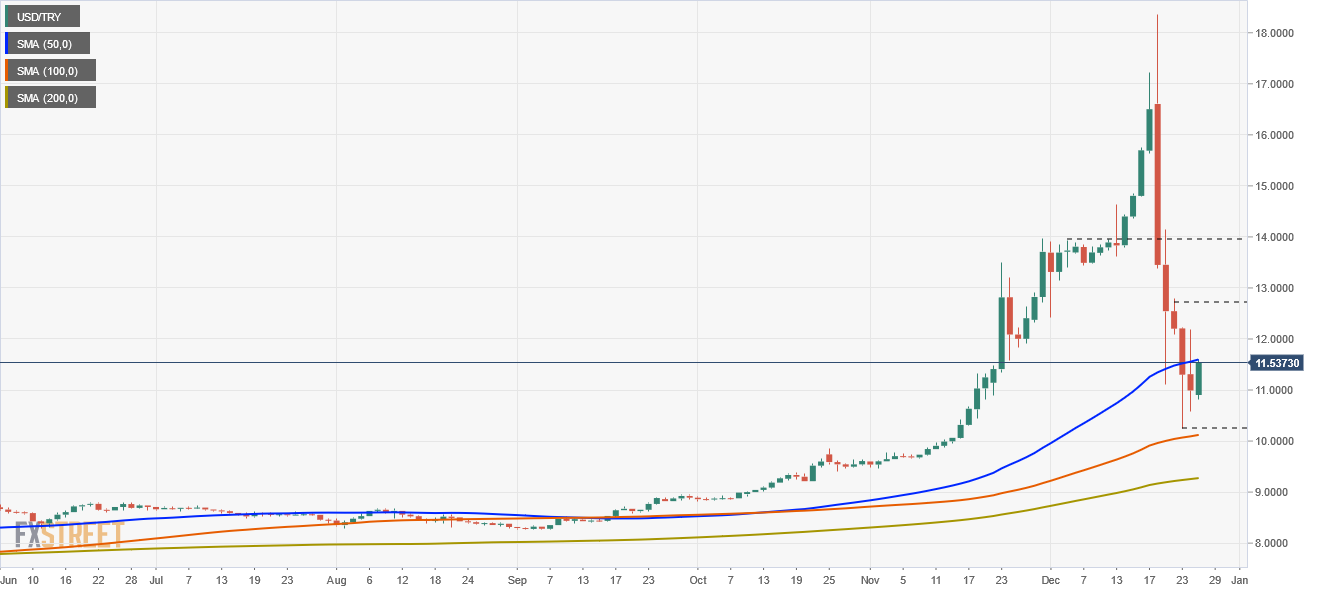
USD/TRY seesaws around the 50-DMA at 11.5360s amid a risk-on market mood

  • The Turkish lira weakens some 5.11% against the greenback amid thin liquidity markets.
  • USD/TRY Price Forecast: It has an upward bias, though a break above the 50-DMA is needed, to resume any moves towards 13.8000s.

The Turkish lira weakens through the day, trading at 11.4100 during the New York session at the time of writing. The market sentiment remains upbeat, with the S&P 500 printing all-time highs, despite the ongoing Omicron strain spread worldwide.

The US Dollar Index, which measures the greenback’s performance against a basket of rivals, edges up some 0.08%, sitting at 96.09.
In the meantime, Turkey’s banking watchdog filed criminal complaints against individuals who commented on the lira, including two former central bank governors. Furthermore, the regulator said that commentators attempted to manipulate exchange rate movements, violating an article of the banking law, according to Bloomberg

Doing a recap of the last week, President Recep Tayyip Erdogan announced extraordinary measures on December 20 to contain the Turkish lira’s losses against the greenback. Erdogan’s effort spurred a downward move from 18.2600 down to 13.0900.

USD/TRY Price Forecast: Technical outlook

The USD/TRY has an upward bias, despite the recent fall of 500-pips on measures implemented to stop the fall of the Turkish lira. The downward move was capped near the 100-day moving average (DMA) at 10.0890, bouncing off that level towards 11.3669, to then seesawed around the 50-DMA, unable of breaking to the upside.

To the upside, the USD/TRY first resistance level would be the 50-day moving average (DMA) at 11.5486. A breach of the latter would expose the December 24 daily high at 12.0550, followed by the December 22 high at 12.6800, and then the December 3 daily high at 13.8723.
Author

Christian Borjon Valencia

Markets analyst, news editor, and trading instructor with over 14 years of experience across FX, commodities, US equity indices, and global macro markets.


More from Christian Borjon Valencia
Share:

Editor's Picks

AUD/USD sticks to neutral bias above 0.7100 amid cautious markets

AUD/USD holds steady above 0.7100 in the Asian session on Monday as the US Dollar stalls its modest pullback from the highest level since late July amid persistent geopolitical uncertainties. The PBOC status quo on Loan Prime Rates also weighs on the Aussie. However, bets on another RBA rate hike continue to underpin the Australian Dollar ahead of the Trump-Xi Summit.

USD/JPY eases below 157.00 amid looming intervention risks

USD/JPY is easing back below 157.00 in Asia on Monday, undermined by modest Japanese Yen strength amid looming intervention risks after Friday's BoJ rate check. A Japanese holiday also keeps traders on edge amid escalating geopolitical tensions between Russia and Ukraine and in the Middle East. As a result, the US Dollar pauses its pullback, limiting the pair's downside.

Gold: Sellers test $4,350 on renewed USD upside

Gold kicks off the new week on a weaker note following Friday's failure near the $4,400 mark. The commodity currently trades near the $4,350 level as traders await further developments surrounding the Middle East crisis and their implications for inflation. This would influence interest rate expectations and, in turn, drive the non-yielding bullion.

Dogecoin extends gains as ETF inflows return and momentum improves

Dogecoin extends its recovery, trading above $0.088 after gaining nearly 6% last week. The bullish price outlook is supported by the return of institutional demand through DOGE spot Exchange Traded Funds. Meanwhile, improving momentum indicators and signs of whale accumulation suggest a positive outlook for the dog-themed meme coin.

Economics week ahead

This week is light on the domestic data front, with focus on Thursday's new home sales report. We expect sales to partially recover in August, rising 2.6% to a 623K pace after a sharp decline in July. Higher mortgage rates continue to weigh on affordability and demand, though builder incentives remained in place and conditions did not worsen materially during the month.

BoJ Recap: Not as hawkish as expected

The Bank of Japan (BoJ) raised its short-term interest-rate target to 1.25% from 1.00% in a 7-2 vote, marking another step in the normalisation of monetary policy and widely matching what everyone has been expecting for weeks.