|

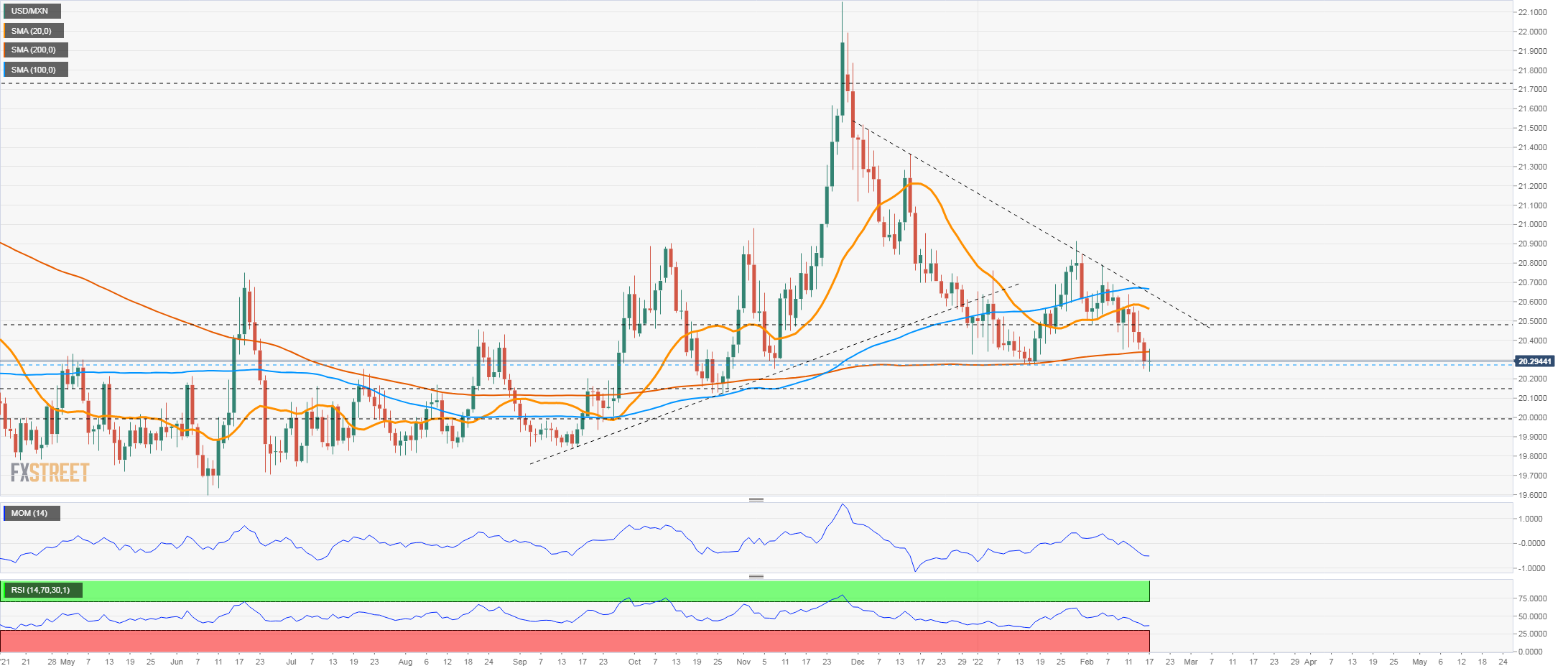
USD/MXN Price Analysis: Bearish, under the 200-day SMA and testing levels below 20.30

  • USD/MXN  drops below the 200-day SMA.
  • Outlook favor the downside, price to face strong support at 20.30 and 20.05.
  • Any recovery of the dollar under 20.70, likely to be unstable.

The USD/MXN posted on Wednesday the first daily close in months below the 200-day moving average and slightly under the 20.30 level. The 20.35/30 area was a strong barrier and while the cross remains below, more losses are on the table.

The next support stands at 20.15 and below a more relevant emerges at 20.00/05. A recovery of USD/MXN could take the price quickly to 20.45 but it should be seen as a correction. The critical resistance at the moment is seen around 20.70, the confluence of horizontal support, key MA and a downtrend line. A break higher would change the short-term bias from bearish to neutral/bullish.

Technical indicators look bearish. The RSI is approaching 70 and flattening, a potential sign of exhaustion, not necessarily followed by a sharp correction. A consolidation is also possible particularly if USD/MXN rises back above 20.30.

USD/MXN daily chart
Usdmxn

USD/MXN

Overview
Today last price20.2971
Today Daily Change0.0075
Today Daily Change %0.04
Today daily open20.2896
 
Trends
Daily SMA2020.5747
Daily SMA5020.6033
Daily SMA10020.6693
Daily SMA20020.3387
 
Levels
Previous Daily High20.4128
Previous Daily Low20.2516
Previous Weekly High20.7031
Previous Weekly Low20.3512
Previous Monthly High20.9144
Previous Monthly Low20.2712
Daily Fibonacci 38.2%20.3132
Daily Fibonacci 61.8%20.3512
Daily Pivot Point S120.2232
Daily Pivot Point S220.1568
Daily Pivot Point S320.0621
Daily Pivot Point R120.3844
Daily Pivot Point R220.4791
Daily Pivot Point R320.5455

Author

Matías Salord

Matías started in financial markets in 2008, after graduating in Economics. He was trained in chart analysis and then became an educator. He also studied Journalism. He started writing analyses for specialized websites before joining FXStreet.


More from Matías Salord
Share:

Editor's Picks

GBP/USD extends the drop to 1.3360

GBP/USD builds on Monday’s decline and briefly clinches five-day lows near 1.3360 on Tuesday. Cable’s extra pullback follows the better tone in the Greenback as uncertainty in the Middle East prompts investors to adopt a cautious stance. Meanwhile, an apathetic UK labour market report also collaborates with the selling pressure on the British Pound.

EUR/USD holds gains above 1.1400 on hawkish ECB expectations despite US-Iran tensions

The EUR/USD pair trades with mild gains around 1.1405 during the early Asian session on Wednesday. A hawkish tone from the European Central Bank provides some support to the Euro against the US Dollar. Traders await the upcoming ECB interest rate decision on Thursday. 

Gold: Strong recovery might face roadblock as oil price extends gains

Gold price extends its winning streak for the third trading day on Wednesday, trading 1.5% higher to near $4,140 during the Asian session. The precious metal recovered strongly in the past few trading days from its three-week low of $3,959.80 as traders scaled back Federal Reserve’s interest rate hike expectations for the monetary policy meeting next week.

The market runs back into AI despite higher Oil and yields
World stocks surged as traders made a spirited return to the market’s commanding centre of gravity, piling back into semiconductors, AI leaders and momentum, with the enthusiasm of a crowd rushing through the one door it still trusts. The Nasdaq led Wall Street higher, semiconductor shares jumped more than 5%, and momentum staged its strongest rebound in years.
The Iranian war has again risen
The Iranian war has again risen to the top of the economics factor list. There is no end in sight. Intelligence experts say the current level of offense/retaliation will not change minds in Tehran, while in Washington, Trump fears all-out war, which would mean boots on the ground.
US Dollar mid-year outlook: Exceptional currency, exceptional risks?
The US Dollar enters the second half of 2026 in a markedly different position from a year ago. The King currency has recovered, reflecting persistent US inflation, changing expectations for Fed policy, geopolitical tensions and renewed demand for defensive assets.