USD/MXN maintains gains amidst global recession fears and Banxico’s unchanged rates
- USD/MXN edges up 0.13% to 17.1880 amidst global recession fears and Banxico’s stable rates.
- PMIs indicate slowed business expansion across Europe and the US, driving risk aversion.
- Banxico maintains an 11.25% rate, signaling extended high rates due to slower inflation.

USD/MXN clings to its gains after the Bank of Mexico (Banxico) decision to hold rates unchanged at 11.25% failed to boost the USD/MXN towards the 20-day EMA and printed a weekly high of 17.2644. Since then, the USD/MXN retreated, but it remains up 0.13% in the day amid risk aversion. At the time of writing, the USD/MXN exchanges hands at 17.1880.
Risk aversion dominates as business activity slows globally; USD/MXN holds firm
US equities are trading with losses as market participants’ sentiment shifted sour. Global recession fears reignited after the release of business activity data across Europe and the US, with PMIs remaining at expansionary territory but continuing to slow down.
Data in the United States (US) showed that S&P Global Manufacturing PMI continued to slide, coming at 46.3, lower than May 48.4, while the Services stood at 54.1, above forecasts, but trailed the prior month’s data. Hence, the Composite Index slowed to 53 from 54.3 in May.
On the data, S&P Global Market Intelligence Chief Economist Chris Williamson said, “The overall rate of expansion of business activity in the US remained robust in June, consistent with GDP rising at a rate of 1.7% to put second-quarter growth in the region of 2%.”
Meanwhile, the US Dollar Index, which measures the buck’s value against a basket of six currencies, climbed 0.54%, up at 102.944, finding a bid amidst falling US Treasury bond yields.
Money market futures portrays odds at a 74.4% chance for a 25 bps rate hike in July, according to CME FedWath Tool data, but traders do not expect the Fed to lift rates past the 5.25%-5.50% threshold.
Across the border, Banxico kept rates unchanged at 11.25% on Thursday, signaling that it would keep them high “for an extended period, as inflation slowed down to 5.18% in the first half f une, below estimates of 5.30%, according to data from INEGI.
Analysts at Goldman Sachs expected the Mexican bank to hold rates unchanged and foresee a rate cut towards the end of 2023.
The San Francisco Fed President Mary Daly crossed the wires, commenting that she supports two more rate increases and that the risks of under/overtightening have come into balance.
USD/MXN Price Analysis: Technical outlook
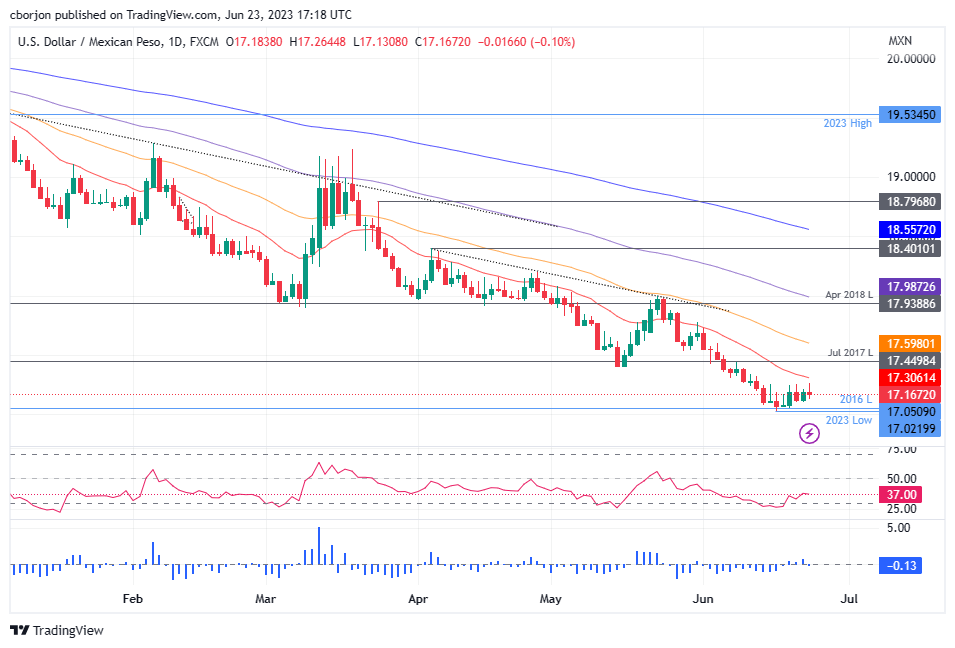
From a technical perspective, the USD/MXN remains downward biased but can continue to consolidate within the 17.00/17.30 area in the near term, below the 20-day Exponential Moving Average (EMA) at 17.3070. if the USD/MXN breaks above that area, it could climb toward May 16 swing low, and previous support turned resistance at 17.4033, followed by the 50-day EMA at 17.5921. Conversely, if USD/MXN cracks below 17.00, the next support lies on the October 2015 lows of 16.3267.
Author

Christian Borjon Valencia
FXStreet
Markets analyst, news editor, and trading instructor with over 14 years of experience across FX, commodities, US equity indices, and global macro markets.
















