USD/JPY surges to four-month high as BoJ maintains cautious stance
- The Japanese Yen weakens for the sixth straight session, with USD/JPY climbing to its highest level since April.
- The Bank of Japan keeps its policy rate unchanged at 0.50% for the fourth consecutive meeting.
- BoJ raises fiscal year inflation forecast to 2.7%, driven by food price pressures, but cautions that domestic consumption remains fragile.

The Japanese Yen (JPY) weakens for the sixth consecutive day against the US Dollar with the USD/JPY pair surging to its highest level in over four months after the Bank of Japan (BoJ) kept its short-term interest rate steady at 0.50% for a fourth consecutive meeting, as widely expected, but the accompanying tone and forward guidance triggered a notable dovish market reaction.
At the time of writing, USD/JPY is edging higher, breaking decisively above the key psychological barrier at 150.00 and hovering near 150.72 during American trading hours, up nearly 0.85% on the day.
At the BoJ press conference on early Thursday, Governor Kazuo Ueda explained that the BoJ had unanimously decided to keep the short‑term interest rate steady, while raising its core consumer inflation forecast for the current fiscal year to 2.7%, up from 2.2% previously. Governor Ueda emphasized that any future interest rate hikes would be data-dependent, and the BoJ would not necessarily wait until underlying inflation reaches the 2% target before acting. Instead, the central bank would respond once it becomes "highly likely" that inflation will sustainably hit that level, especially if accompanied by stronger wage growth. While acknowledging that the inflation trend is improving, Ueda noted that much of the price pressure remains supply-driven, particularly due to elevated food costs. He warned that premature tightening could suppress domestic consumption, which remains fragile.
Governor Ueda also welcomed the recent US-Japan trade agreement, calling it a “big step forward” in reducing economic uncertainty. However, he cautioned that the full impact of changing trade dynamics and tariffs is yet to play out. He further explained that the recent fluctuations in the Japanese Yen were within the range anticipated by the BoJ and have not materially altered its inflation outlook.
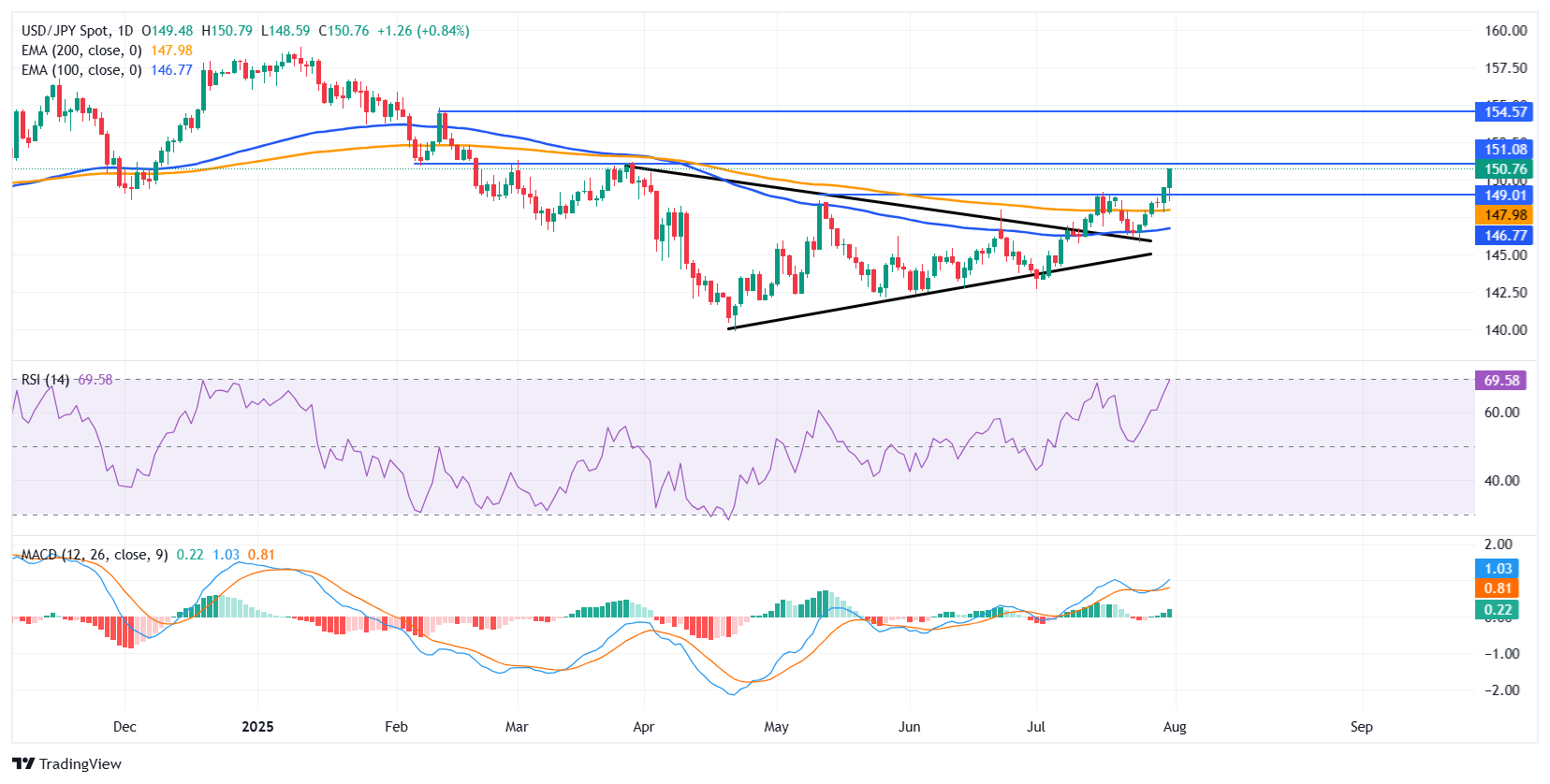
From a technical standpoint, USD/JPY has confirmed a bullish breakout from an ascending triangle, typically a continuation pattern pointing to further upside. After retesting the triangle’s upper boundary near 146.00, the pair bounced sharply, validating the breakout and reinforcing the bullish setup. The pair is now trading above its short-term moving averages, supported by strong upward momentum. The move was further reinforced by a sustained climb above the 100-day Exponential Moving Average(EMA) at 146.77 and the 200-day EMA at 147.99, both of which now act as dynamic support levels.
The successful retest of the ascending triangle pattern suggests that buyers have regained control, with price action now targeting the next resistance levels at the April high of 151.08 and the February high near 154.57. On the downside, immediate support lies at 149.00, followed by the 200-day EMA.
Momentum indicators align with the bullish bias. The Relative Strength Index (RSI) is trending near 69, approaching overbought territory, while the Moving Average Convergence Divergence (MACD) remains in bullish alignment with a widening gap between the MACD and signal lines. The rising histogram bars confirm sustained upward momentum.
Author

Vishal Chaturvedi
FXStreet
I am a macro-focused research analyst with over four years of experience covering forex and commodities market. I enjoy breaking down complex economic trends and turning them into clear, actionable insights that help traders stay ahead of the curve.