USD/JPY stalls amid mixed market mood, intervention concerns
- USD/JPY hovers at 151.28, with traders wary of potential Japanese market intervention to support the Yen.
- US Q4 GDP growth surpasses expectations at 3.4%, while jobless claims and consumer sentiment indicate a robust economy.
- Fed Governor Waller's hawkish stance underscores the need for sustained inflation progress, influencing rate cut expectations.

The USD/JPY remains subdued during the North American session, trading at 151.28, almost flat, amid renewed fears of Japan’s intervening in the markets to cap the Japanese Yen (JPY) weakness.
USD/JPY trades cautiously with US economic growth and job data in focus, alongside Japan's intervention warnings
Market sentiment is mixed amid thin liquidity trading as the year's first quarter ends. US economic data revealed the country grew 3.4% in the last quarter of 2023, exceeding the preliminary reading of 3.2%, according to the Bureau of Economic Analysis. In the meantime, inflation measures on a quarterly basis hit the Federal Reserve’s (Fed) objective of 2%,
Other data showed that Initial Jobless Claims for the week ending March 23 were below market expectations of a 215K increase and came to 210K, lower than the previous week. The data shows that the labor market remains tight, which could deter the Fed from cutting rates.
At the same time, the University of Michigan Consumer Sentiment index rose to its highest level since July 2021, climbing to 79.4, exceeding estimates of 76.5. Pending Home Sales recovered in February, increasing 1.6% MoM after plunging -4.7% in January and above the consensus of 1.5%.
On Wednesday, the Fed’s Governor Christopher Waller delivered hawkish remarks. He said that rates need to be higher for longer than expected and that more inflation progress is needed before supporting a rate cut. He sees the beginning of the easing cycle in 2024, though he suggests that back-to-back months of inflation data heading to 2% are needed.
On the Japanese front, the Bank of Japan Summary of Opinions revealed that members said that Yield Curve Control, negative interest rates, and other measures of stimulus accomplished their roles. Meanwhile, Japanese authorities' verbal intervention deterred traders from opening fresh long bets in the USD/JPY pair as intervention threats loom.
USD/JPY Price Analysis: Technical outlook
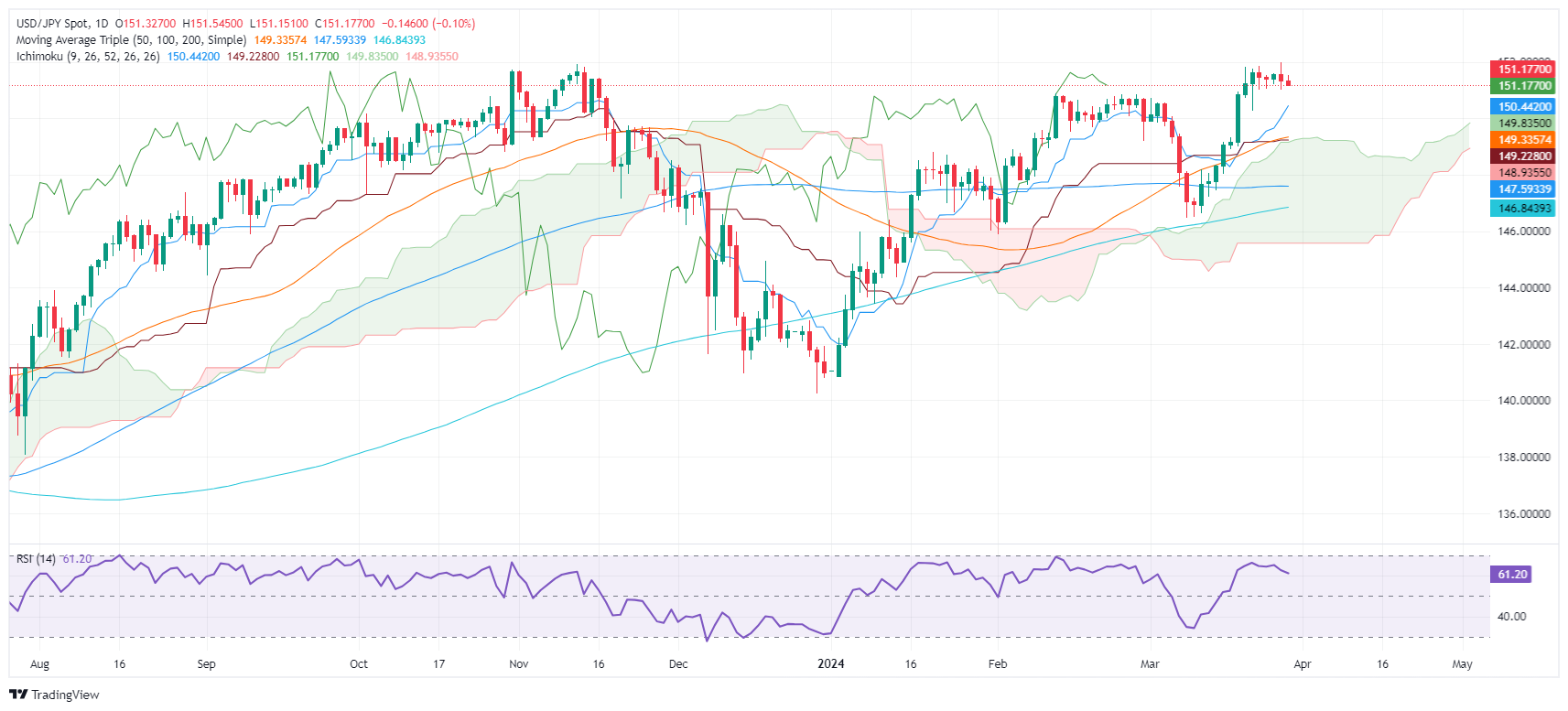
The daily chart suggests the USD/JPY has peaked at around the 151.20/151.90 area, although the bullish bias remains. A clear break above 152.00, could pave the way for challenging 153.00. On the other hand, a pullback is seen if sellers push the exchange rate below 151.00, with the Tenkan/Sen seen as first support at 150.44, followed by 150.00 and the Senkou Span A at 149.84.
Japanese Yen FAQs
The Japanese Yen (JPY) is one of the world’s most traded currencies. Its value is broadly determined by the performance of the Japanese economy, but more specifically by the Bank of Japan’s policy, the differential between Japanese and US bond yields, or risk sentiment among traders, among other factors.
One of the Bank of Japan’s mandates is currency control, so its moves are key for the Yen. The BoJ has directly intervened in currency markets sometimes, generally to lower the value of the Yen, although it refrains from doing it often due to political concerns of its main trading partners. The current BoJ ultra-loose monetary policy, based on massive stimulus to the economy, has caused the Yen to depreciate against its main currency peers. This process has exacerbated more recently due to an increasing policy divergence between the Bank of Japan and other main central banks, which have opted to increase interest rates sharply to fight decades-high levels of inflation.
The BoJ’s stance of sticking to ultra-loose monetary policy has led to a widening policy divergence with other central banks, particularly with the US Federal Reserve. This supports a widening of the differential between the 10-year US and Japanese bonds, which favors the US Dollar against the Japanese Yen.
The Japanese Yen is often seen as a safe-haven investment. This means that in times of market stress, investors are more likely to put their money in the Japanese currency due to its supposed reliability and stability. Turbulent times are likely to strengthen the Yen’s value against other currencies seen as more risky to invest in.
Author

Christian Borjon Valencia
FXStreet
Markets analyst, news editor, and trading instructor with over 14 years of experience across FX, commodities, US equity indices, and global macro markets.