|

USD/JPY slips toward 140.50 as Fed pressure builds

  • USD/JPY dives to the 140.50 region amid renewed political threats to Fed independence
  • Trump’s remarks intensify fears of institutional instability, weighing further on the US Dollar
  • Momentum signals remain bearish, with next key support eyed near 139.60

The USD/JPY pair slumped on Monday during North American trading, falling sharply toward the 140.50 mark as the broader market reacted to escalating concerns surrounding the Federal Reserve’s independence. The Greenback extended its downtrend after US President Donald Trump reiterated his displeasure with Fed Chair Jerome Powell, accusing him of politically motivated rate adjustments in late 2024. The situation has sparked intense speculation over Powell’s future and raised doubts about the Fed's autonomy.

Meanwhile, the US Dollar Index (DXY) trades deep in the red, testing the 98.50 zone for the first time in three years. Amid this backdrop, demand for the Japanese Yen has strengthened. Investors are seeking safer assets as global uncertainty grows and confidence in US monetary leadership deteriorates. Despite Trump’s 90-day pause on new reciprocal tariffs, the absence of a clear trade policy path continues to unsettle markets.

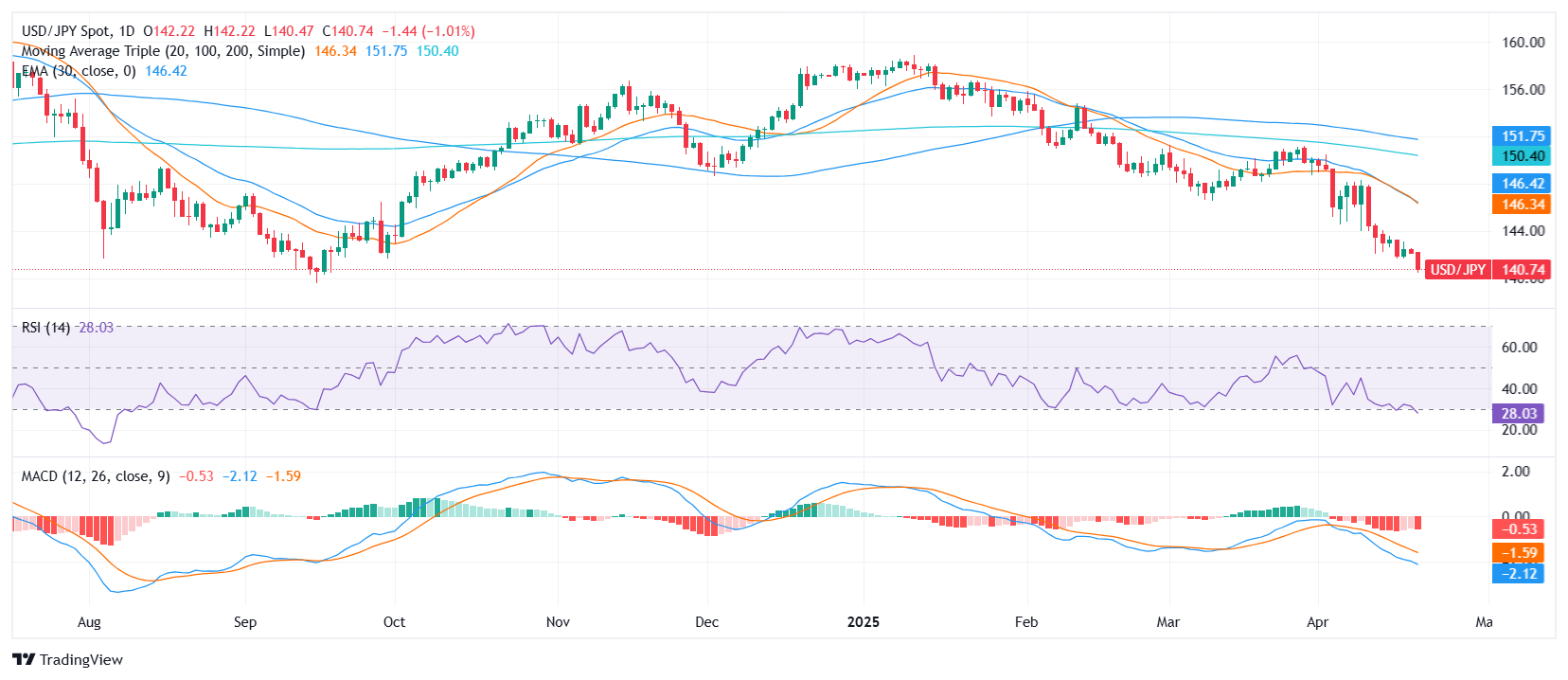
On the technical front, USD/JPY is flashing a bearish signal. Price action collapsed through the prior week’s low at 141.64 and now targets the June 2023 trough near 139.60. The 140.00 level remains a pivotal psychological support zone. A clean break below this threshold could expose downside risk toward the mid-130s in the medium term. Indicators support this outlook, with MACD printing bearish divergence and the RSI slipping into oversold territory. Key resistance levels are seen near 142.20, followed by 143.40 and 144.60.

Daily chart
Author

Patricio Martín

Patricio is an economist from Argentina passionate about global finance and understanding the daily movements of the markets.


More from Patricio Martín
Share:

Editor's Picks

GBP/USD trims gains, back to around 1.3500

GBP/USD now surrenders part of the earlier move to multi-week peaks around 1.3530 and comes close to the 1.3500 support on Monday. Cable’s uptick comes in tandem with decent gains in the Greenback, always amid persistent uncertainty lingering over the reopening of the Strait of Hormuz and US-Iran talks.

EUR/USD deflates to 1.1540

EUR/USD begins the week on the back foot, retesting the 1.1540 zone as the NA session draws to a close. The better tone in the US Dollar weighs on the risk complex, sparking the daily correction in spot, always on the back of unabated effervescence in the Middle East.

Gold surges past $4,400, hitting fresh two-month highs

Gold climbs further beyond $4,400, touching its highest level since June 5 in the Asian session on Tuesday. Easing Fed rate hike expectations continue to drive flows towards the non-yielding bullion. Meanwhile, inflation risks stemming from volatile oil prices back the case for at least one rate hike in 2026, which supports the US Dollar and might cap the precious metal ahead of the crucial US CPI report on Wednesday.

Ethereum: SharpLink reports loss as BitMine continues share buybacks and ETH acquisitions

SharpLink reported $394.3 million in Q2 net losses following heavy declines in the crypto market, over a 3.5x decline from the $103.4 million losses in Q2 2025, according to a filing on Monday. The losses comprise $321 million in unrealized crypto losses on its ETH holdings and $76.1 million in impairments on its liquid staking tokens LsETH and weETH.

RBA set to hold interest rate at 4.35% as softer inflation cools hike bets

The Reserve Bank of Australia is on track to keep the Official Cash Rate (OCR) steady at 4.35% for the second consecutive meeting on Tuesday. The decision will be announced at 04:30 GMT, accompanied by the Monetary Policy Statement and updated economic forecasts. RBA Governor Michele Bullock’s press conference will follow at 05:30 GMT.

9-3: Is the Federal Reserve’s vote tally Warsh's new forward guidance?
The rate did not move. Neither did the statement, and that’s the more interesting fact. Set the July 29 Federal Open Market Committee (FOMC) statement beside the one issued on June 17, and the two documents are identical apart from a single verb and a paragraph at the bottom naming three dissenters.













