USD/JPY slips as Fed cut hopes rise and tariff confusion grows
- USD/JPY trades around the 143.00 zone, reversing earlier gains in Thursday’s session.
- Fed rate cut hopes and record-high US tariffs on China weigh on sentiment.
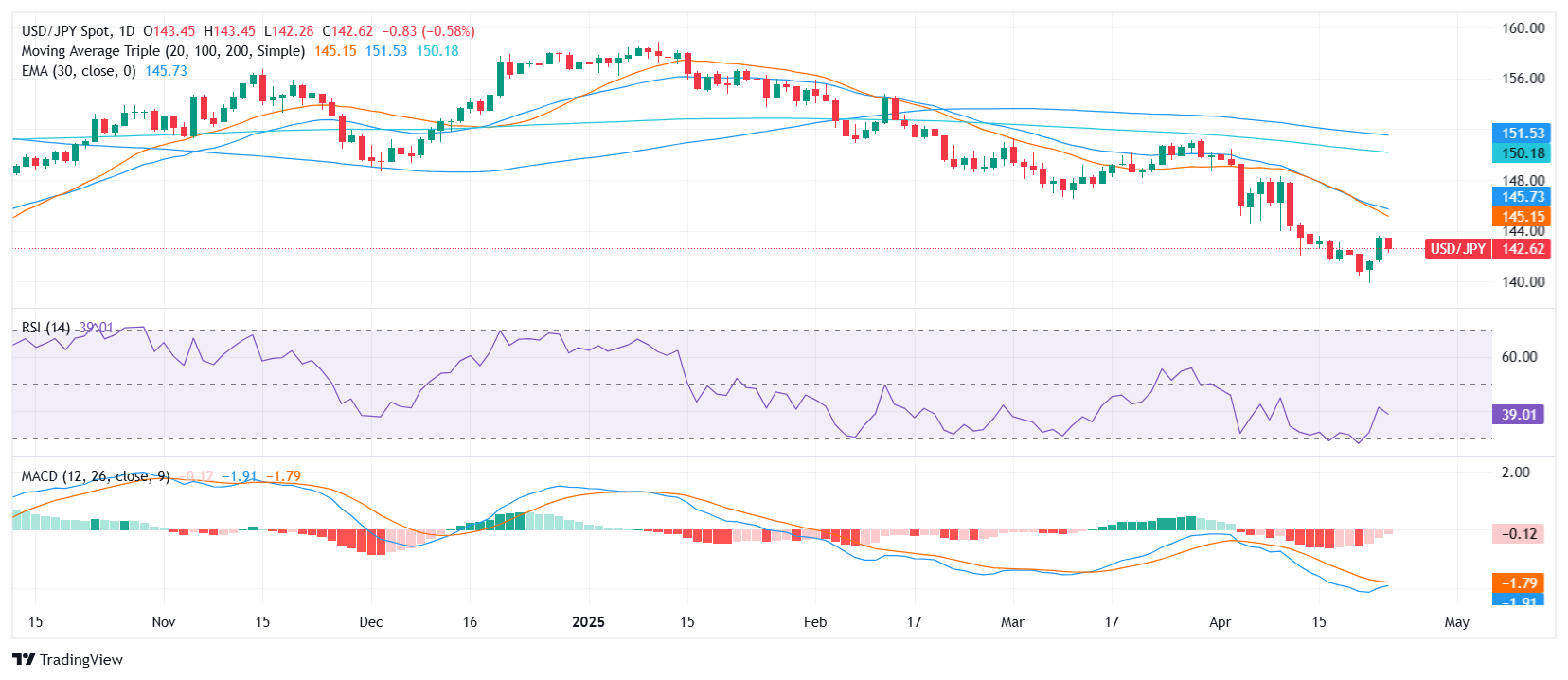
- Resistance is seen near 143.05 and 145.10, with support at 142.45 and 142.26.

The USD/JPY pair moved lower during Thursday’s European session, retreating toward the 143.00 zone after two days of modest recovery. The shift comes amid renewed US Dollar weakness as Fed rate cut speculation resurfaces and trade headlines stir market uncertainty. With risk sentiment modestly improved and US equities pushing higher—boosted by upbeat Durable Goods data and Trump’s trade optimism—the Japanese Yen continues to outperform most G10 peers, supported by a pullback in US yields and ongoing safe-haven demand.
Markets entered Thursday’s session with a cautiously positive tone, sparked by US President Donald Trump’s comments on striking a deal with China and softening his stance on tariffs. Though US Treasury Secretary Scott Bessent later clarified that no formal offer had been made to China, he acknowledged that current tariff levels were likely unsustainable. On the data front, headline US Durable Goods Orders for March surged 10.4%, but the core reading excluding transportation fell flat at 0.0%, painting a mixed economic picture.
Meanwhile, weekly Initial Jobless Claims ticked up slightly to 222K, suggesting minor softening in the US labor market. Fed Governor Beth Hammack emphasized patience in monetary policy, stating the Fed may act by June if data justifies it. These dovish tones, alongside persistent political and fiscal headwinds, have dragged the US Dollar Index (DXY) back below 99.50, limiting any rebound in USD/JPY.
In Japan, attention is turning to next week’s visit by Economy Minister Ryosei Akazawa to Washington for renewed tariff negotiations. Prior discussions with the US were reportedly unfavorable for Japan, particularly regarding automobile and steel tariffs. Despite this, the Bank of Japan remains one of the few G10 central banks maintaining a hawkish outlook, providing longer-term support for the Yen.
Technical outlook
From a technical standpoint, USD/JPY is flashing bearish signals. The Relative Strength Index (RSI) sits in neutral territory near 39, while the Moving Average Convergence Divergence (MACD) continues to issue a sell signal. Additional neutral readings come from the Williams %R and Bull Bear Power indicators, suggesting limited conviction on intraday direction.
The broader trend bias remains bearish, as the 20-day, 100-day, and 200-day Simple Moving Averages all slope downward. Shorter-term Exponential Moving Averages (10-day at 143.05 and 30-day at 145.70) further cap upside attempts.
Immediate resistance is seen at 143.05, with further hurdles at 144.53 and 145.10. On the downside, support levels are aligned near 142.45 and 142.26. A decisive break below these could open a path toward the 141.00 handle.
Unless the USD sees renewed demand or tariffs talks provide a lasting catalyst, the path of least resistance for USD/JPY may remain tilted downward.
Author

Patricio Martín
FXStreet
Patricio is an economist from Argentina passionate about global finance and understanding the daily movements of the markets.