USD/JPY rebounds above 152.00 amid holiday market lull
- USD/JPY bounced back above 152.00 after a sharp downturn late last week.
- Early week data remains limited, trapping investors in a trade headline worry circle.
- More US inflation data is due later this week, keeping Fed expectations near the front.

USD/JPY clawed its way back above the 152.00 handle on Monday, paring away some of last Friday’s steep tariff-headline-fueled losses. The Dollar-Yen pairing remains bolstered into near-term bullish territory, but a rapid re-escalation of trade war rhetoric between the US and China has knocked US Dollar (USD) markets for a loop.
The trading week opens on a slow note, with US markets dark for the Columbus Day holiday and little of note on the economic calendar outside a smattering of appearances from Federal Reserve (Fed) policymakers. However, Fedspeak is unlikely to mean much at this stage: Markets remain confident that the Fed is firmly on pace to deliver two more quarter-point interest rate cuts before the end of the year, and the majority of Fed speeches have tilted into confirming that assessment.
The US government shutdown continues to simmer away on the back burner, throwing off the release schedule for official datasets. US Producer Price Index (PPI) business-level inflation data is dubiously slated for Thursday, but with the Bureau of Labor Statistics (BLS) mired in the federal funding dryout, critical data releases have been delayed or suspended for the time being.
USD/JPY forecast
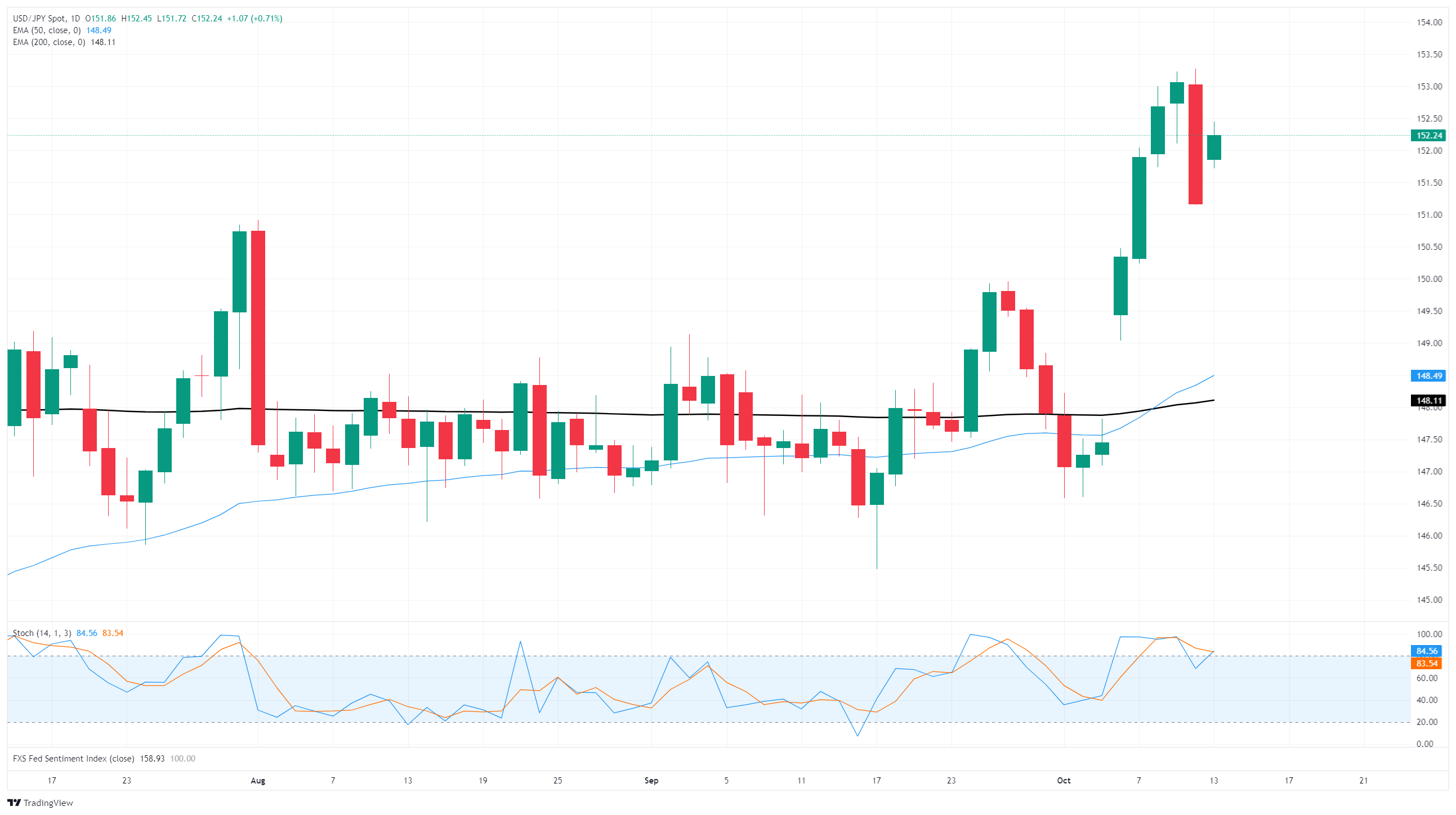
USD/JPY extended its rally last week, pushing toward 152.00 after clearing a prolonged consolidation above the 148.00 area. The pair broke cleanly above both the 50-day and 200-day EMAs, confirming a shift in momentum toward the upside. The recent pullback looks more like a pause than a reversal, with buyers defending support near 151.00 after last week’s sharp advance.
Momentum remains stretched, with the stochastic oscillator still holding in overbought territory. That suggests short-term exhaustion could lead to some sideways movement before another push higher. As long as price holds above the 150.50–151.00 region, the broader structure favors continuation toward the 153.00 zone. A daily close back below the moving averages, however, would raise the risk of a deeper retracement.
USD/JPY daily chart
Japanese Yen FAQs
The Japanese Yen (JPY) is one of the world’s most traded currencies. Its value is broadly determined by the performance of the Japanese economy, but more specifically by the Bank of Japan’s policy, the differential between Japanese and US bond yields, or risk sentiment among traders, among other factors.
One of the Bank of Japan’s mandates is currency control, so its moves are key for the Yen. The BoJ has directly intervened in currency markets sometimes, generally to lower the value of the Yen, although it refrains from doing it often due to political concerns of its main trading partners. The BoJ ultra-loose monetary policy between 2013 and 2024 caused the Yen to depreciate against its main currency peers due to an increasing policy divergence between the Bank of Japan and other main central banks. More recently, the gradually unwinding of this ultra-loose policy has given some support to the Yen.
Over the last decade, the BoJ’s stance of sticking to ultra-loose monetary policy has led to a widening policy divergence with other central banks, particularly with the US Federal Reserve. This supported a widening of the differential between the 10-year US and Japanese bonds, which favored the US Dollar against the Japanese Yen. The BoJ decision in 2024 to gradually abandon the ultra-loose policy, coupled with interest-rate cuts in other major central banks, is narrowing this differential.
The Japanese Yen is often seen as a safe-haven investment. This means that in times of market stress, investors are more likely to put their money in the Japanese currency due to its supposed reliability and stability. Turbulent times are likely to strengthen the Yen’s value against other currencies seen as more risky to invest in.
Author

Joshua Gibson
FXStreet
Joshua joins the FXStreet team as an Economics and Finance double major from Vancouver Island University with twelve years' experience as an independent trader focusing on technical analysis.