USD/JPY rallies as BoJ caution and US data push pair to two-week high
- The USD/JPY is trading with strong gains near 146.00 as the Yen weakens sharply following the BoJ’s dovish policy guidance.
- US jobless claims surged to 241,000 while the ISM Manufacturing PMI slipped to 48.7, reinforcing expectations for Fed rate cuts later this year.
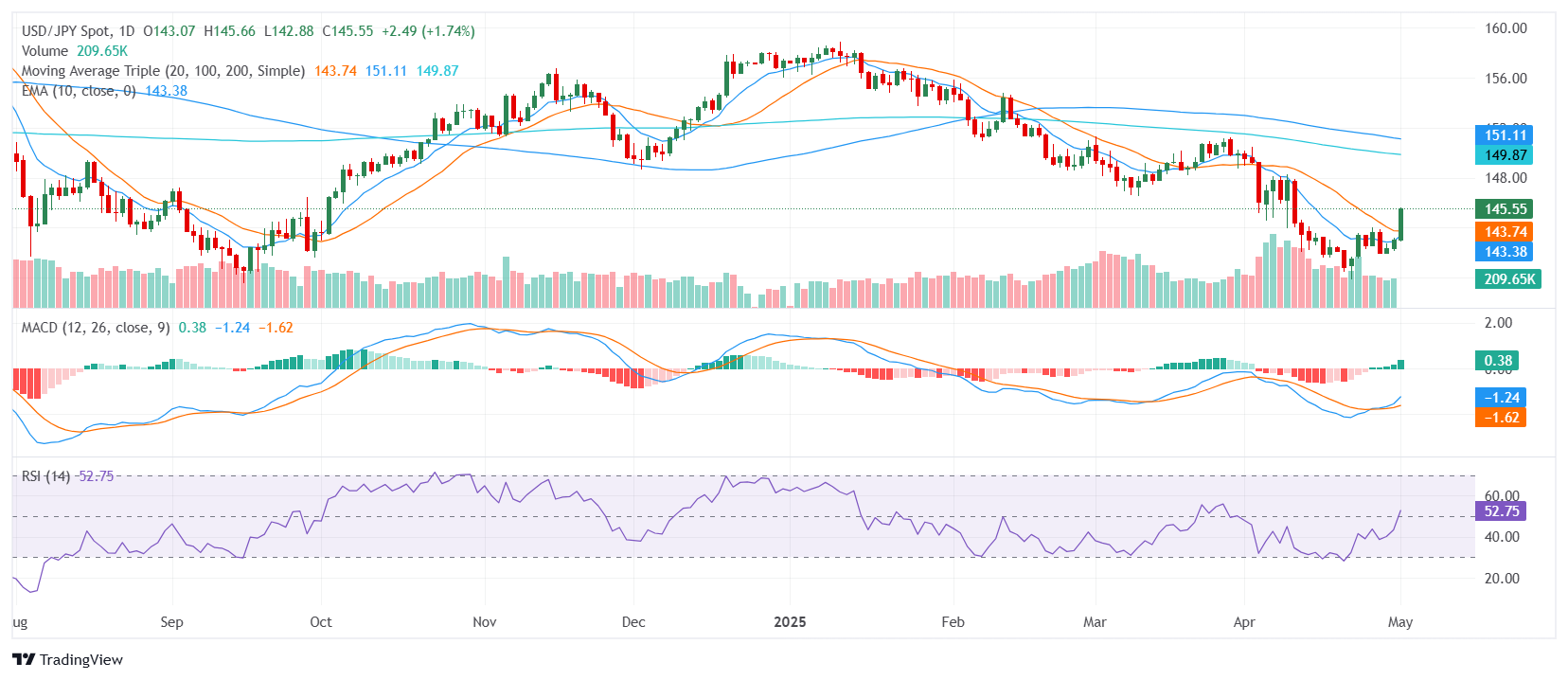
- Technical outlook remains bullish short-term, with the pair testing resistance near 146.64 and support seen around 145.04.

The USD/JPY is trading with notable strength, surging to the upper end of its recent range as the Japanese Yen continues to underperform following the Bank of Japan’s latest policy meeting. The pair is up 1.76% on the day and approaches the 146.00 area, driven by renewed divergence between US and Japanese monetary policy outlooks and fresh signs of labor market softness in the US.
The BoJ kept interest rates unchanged at 0.50% and downgraded its GDP and inflation forecasts for the current and next fiscal years, citing elevated external risks and domestic uncertainty. BoJ Governor Kazuo Ueda struck a cautious tone during his press conference, highlighting that inflation momentum may stall and that the outlook lacks the confidence needed for further rate hikes. The central bank now expects GDP growth of just 0.5% for FY2025, down from 1.1%, and also lowered its inflation forecast. Markets interpreted this stance as dovish, pushing back expectations for the next hike to late 2025 at the earliest.
Meanwhile, the US Dollar held firm against most peers after mixed data. The ISM Manufacturing PMI fell slightly to 48.7 in April, down from 49.0, but still better than expectations of 48. Employment conditions in the manufacturing sector improved modestly, with the subindex rising to 46.5, while the Prices Paid Index climbed to 69.8, showing sustained cost pressures. Additionally, initial jobless claims rose to 241,000, above both the previous week’s print and market expectations, signaling a softening labor market. These figures added to the view that the Fed may soon need to respond with rate cuts to support growth.
Political and trade uncertainty also added a layer of caution to market sentiment. Former Treasury Secretary Janet Yellen warned about the adverse economic impact of Trump’s new tariffs, while reports suggest the US may be seeking to re-engage with China and Japan on trade terms. The USD remains broadly supported for now, helped by rising US Treasury yields and strong tech earnings boosting equity sentiment.
Technical Analysis
From a technical standpoint, USD/JPY is flashing a bullish signal, currently trading around 146.00 and near the top of its daily range of 142.87 to 145.65. The MACD is giving a clear buy signal, aligning with bullish support from the 10-day EMA at 143.35 and the 10-day SMA at 142.71. The RSI sits at 52.88, indicating room for further upside, while the ADX at 34.02 reinforces the bullish trend. The Williams Percent Range at -1.46 is neutral, and the 20-day SMA at 143.70 continues to underpin the uptrend. However, the 100-day and 200-day SMAs at 151.01 and 149.83 respectively suggest longer-term resistance remains significant.
Key support levels are found at 145.55, 145.04, and 144.65. On the upside, resistance lies at 145.67, 146.64, and 146.95. A sustained break above 146.64 could open the door toward testing the 148.00 handle in coming sessions, particularly if Friday’s nonfarm payrolls confirm further labor market weakness and intensify Fed cut bets. Until then, the short-term bias remains skewed to the upside.
Daily Chart
Author

Patricio Martín
FXStreet
Patricio is an economist from Argentina passionate about global finance and understanding the daily movements of the markets.