USD/JPY Price Forecast: US Dollar nears 155.00 with bulls losing steam
- The US Dollar crawls higher, nearing eight-month highs at 155.00.
- Political pressure on the BoJ to keep interest rates near zero is adding pressure on the Yen.
- USD/JPY is trading in an ending wedge, a pattern highlighting a fading bullish momentum.
,

The US Dollar trades higher against the Japanese Yen on Monday, with price action approaching the 155.00 level. Dwindling hopes of Fed cuts, combined with political pressure on the Bank of Japan to keep interest rates unchanged in December, and the growing geopolitical tensions between Japan and China, are weighing on the Japanese Yen on Monday.
Beyond that, investors are showing a cautious mood at the week's opening, wary of betting against the US Dollar, ahead of a slew of delayed US macroeconomic releases, which keep the US Dollar moderately bullish against most of its main peers.
Technical Analysis: USD/JPY is forming an ending wedge pattern
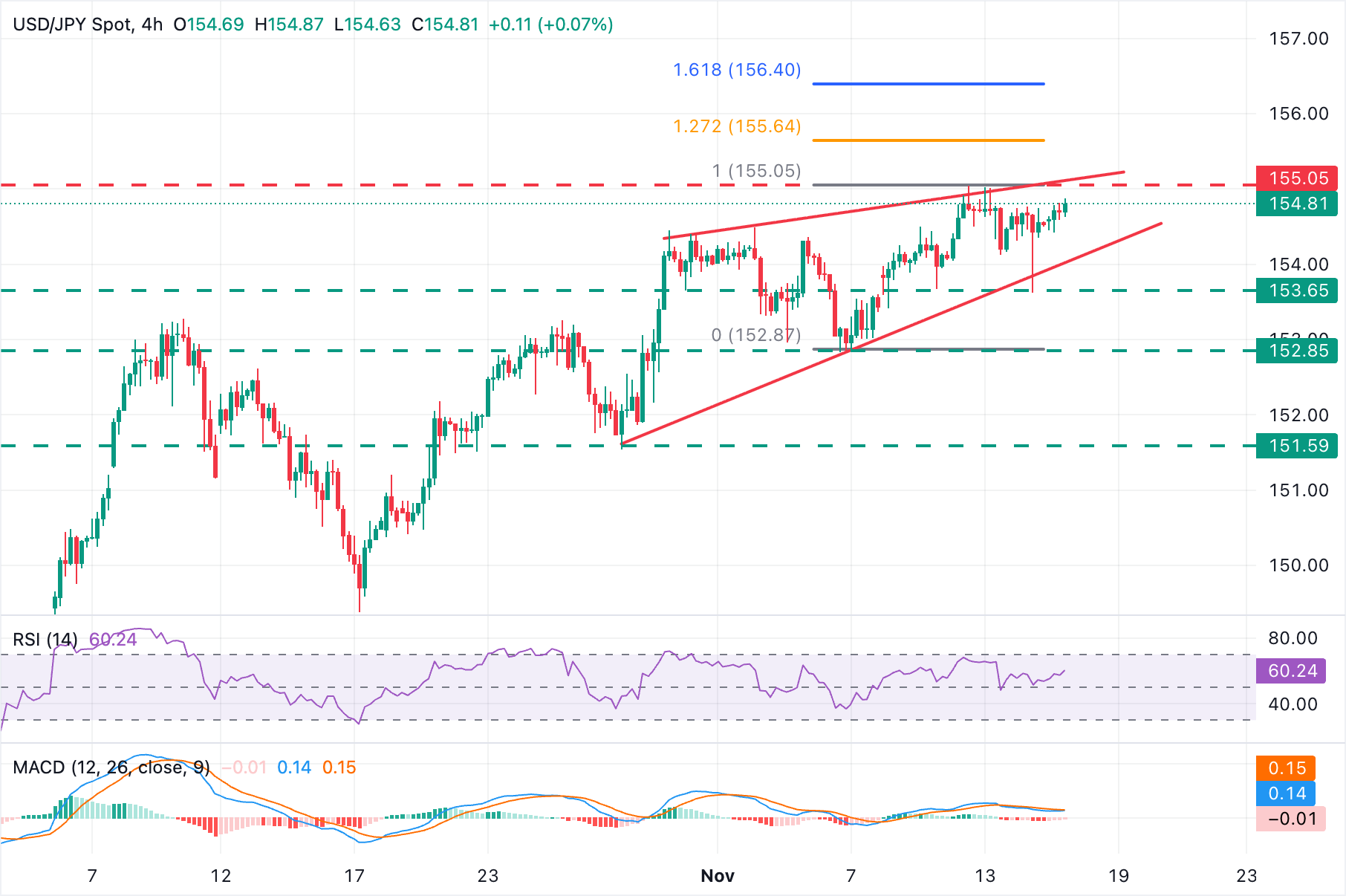
A look at the four-hour charts shows price action moving into an ever-tightening range, after having rallied about 5.5% since early April. This is commonly known as an ending wedge pattern, which reveals that bullish momentum is fading and often precedes a significant correction.
Upside attempts are likely to find resistance at the mentioned 155.00 area, and the top of the wedge, now at 155.15. Further up, the 127.2% Fibonacci extension of the November 6-12 rally, at 155.65, emerges as the next target.
Support levels are at the trendline support, now around the 154.00 area and the December 11 ns 14 lows, at 153.65. A clear break below these levels would confirm a trend shift and bring the November 6 low, at 152.85, and the October 22 and 29 lows, at 151,60, into focus.
Japanese Yen FAQs
The Japanese Yen (JPY) is one of the world’s most traded currencies. Its value is broadly determined by the performance of the Japanese economy, but more specifically by the Bank of Japan’s policy, the differential between Japanese and US bond yields, or risk sentiment among traders, among other factors.
One of the Bank of Japan’s mandates is currency control, so its moves are key for the Yen. The BoJ has directly intervened in currency markets sometimes, generally to lower the value of the Yen, although it refrains from doing it often due to political concerns of its main trading partners. The BoJ ultra-loose monetary policy between 2013 and 2024 caused the Yen to depreciate against its main currency peers due to an increasing policy divergence between the Bank of Japan and other main central banks. More recently, the gradually unwinding of this ultra-loose policy has given some support to the Yen.
Over the last decade, the BoJ’s stance of sticking to ultra-loose monetary policy has led to a widening policy divergence with other central banks, particularly with the US Federal Reserve. This supported a widening of the differential between the 10-year US and Japanese bonds, which favored the US Dollar against the Japanese Yen. The BoJ decision in 2024 to gradually abandon the ultra-loose policy, coupled with interest-rate cuts in other major central banks, is narrowing this differential.
The Japanese Yen is often seen as a safe-haven investment. This means that in times of market stress, investors are more likely to put their money in the Japanese currency due to its supposed reliability and stability. Turbulent times are likely to strengthen the Yen’s value against other currencies seen as more risky to invest in.
Author

Guillermo Alcala
FXStreet
Graduated in Communication Sciences at the Universidad del Pais Vasco and Universiteit van Amsterdam, Guillermo has been working as financial news editor and copywriter in diverse Forex-related firms, like FXStreet and Kantox.