USD/JPY Price Forecast: Extends losing streak for third trading day
- USD/JPY declines for the third trading day in a row as the Japanese Yen outperforms.
- BoJ Uchida keeps doors open for further interest rate hikes on hopes of steady wage growth.
- The US Dollar faces selling pressures ahead of Fed Powell’s speech.

The USD/JPY pair extends its losing spree for the third trading day on Thursday. The pair faces selling pressure as the Japanese Yen (JPY) continues to outperform across the board on hopes that the Bank of Japan (BoJ) will raise interest rates further despite elevated global economic uncertainty due to the fallout of tariffs by United States (US) President Donald Trump.
Japanese Yen PRICE This week
The table below shows the percentage change of Japanese Yen (JPY) against listed major currencies this week. Japanese Yen was the strongest against the Canadian Dollar.
| USD | EUR | GBP | JPY | CAD | AUD | NZD | CHF | |
|---|---|---|---|---|---|---|---|---|
| USD | 0.49% | 0.16% | -0.19% | 0.62% | 0.15% | 0.83% | 0.45% | |
| EUR | -0.49% | -0.20% | -0.13% | 0.63% | 0.29% | 0.83% | 0.44% | |
| GBP | -0.16% | 0.20% | 0.25% | 0.83% | 0.50% | 0.95% | 0.64% | |
| JPY | 0.19% | 0.13% | -0.25% | 0.81% | -0.29% | 0.16% | 0.41% | |
| CAD | -0.62% | -0.63% | -0.83% | -0.81% | -0.19% | 0.20% | -0.18% | |
| AUD | -0.15% | -0.29% | -0.50% | 0.29% | 0.19% | 0.43% | 0.12% | |
| NZD | -0.83% | -0.83% | -0.95% | -0.16% | -0.20% | -0.43% | -0.41% | |
| CHF | -0.45% | -0.44% | -0.64% | -0.41% | 0.18% | -0.12% | 0.41% |
The heat map shows percentage changes of major currencies against each other. The base currency is picked from the left column, while the quote currency is picked from the top row. For example, if you pick the Japanese Yen from the left column and move along the horizontal line to the US Dollar, the percentage change displayed in the box will represent JPY (base)/USD (quote).
Traders have become increasingly confident about the BoJ raising interest rates again this year after comments from Bank of Japan (BoJ) Deputy Governor Shinichi Uchida earlier this week that “wages are expected to continue rising” as Japan’s job market is very tight despite medium- to-long-term inflation expectations are likely to “temporarily stagnate”.
Meanwhile, the US Dollar (USD) is also underperforming ahead of Federal Reserve (Fed) Chair Jerome Powell’s speech at 12:40 GMT in a Thomas Laubach Research Conference in Washington. Financial market participants would like to know whether the Fed is still sticking to its stance of holding interest rates in the current range of 4.25%-4.50% despite soft US Consumer Price Index (CPI) data for April and a temporary US-China trade truce.
Ahead of Fed Powell’s speech, the US Dollar Index (DXY), which tracks the Greenback’s value against six major currencies, trades lower near 100.80.
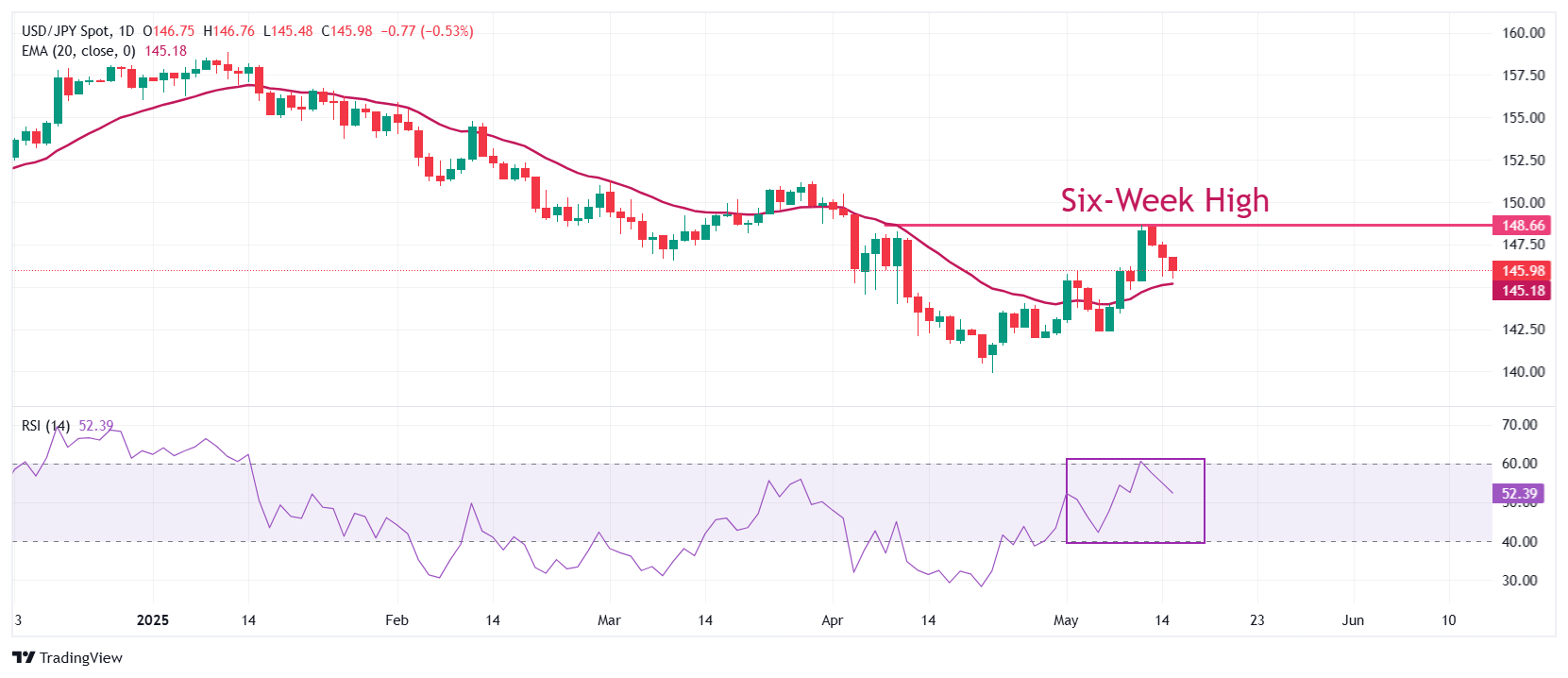
USD/JPY retraces significantly from an almost six-week high of 148.54 to near 145.50 on Thursday. Still, the pair holds the 20-day Exponential Moving Average (EMA), which trades around 145.18, indicating that the near-term trend remains bullish.
The 14-day Relative Strength Index (RSI) struggles to break above 60.00. A fresh bullish momentum would trigger if the RSI breaks above the 60.00 level.
An upside move in the pair towards the psychological level of 150.00 and the March 28 high of 151.21 would come if it breaks above the May 13 high of 148.57.
The asset would face more downside towards the April 22 low of 139.90 and the 14 July 2023 low of 137.25 if it breaks below the May 7 low of 142.42.
USD/JPY daily chart
Economic Indicator
Fed's Chair Powell speech
Jerome H. Powell took office as a member of the Board of Governors of the Federal Reserve System on May 25, 2012, to fill an unexpired term. On November 2, 2017, President Donald Trump nominated Powell to serve as the next Chairman of the Federal Reserve. Powell assumed office as Chair on February 5, 2018.
Read more.Next release: Thu May 15, 2025 12:40
Frequency: Irregular
Consensus: -
Previous: -
Source: Federal Reserve
Author

Sagar Dua
FXStreet
Sagar Dua is associated with the financial markets from his college days. Along with pursuing post-graduation in Commerce in 2014, he started his markets training with chart analysis.