USD/JPY Price Analysis: Retreats below 155.00 on trade war tensions
- USD/JPY faces continued pressure, potentially closing below 155.00 as US-China trade war escalates.
- Technical indicators suggest further downside, with pair now trading within the Ichimoku Cloud.
- Resistance and support levels closely watched, with potential rebounds facing hurdles at 155.76 and 156.29.


The USD/JPY drops below 155.00 for the second straight day and seems poised to achieve a daily close below the latter. Falling US Treasury yields and the escalation of the “trade war” between the United States (US) and China would underpin the Japanese Yen (JPY) due to its safe-haven appeal. At the time of writing, the pair posts losses of 0.28%.
USD/JPY Price Analysis: Technical outlook
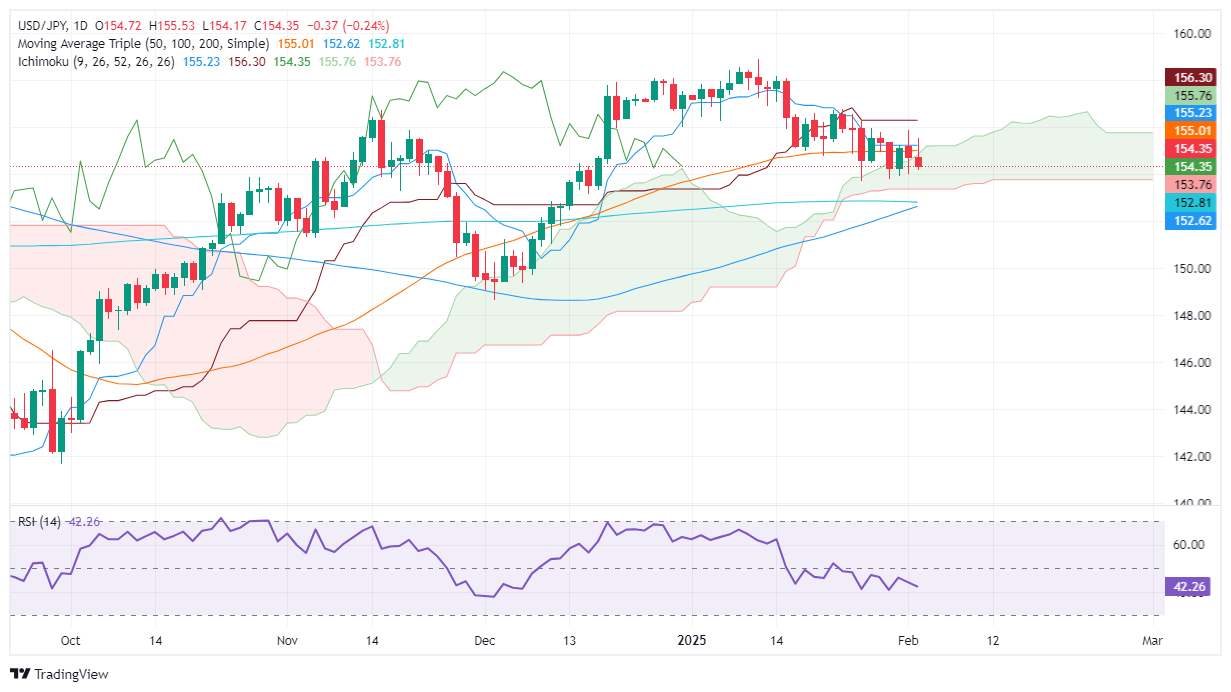
Developments over the weekend developed a huge 190-pipe candle on February 3, which lately closed below 155.00 for the first time since January 30. Additionally, the USD/JPY pair cleared the 50-day Simple Moving Average (SMA) at 155.02 and registered back-to-back bearish close days, which could pave the way for further downside.
Of note is that the USD/JPY spot price lies inside the Ichimoku Cloud (Kumo), which indicates “sideways price action.”
If USD/JPY edged below the January 30 low of 153.79, this could open the door to challenge the Senkou Span B at 153.76, followed by the January 27 low of 153.71. If those levels are cleared, the next support would be the 200-day SMA at 152.81.
Conversely, if USD/JPY climbs above the 50-day SMA, the next resistance would be the Senkou Span A at 155.76, ahead of challenging the Tenkan-Sen at 156.29
USD/JPY Price Chart
Tariffs FAQs
Tariffs are customs duties levied on certain merchandise imports or a category of products. Tariffs are designed to help local producers and manufacturers be more competitive in the market by providing a price advantage over similar goods that can be imported. Tariffs are widely used as tools of protectionism, along with trade barriers and import quotas.
Although tariffs and taxes both generate government revenue to fund public goods and services, they have several distinctions. Tariffs are prepaid at the port of entry, while taxes are paid at the time of purchase. Taxes are imposed on individual taxpayers and businesses, while tariffs are paid by importers.
There are two schools of thought among economists regarding the usage of tariffs. While some argue that tariffs are necessary to protect domestic industries and address trade imbalances, others see them as a harmful tool that could potentially drive prices higher over the long term and lead to a damaging trade war by encouraging tit-for-tat tariffs.
During the run-up to the presidential election in November 2024, Donald Trump made it clear that he intends to use tariffs to support the US economy and American producers. In 2024, Mexico, China and Canada accounted for 42% of total US imports. In this period, Mexico stood out as the top exporter with $466.6 billion, according to the US Census Bureau. Hence, Trump wants to focus on these three nations when imposing tariffs. He also plans to use the revenue generated through tariffs to lower personal income taxes.
Author
Christian Borjon Valencia
FXStreet
Markets analyst, news editor, and trading instructor with over 14 years of experience across FX, commodities, US equity indices, and global macro markets.