|

USD/JPY Price Analysis: Recovers early lost ground, struggles to capitalize on move beyond 149.00

  • USD/JPY catches fresh bids following an intraday dip to 148.25, albeit lacks follow-through.
  • Intervention fears turn out to be the only factor holding back bulls from placing fresh bets.
  • The technical setup suggests that the path of least resistance for the pair is to the upside.

The USD/JPY pair attracts some dip-buying following an intraday slide to the 148.25 region on Thursday and climbs to the top end of its daily range during the first half of the European session. Spot prices currently trade around the 149.00 mark, though lack follow-through in the wake of speculations that Japanese authorities will intervene in the FX market to defend the domestic currency.

The initial market reaction to Wednesday's rather unimpressive US macro data, meanwhile, turns out to be short-lived amid firming expectations that the Federal Reserve (Fed) will keep interest rates higher for longer. This, in turn, triggers a fresh leg up in the US Treasury bond yields, which assists the US Dollar (USD) to stall its corrective slide from an 11-month peak and acts as a tailwind for the USD/JPY pair.

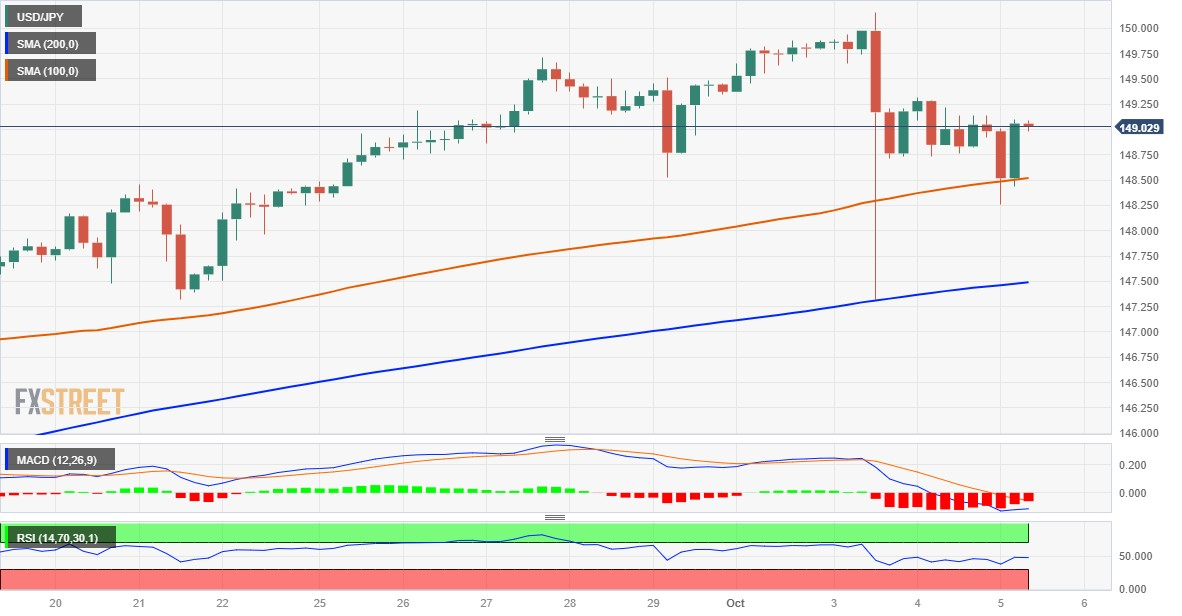
From a technical perspective, the intraday decline showed some resilience below the 100-period Simple Moving Average (SMA) on the 4-hour chart. This comes on the back of a solid rebound from the 200-period SMA on the 4-hour chart, around the 147.30 area, or the lowest level since September 14 touched on Tuesday, and supports prospects for a further near-term appreciating move for the USD/JPY pair.

Moreover, oscillators on the daily chart – though have been retreating recently – are still holding comfortably in the positive territory. This, in turn, favours bullish traders and suggests that the path of least resistance for the USD/JPY pair is to the upside. Any subsequent move up, however, might confront some barrier near the 149.60 area, above which bulls might aim back to challenge the 150.00 intervention level.

The latter should act as a key pivotal point for short-term traders, which if cleared decisively will confirm a fresh breakout and pave the way for an extension of the recent well-established uptrend witnessed over the past two months or so. The subsequent move up has the potential to lift the USD/JPY pair towards the 151.00 mark en route to a multi-decade higher, closer to the 152.00 mark touched in October 2022.

On the flip side, the daily swing low, around the 148.25 region, now seems to protect the immediate downside ahead of the 148.00 mark. Failure to defend the said support levels might prompt some technical selling and drag the USD/JPY pair back towards the weekly trough, around the 147.30 region. This is followed by the 147.00 round figure, which if broken will suggest that spot prices have topped out in the near term.

USD/JPY 4-hour chart
fxsoriginal

Technical levels to watch

USD/JPY

Overview
Today last price149.06
Today Daily Change-0.07
Today Daily Change %-0.05
Today daily open149.13
 
Trends
Daily SMA20148.28
Daily SMA50146.18
Daily SMA100143.53
Daily SMA200138.27
 
Levels
Previous Daily High149.32
Previous Daily Low148.74
Previous Weekly High149.71
Previous Weekly Low148.25
Previous Monthly High149.71
Previous Monthly Low144.44
Daily Fibonacci 38.2%149.1
Daily Fibonacci 61.8%148.96
Daily Pivot Point S1148.8
Daily Pivot Point S2148.48
Daily Pivot Point S3148.22
Daily Pivot Point R1149.38
Daily Pivot Point R2149.64
Daily Pivot Point R3149.97

Author

Haresh Menghani

Haresh Menghani is a detail-oriented professional with 10+ years of extensive experience in analysing the global financial markets.


More from Haresh Menghani
Share:

Editor's Picks

AUD/USD consolidates above 0.7000; remains close to monthly top

AUD/USD holds steady above 0.7000 during the Asian session on Friday, trading just below the previous day's monthly low amid diverging forces. A hawkish RBA continues to support the Aussie, while the recent decline in US bond yields keeps the US Dollar depressed near a three-week low. However, oil-driven inflation fears reinforce Fed hike bets, which, along with geopolitical risks, could benefit the safe-haven buck and cap the currency pair.

USD/JPY bounces off one-month low; climbs to 157.00 amid reviving USD demand

USD/JPY rebounds from the 156.00 neighborhood, or a one-month low touched during Friday’s Asian session, with bulls looking to extend momentum beyond 157.00 amid the emergence of some US Dollar buying. Meanwhile, Japan's National CPI rose to a nine-month peak and reaffirmed BoJ rate-hike bets, which could support the Japanese Yen and cap gains for the currency pair.

Gold treads water around $4,000

Gold prices maintain its offered stance in place at the end of the week, hovering around the key $4,000 threshold per troy ounce. The persistent selling bias in the precious metal comes amid decent gains in the US Dollar and an acceptable rebound in US Treasury yields across the curve, all alongside further upside traction in crude oil prices.

Crypto Today: Bitcoin holds the 50-day EMA as Ethereum and XRP face structural resistance

Bitcoin gradually ticks up on Friday, trading above $81,000. The Crypto King has recently defended structural support near $80,000, reinforcing the prevailing bullish outlook. Ethereum similarly edges higher above $2,400, while Ripple trades above $1.32 after testing support around $1.30.

The French bond panic is overdone. Here's what the market is misreading 

France's 10-year government bond yield has climbed above 5%, reigniting fears of a sovereign debt crisis in the Eurozone. With public debt exceeding €3.5 trillion, persistent budget deficits and a fragmented political landscape, investors are increasingly questioning the French government's ability to stabilize its finances.

What November 3 means for the Fed's rate path and the US Dollar

The USD faces a decisive period ahead of the November 3 midterm elections. While markets anticipate another interest rate increase from the Fed in December, the battle for control of Congress could reshape fiscal policy expectations and, indirectly, the path of US monetary policy in 2027.















