USD/JPY Price Analysis: Plummets below 157.00 as bears stepped in
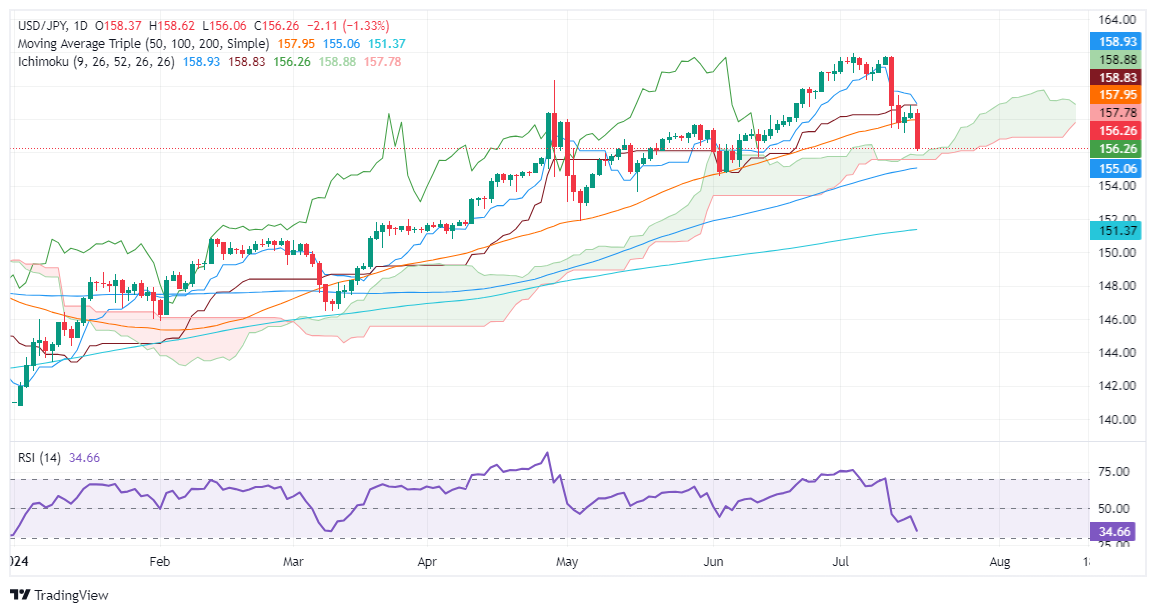
- USD/JPY drops to a three-week low of 156.32, diving from a daily high of 158.62.
- Bearish signals: Chikou Span crosses below June’s candle; Tenkan-Sen nearing cross below Kijun-Sen.
- Key supports at 155.50/60 and 153.61; resistance at 157.00 with potential re-test of 158.85.


The USD/JPY falls sharply on Wednesday, down by more than 1.30% and approaching the top of the Ichimoku Cloud (Kumo) at around 156.00. At the time of writing, the pair exchanged hands at 156.32 after diving from a daily high of 158.62.
USD/JPY Price Analysis: Technical outlook
The USD/JPY has dropped to a three-week low slightly above the Kumo, as more technical signals suggest the pair could extend its losses.
The Chikou Span crossed below June’s 12 candle, a bearish signal, while the Tenkan-Sen is about to cross below the Kijun-Sen at around 158.80/91. This and the USD/JPY clearing key support levels seen at 157.14 opened the door for further downside.
If USD/JPY clears the narrowest part of the Kumo sliding beneath 155.50/60, that would expose the May 16 swing low of 153.61. A breach of the latter will expose the May 2 pivot low at 151.87, ahead of testing the 151.00 mark.
On the other hand, if buyers stepped in and pushed the USD/JPY above 157.00, look for a re-test of the July 16 peak at 158.85.
USD/JPY Price Action – Daily Chart
Japanese Yen FAQs
The Japanese Yen (JPY) is one of the world’s most traded currencies. Its value is broadly determined by the performance of the Japanese economy, but more specifically by the Bank of Japan’s policy, the differential between Japanese and US bond yields, or risk sentiment among traders, among other factors.
One of the Bank of Japan’s mandates is currency control, so its moves are key for the Yen. The BoJ has directly intervened in currency markets sometimes, generally to lower the value of the Yen, although it refrains from doing it often due to political concerns of its main trading partners. The current BoJ ultra-loose monetary policy, based on massive stimulus to the economy, has caused the Yen to depreciate against its main currency peers. This process has exacerbated more recently due to an increasing policy divergence between the Bank of Japan and other main central banks, which have opted to increase interest rates sharply to fight decades-high levels of inflation.
The BoJ’s stance of sticking to ultra-loose monetary policy has led to a widening policy divergence with other central banks, particularly with the US Federal Reserve. This supports a widening of the differential between the 10-year US and Japanese bonds, which favors the US Dollar against the Japanese Yen.
The Japanese Yen is often seen as a safe-haven investment. This means that in times of market stress, investors are more likely to put their money in the Japanese currency due to its supposed reliability and stability. Turbulent times are likely to strengthen the Yen’s value against other currencies seen as more risky to invest in.
Author
Christian Borjon Valencia
FXStreet
Christian Borjon began his career as a retail trader in 2010, mainly focused on technical analysis and strategies around it. He started as a swing trader, as he used to work in another industry unrelated to the financial markets.