USD/JPY hesitates at 144.00 with markets awaiting US data
- The US Dollar loses momentum as the enthusiasm following US Job Openings fades.
- Investors are looking at the US ADP and Services PMI data for further guidance
- A bullish engulfing candle on the daily chart suggests a potential trend shift.


The US Dollar’s recovery from Monday’s lows has lost steam during Wednesday’s European trading session. The USD/JPY 4-hour chart shows doji candles at the 144.00 level, highlighting an indecisive market.
The Dollar performed a significant rebound on Tuesday, fuelled by a positive surprise on US JOLTS Job Openings, which rose by 7.39 million in April, beating expectations of a more modest 7.1 million increment.
These figures offset the sharper-than-expected decline in Factory Orders, which follows the downbeat Manufacturing activity report seen on Monday, and add to the evidence of the negative impact of Trump’s tariffs on the manufacturing sector.
Market optimism, however, has eased, with investors growing cautious ahead of the US ADP Employment report, which is expected to show a significant increase in payrolls in May, and the ISM Services PMI, which is also expected to have improved in May.
Technical Analysis: A Bullish engulfing candle suggests a trend shift
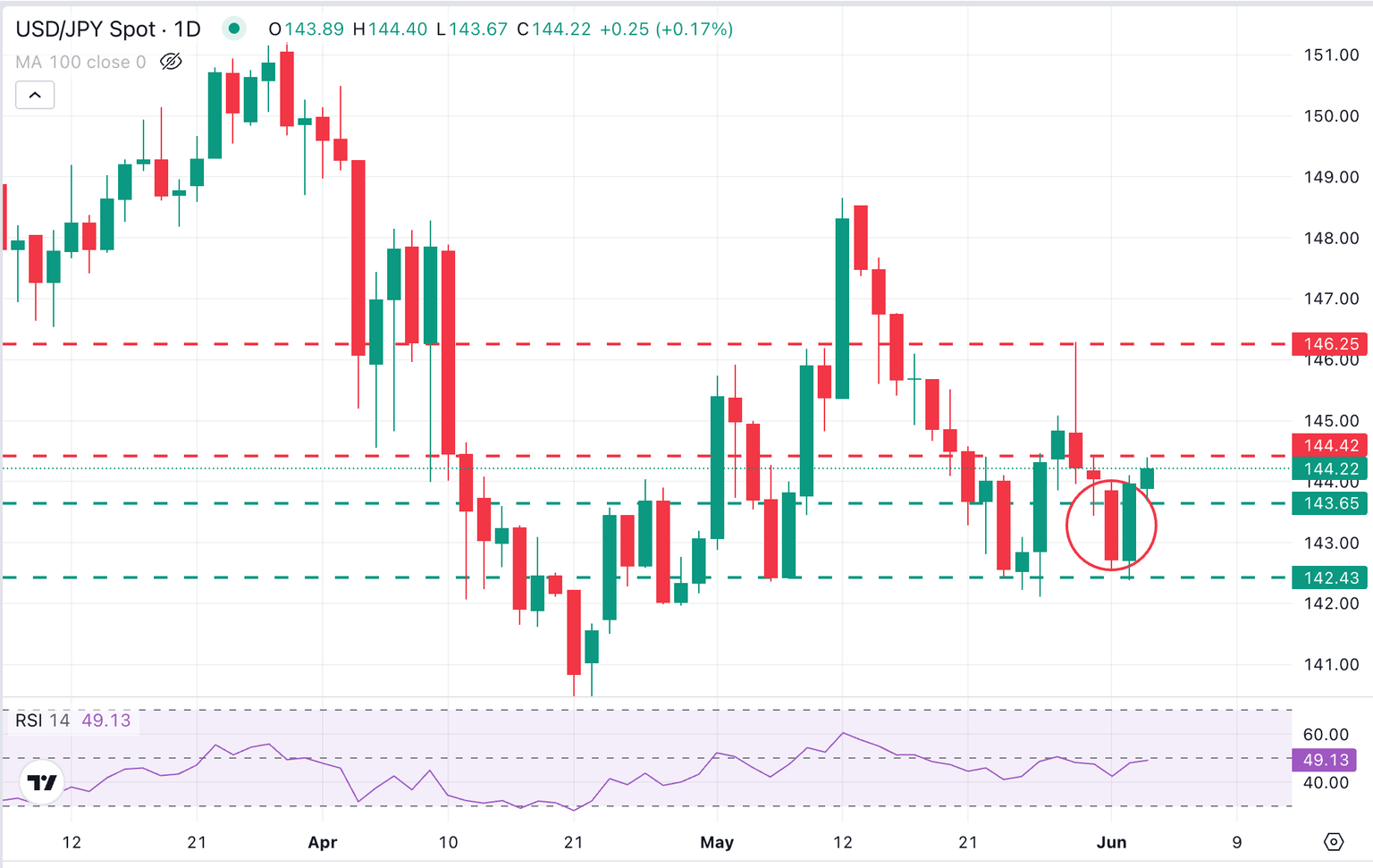
A look at the daily chart and we observe a bullish engulfing candle on Tuesday, which is often a signal anticipating a trend change. The pair, however, should break above the 144.40 resistance area to confirm that view, and extend gains towards 146.25.
On the downside, immediate support is at 143.65, followed by 142.40.
Japanese Yen FAQs
The Japanese Yen (JPY) is one of the world’s most traded currencies. Its value is broadly determined by the performance of the Japanese economy, but more specifically by the Bank of Japan’s policy, the differential between Japanese and US bond yields, or risk sentiment among traders, among other factors.
One of the Bank of Japan’s mandates is currency control, so its moves are key for the Yen. The BoJ has directly intervened in currency markets sometimes, generally to lower the value of the Yen, although it refrains from doing it often due to political concerns of its main trading partners. The BoJ ultra-loose monetary policy between 2013 and 2024 caused the Yen to depreciate against its main currency peers due to an increasing policy divergence between the Bank of Japan and other main central banks. More recently, the gradually unwinding of this ultra-loose policy has given some support to the Yen.
Over the last decade, the BoJ’s stance of sticking to ultra-loose monetary policy has led to a widening policy divergence with other central banks, particularly with the US Federal Reserve. This supported a widening of the differential between the 10-year US and Japanese bonds, which favored the US Dollar against the Japanese Yen. The BoJ decision in 2024 to gradually abandon the ultra-loose policy, coupled with interest-rate cuts in other major central banks, is narrowing this differential.
The Japanese Yen is often seen as a safe-haven investment. This means that in times of market stress, investors are more likely to put their money in the Japanese currency due to its supposed reliability and stability. Turbulent times are likely to strengthen the Yen’s value against other currencies seen as more risky to invest in.
Author
Guillermo Alcala
FXStreet
Graduated in Communication Sciences at the Universidad del Pais Vasco and Universiteit van Amsterdam, Guillermo has been working as financial news editor and copywriter in diverse Forex-related firms, like FXStreet and Kantox.

















