USD/JPY edges lower as recession fears rise and Japan data underwhelms
- The USD/JPY is trading slightly down, stuck in a tight range, as growth concerns pressure the Dollar while weak Japanese data caps Yen strength.
- US GDP contracted by 0.3% in Q1, inflation slowed, and traders now see increased chances of Fed rate cuts; Trump renews criticism of Powell.
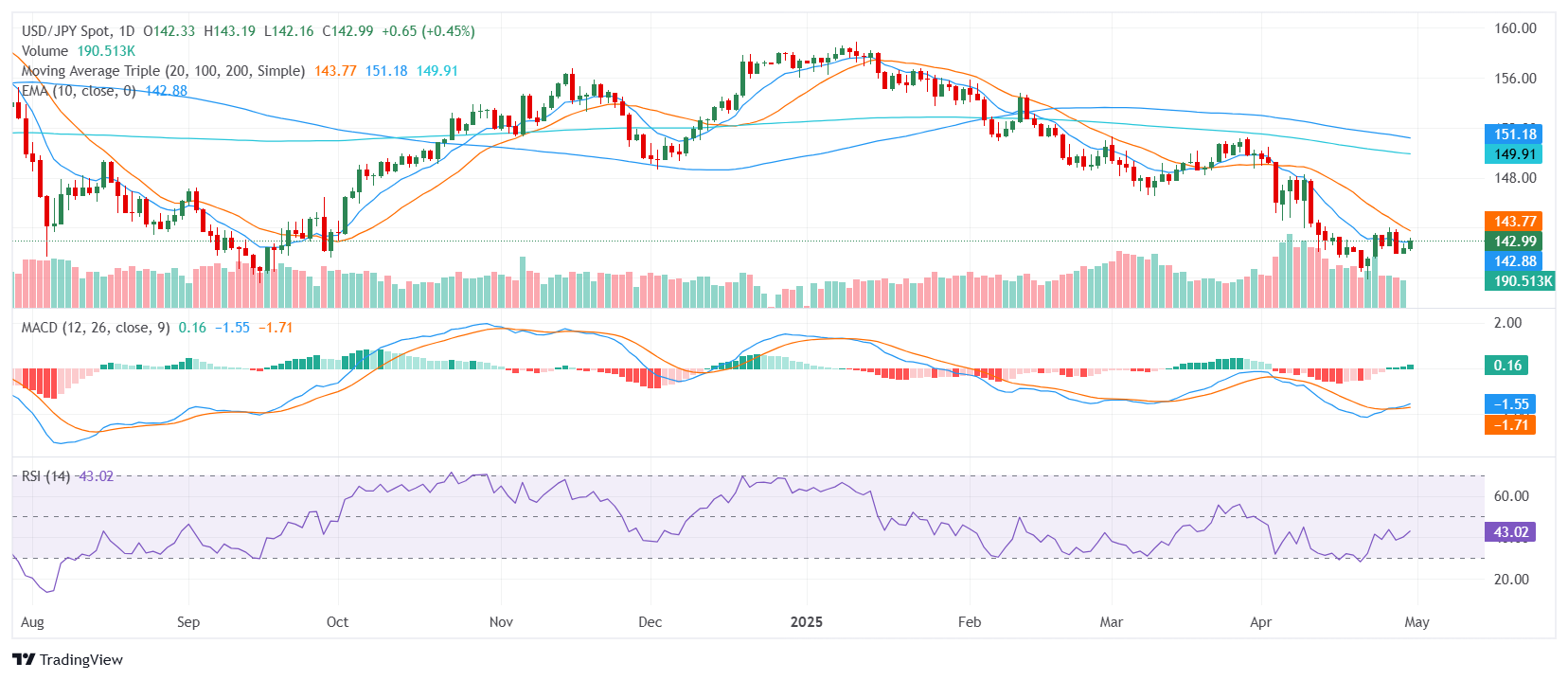
- Technical signals remain bearish, with multiple SMAs pointing lower and the pair struggling below resistance at 143.57.


The USD/JPY is trading with modest losses, hovering near the mid-143.00s after disappointing US growth data and lackluster Japanese economic reports fueled diverging sentiment around both currencies. The US economy contracted by 0.3% in the first quarter of 2025, the first decline since 2022, missing expectations for growth and highlighting the impact of higher imports and reduced government spending. At the same time, Japan reported weaker-than-expected industrial production and retail sales, which limited the Yen’s upside even as global risk appetite faltered.
On the macro front, the US Bureau of Economic Analysis reported that real GDP shrank by 0.3% in Q1, missing the market forecast of 0.4% growth and marking a sharp deceleration from the 2.4% increase in Q4 2024. The contraction was primarily driven by a 41% surge in imports and lower government outlays. Meanwhile, core PCE inflation, the Fed’s preferred gauge, moderated to 2.3% year-on-year, in line with expectations and down from February’s 2.5%. Other data showed weaker job creation, with the ADP report revealing just 62,000 new jobs in April versus an expected 108,000.
Despite softer data, personal spending remained solid in March, rising by 0.7%, while income rose 0.5%. However, market sentiment turned cautious, with the Dow Jones Industrial Average dropping over 200 points and lingering around 40,300. President Donald Trump reignited tension by blaming the economic downturn on his predecessor and calling out Fed Chair Jerome Powell during a speech, saying he knows more about interest rates. Additionally, Trump hinted at progress in trade talks with Canada and possibly China.
In Japan, the Yen weakened 0.5% against the Dollar as industrial production and retail sales data both disappointed, highlighting domestic fragility. Although the Bank of Japan is not expected to adjust policy at its next meeting, investors will focus on updated forecasts and any signals about trade-related risks. With US-Japan trade talks ongoing and China’s macro indicators also signaling a slowdown, markets remain on edge heading into Friday’s key Nonfarm Payrolls release.
Technical Analysis
From a technical standpoint, USD/JPY is flashing bearish signals, currently trading around 143.00. The pair is contained between 142.93 and 143.05. The RSI at 43.20 is neutral, while MACD gives a soft buy indication. However, momentum at 0.55 and the flat Ultimate Oscillator at 52.21 show indecision. Moving averages lean negative, with the 20-day SMA at 143.57, 100-day at 150.99, and 200-day at 149.81 all suggesting a downward trend. Additional resistance is located at 143.84 and 144.63, while support levels are seen at 142.88, 142.76, and 142.45.
The market’s focus now turns to the ISM Manufacturing PMI and Friday’s jobs report, which will be pivotal in shaping expectations for the Fed’s next move. Until then, risk sentiment and rate expectations are likely to dictate short-term direction.
Daily Chart
Author
Patricio Martín
FXStreet
Patricio is an economist from Argentina passionate about global finance and understanding the daily movements of the markets.