USD/JPY edges higher as softer US data weighs on yields despite trade uncertainty
- USD/JPY trades in the mid-142.00 area after mixed US economic data and cautious trade comments.
- Weaker US JOLTS job openings and consumer confidence figures contrast with ongoing US-China trade uncertainty.
- Technical indicators suggest a bearish bias with key SMAs pointing lower, while immediate support and resistance levels are in focus.

The USD/JPY pair is trading around the 142.00 handle during the North American session on Tuesday. The pair saw some upward movement as the US Dollar (USD) steadied following the release of softer-than-expected US JOLTS Job Openings data and a sharp drop in Consumer Confidence. However, gains remain limited due to ongoing uncertainty surrounding US trade negotiations, particularly with China.
The Dow Jones Industrial Average (DJIA) experienced a notable surge of over 300 points, or 0.80%, as weaker US economic data hinted at potential future interest rate cuts, leading to a decline in US Treasury yields. Despite this positive sentiment in the equity markets, comments from US Treasury Secretary Scott Bessent regarding the lack of imminent trade deals and White House Press Secretary Karoline Leavitt's remarks about Amazon's potential tariff disclosures injected a note of caution into the broader market.
On the data front, the US Bureau of Labor Statistics (BLS) reported that Job Openings for March fell to 7.19 million, below the expected 7.5 million and the previous reading of 7.48 million. This marked the lowest level since September, indicating a cooling in labor demand. Adding to the downbeat economic picture, the Conference Board’s Consumer Confidence Index plummeted to 86.0 in April, its lowest in nearly five years, significantly missing the forecast of 87.5 and the previous month's 93.9. This drop signals increasing pessimism among US consumers.
Despite the weaker data, US Treasury Secretary Scott Bessent stated that President Donald Trump is employing "strategic uncertainty" in trade negotiations. Meanwhile, the Japanese Yen (JPY) weakened across the board, underperforming even other safe-haven currencies, as investors anticipate soft domestic economic releases and upcoming US-Japan trade discussions. The Bank of Japan (BoJ) is widely expected to maintain its current monetary policy, leaving the JPY susceptible to external factors and policy inaction, according to Scotiabank's Chief FX Strategist Shaun Osborne. The BoJ's interest rate decision is scheduled for Thursday.
USD/JPY Technical Analysis
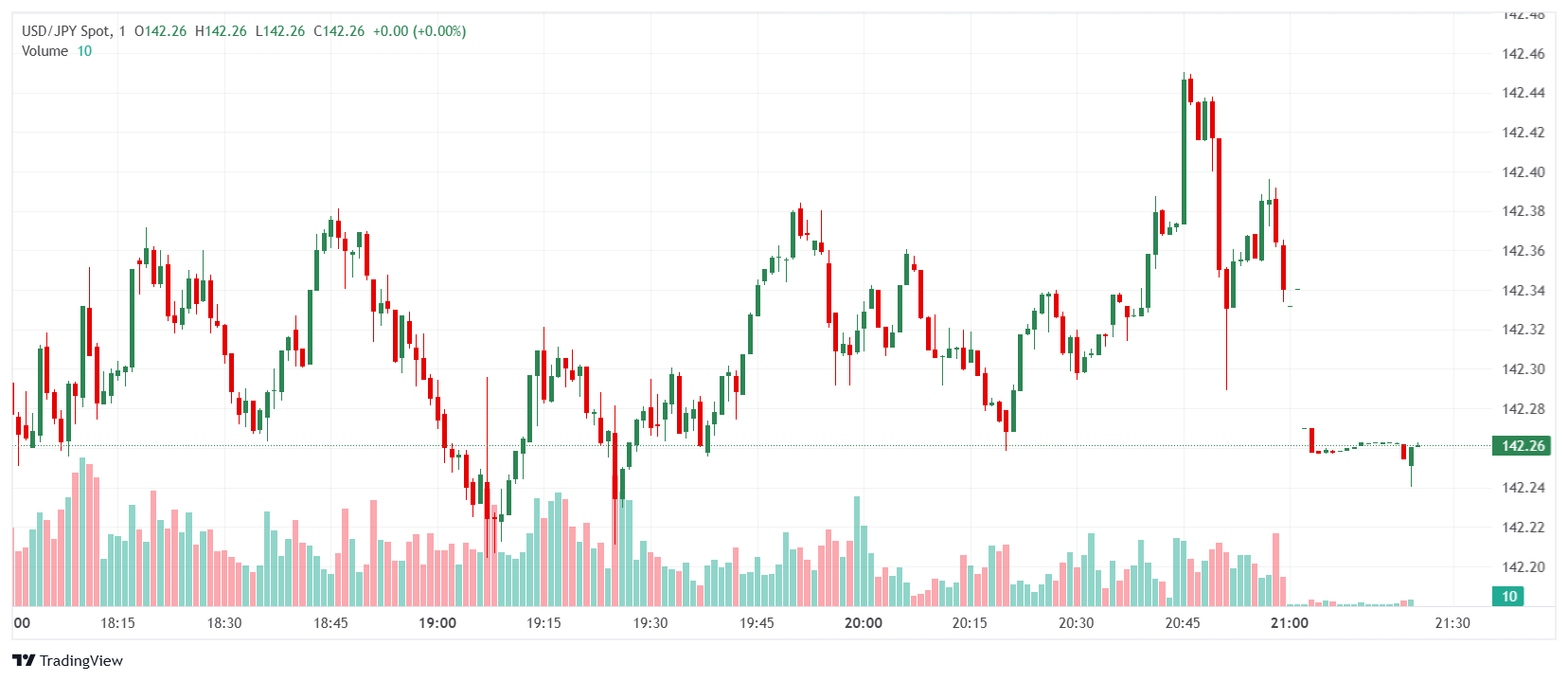
From a technical analysis perspective, the USD/JPY pair is showing bearish signals. Currently trading around 142.00, the pair has registered a slight gain of approximately 0.22% on the day but remains within a range defined by 141.96 and 142.76. While the Relative Strength Index (RSI) at 40.03 offers a neutral outlook and the MACD indicates a potential buy signal, the overall trend appears bearish. The 20-day Simple Moving Average (SMA) at 144.03, the 100-day SMA at 151.16, and the 200-day SMA at 149.95 all suggest selling pressure. The Stochastic RSI Fast at 77.40 and the Bull Bear Power indicator at -1.59 are both neutral. Furthermore, the 10-day Exponential Moving Average (EMA) at 142.80 and the 30-day EMA at 145.13 also point towards a sell signal. Immediate support is identified around 142.26, while resistance levels are clustered at 142.80, 142.87, and 144.02.
Daily Chart
Author

Patricio Martín
FXStreet
Patricio is an economist from Argentina passionate about global finance and understanding the daily movements of the markets.