USD/JPY continues sideways grind ahead of key data
- USD/JPY remains trapped in consolidation near key moving averages.
- Dollar-Yen traders are unlikely to find a reason to move from their perch through the midweek.
- Key inflation data looms large later this week on both sides of the Pacific.


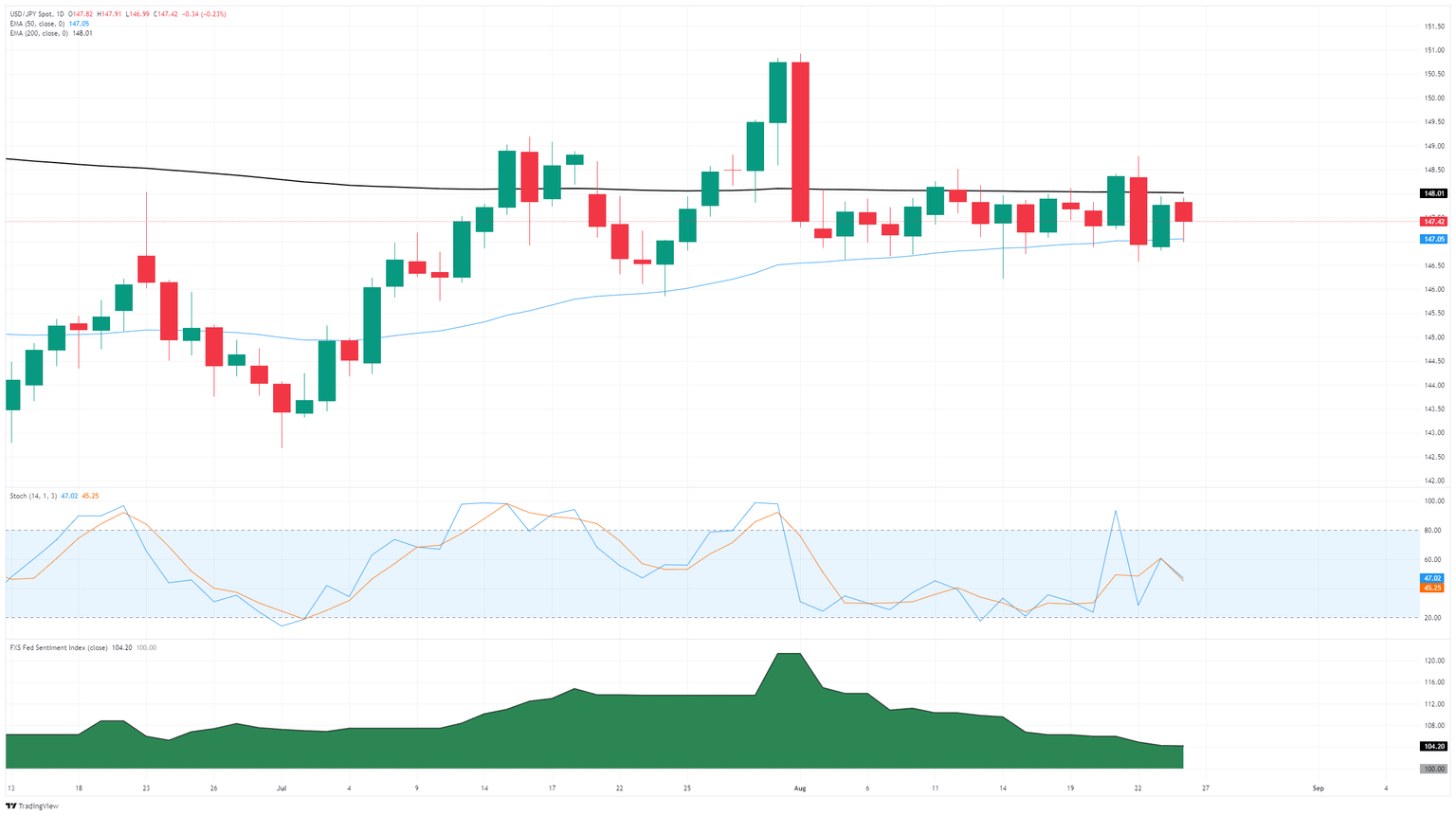
USD/JPY eased slightly on Tuesday, backsliding around one-quarter of one percent and keeping the pair hobbled just below the 148.00 handle. The pair has been adrift in a tight consolidation pattern since the beginning of August, and Yen traders are unlikely to find much of a reason to kick off a new trend ahead of key economic data.
US and Japanese inflation looms large this week
US Personal Consumption Expenditures Price Index (PCE) will land on markets on Friday. Investors will be increasingly apprehensive as the week progresses; global markets are broadly hoping for a fresh round of interest rate cuts from the Federal Reserve (Fed) starting in September, however rate cut hopes could easily be broken if tariff-led inflation impacts show up in headline inflation data too quickly.
Before that, Thursday will bring the latest round of Tokyo Consumer Price Index (CPI) inflation. Core monthly Tokyo CPI is expected to ease to 2.5%, and the Bank of Japan (BoJ) is burdened by (or benefits from, depending on your stance) inverse interest rate expectations from the Fed: the BoJ has been slow to raise already-low interest rates, citing concerns that Japanese inflation may be too low, despite rising above the BoJ’s 2% headline target for years.
USD/JPY price forecast
USD/JPY is holding attention just above the 200-hour moving average after managing to break through it around the 147.50 level, and now it is testing the 100-hour moving average at approximately 147.65. The pair’s bounce from the 50-day EMA adds a touch of optimism, and the market is keeping a close eye on 149.00 as resistance, while support is shaping up near 146.00. This intraday movement looks a lot like a cautious climb, where momentum is building but judgment calls hinge on whether the rally can clear and sustain above that 149.00 threshold.
On the daily chart, USD/JPY remains locked in neutral territory, ranging between key pivot points roughly between 146.20 on the downside and 148.76 on the upside. Technicians are watching the 146.20 mark closely, because a firm break would suggest the rebound from just under 140.00 has run its course and could open the door to a slide toward 142.67. On the flip side, a sustained push above 148.76 could see buyers eye another run back to last year’s high near 150.90. In short, daily trading appears to be in wait-and-see mode, tilting only when one of those thresholds gives way.
USD/JPY daily chart
Japanese Yen FAQs
The Japanese Yen (JPY) is one of the world’s most traded currencies. Its value is broadly determined by the performance of the Japanese economy, but more specifically by the Bank of Japan’s policy, the differential between Japanese and US bond yields, or risk sentiment among traders, among other factors.
One of the Bank of Japan’s mandates is currency control, so its moves are key for the Yen. The BoJ has directly intervened in currency markets sometimes, generally to lower the value of the Yen, although it refrains from doing it often due to political concerns of its main trading partners. The BoJ ultra-loose monetary policy between 2013 and 2024 caused the Yen to depreciate against its main currency peers due to an increasing policy divergence between the Bank of Japan and other main central banks. More recently, the gradually unwinding of this ultra-loose policy has given some support to the Yen.
Over the last decade, the BoJ’s stance of sticking to ultra-loose monetary policy has led to a widening policy divergence with other central banks, particularly with the US Federal Reserve. This supported a widening of the differential between the 10-year US and Japanese bonds, which favored the US Dollar against the Japanese Yen. The BoJ decision in 2024 to gradually abandon the ultra-loose policy, coupled with interest-rate cuts in other major central banks, is narrowing this differential.
The Japanese Yen is often seen as a safe-haven investment. This means that in times of market stress, investors are more likely to put their money in the Japanese currency due to its supposed reliability and stability. Turbulent times are likely to strengthen the Yen’s value against other currencies seen as more risky to invest in.
Author
Joshua Gibson
FXStreet
Joshua joins the FXStreet team as an Economics and Finance double major from Vancouver Island University with twelve years' experience as an independent trader focusing on technical analysis.