USD/JPY churns post-Fed rate cut, FOMC delivers 25 bps rate trim
- USD/JPY swirled around 153.20 after the Fed broadly met market expectations on November's rate call.
- The Fed delivered a follow-up quarter-point cut on Thursday; markets now bet on odds of a December three-peat.
- According to the CME FedWatch Tool, markets see over 66% odds of one last 25 bps rate trim in 2024.

USD/JPY roiled just north of the 153.00 handle on Thursday as investors grapple to find something motivational after the Federal Reserve (Fed) widely met market expecations and delivered a quarter-point interest rate cut on November 7. One more rate call meeting remains on the docket for 2024, and market participants remain cautiously optimistic that the Fed has at least one more 25 bps rate trim in the bag for the year.
According to the CME's FedWatch Tool, rate markets are pricing in about 66% odds of one last quarter-point rate drop in 2024.
more to come...
USD/JPY daily chart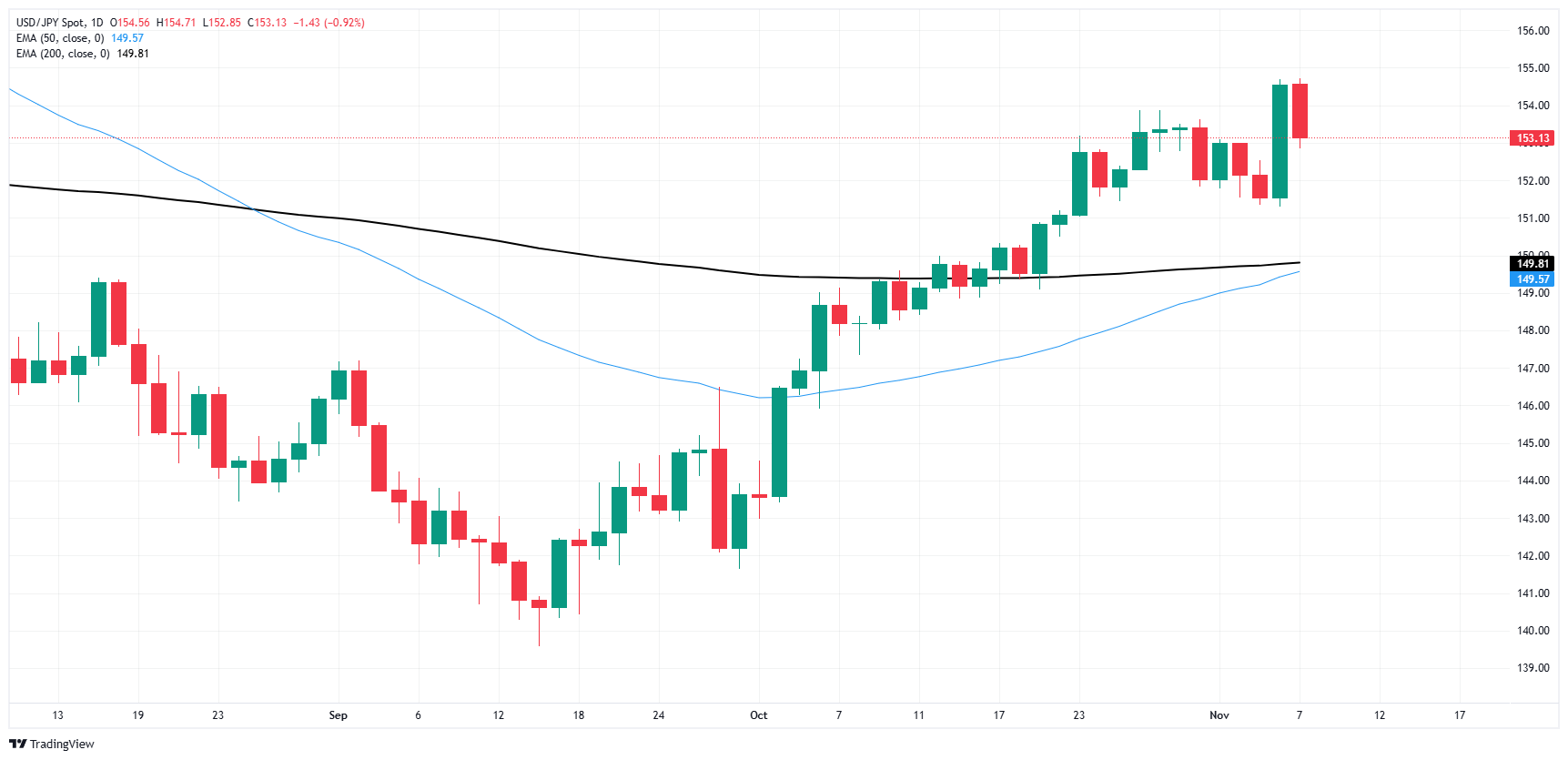
Japanese Yen FAQs
The Japanese Yen (JPY) is one of the world’s most traded currencies. Its value is broadly determined by the performance of the Japanese economy, but more specifically by the Bank of Japan’s policy, the differential between Japanese and US bond yields, or risk sentiment among traders, among other factors.
One of the Bank of Japan’s mandates is currency control, so its moves are key for the Yen. The BoJ has directly intervened in currency markets sometimes, generally to lower the value of the Yen, although it refrains from doing it often due to political concerns of its main trading partners. The BoJ ultra-loose monetary policy between 2013 and 2024 caused the Yen to depreciate against its main currency peers due to an increasing policy divergence between the Bank of Japan and other main central banks. More recently, the gradually unwinding of this ultra-loose policy has given some support to the Yen.
Over the last decade, the BoJ’s stance of sticking to ultra-loose monetary policy has led to a widening policy divergence with other central banks, particularly with the US Federal Reserve. This supported a widening of the differential between the 10-year US and Japanese bonds, which favored the US Dollar against the Japanese Yen. The BoJ decision in 2024 to gradually abandon the ultra-loose policy, coupled with interest-rate cuts in other major central banks, is narrowing this differential.
The Japanese Yen is often seen as a safe-haven investment. This means that in times of market stress, investors are more likely to put their money in the Japanese currency due to its supposed reliability and stability. Turbulent times are likely to strengthen the Yen’s value against other currencies seen as more risky to invest in.
Author

Joshua Gibson
FXStreet
Joshua joins the FXStreet team as an Economics and Finance double major from Vancouver Island University with twelve years' experience as an independent trader focusing on technical analysis.