USD/INR reaches fresh highs as Fed projects a slower pace of further rate cuts
- The Indian Rupee attracts some sellers to an all-time low in Thursday’s Asian session.
- Persistent demand for USD and a cautious outlook from Fed officials might add further pressure on the INR.
- The US weekly Initial Jobless Claims, Existing Home Sales, and final reading of Q3 GDP data will be released later on Thursday.

The Indian Rupee (INR) falls to near a fresh record low on Thursday. The renewed US Dollar (USD) demand from importers and foreign banks undermines the local currency. Furthermore, the US Federal Reserve (Fed) lowered its key interest rate by a quarter percentage point at its December meeting on Wednesday and also projected a slower pace of cuts in 2025. This, in turn, boosts the Greenback against the INR.
The Indian equity markets mirrored a drop on Wall Street overnight, following the Federal Reserve's indication of a slower pace of rate cuts next year. Foreign outflows also continued to put pressure on the Indian Rupee against the US Dollar. The Nifty 50 and the BSE Sensex indices opened lower around 23,880 and 79,029, respectively, on Thursday. This marks the fourth consecutive session of decline, driven by losses in the banking, financial services, metals, and tech sectors.
Nonetheless, the downside of the INR might be limited as the Reserve Bank of India (RBI) is likely to intervene in the market to prevent excess volatility. Traders will keep an eye on the US weekly Initial Jobless Claims, Existing Home Sales, and final reading of Gross Domestic Product Annualized for the third quarter (Q3), which are due later on Thursday.
Indian Rupee remains weak after the Fed hawkish rate cut
- Traders are exercising caution ahead of Friday's decision on key lending rates by the Chinese central bank, India's top trading partner. Additionally, there is growing uncertainty surrounding potential policy changes and tariff shifts from the incoming US administration, further influencing market sentiment.
- A rise in Gold imports that widened India's trade deficit to a record in November and pushed the INR to a record low was due to an error in calculation, Bloomberg News reported on Wednesday, citing people with knowledge of the matter.
- “There is pressure on the rupee due to the demand for dollars from foreign clients. However, the rupee is performing better than other currencies. The depreciation is gradual. Now it is expected to trade in a narrow range and 85 per dollar level will be protected,” said the treasury head at a state-owned bank.
- On Wednesday, the Fed reduced the Federal Funds Rate by 25 basis points (bps) to a target range of 4.25%-4.50%, back to the level where it was in December 2022.
- The Fed expects to continue cutting rates next year, although it is now penciling in two rate cuts, down from the four it had forecast in September, according to the Summary of Economic Projections, or “dot plot”.
- The dot plot saw the committee lower its expected unemployment rate this year to 4.2% and raise its projection for 2024 Gross Domestic Product growth to 2.5%.
USD/INR’s broader trend remains constructive
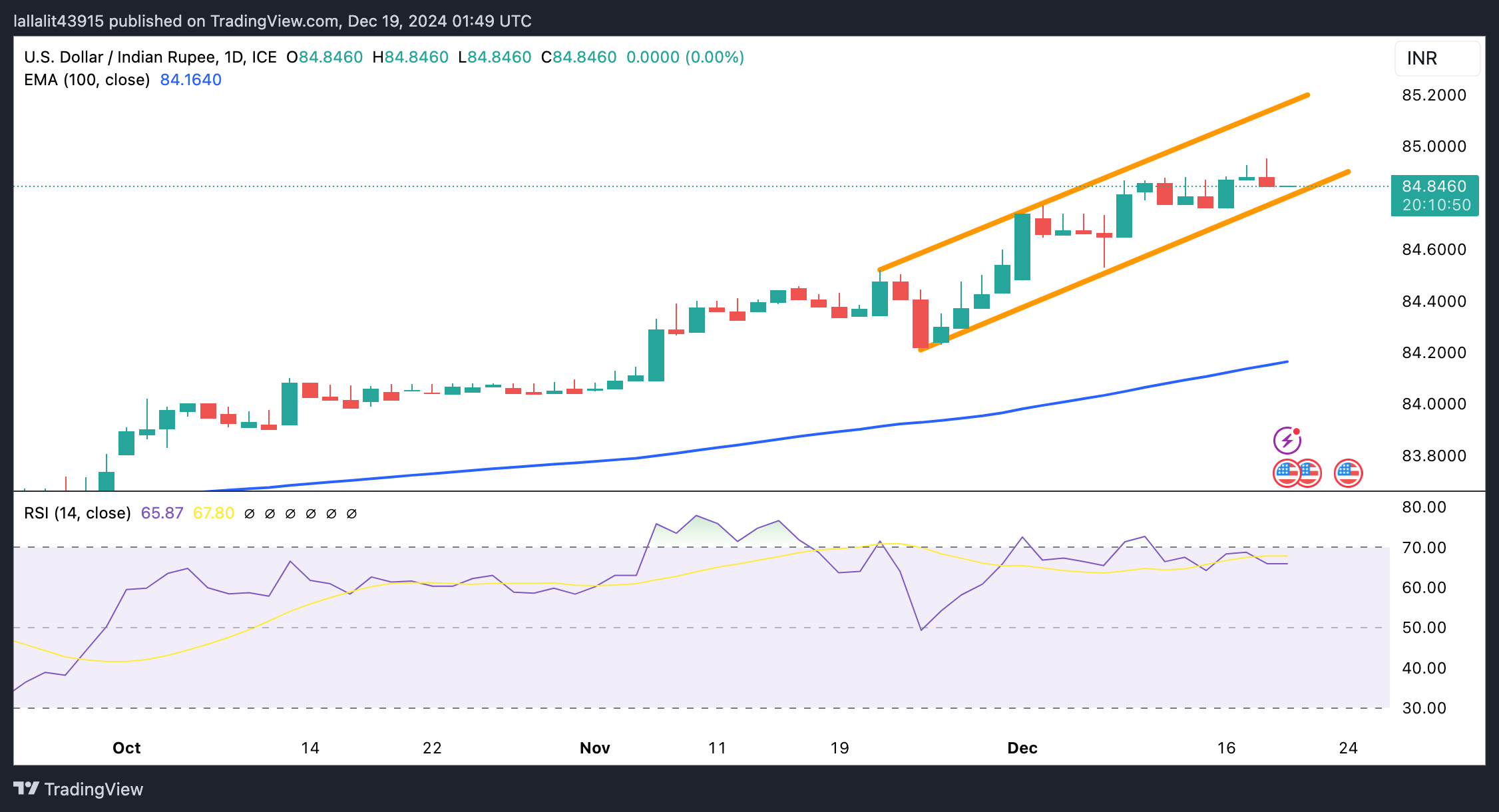
The Indian Rupee trades on a weaker note on the day. The USD/INR pair maintains a strong uptrend on the daily chart, with the price holding above the key 100-day Exponential Moving Average (EMA). The path of least resistance is to the upside as the 14-day Relative Strength Index (RSI) is above the midline near 65.85, suggesting bullish pressure is present.
The ascending trend channel and the psychological level of 85.00 appear to be a tough nut to crack for bulls. The breakout above this level could see a rally to the next upside target at 85.50.
On the other hand, the initial support level emerges at 84.82, the lower boundary of the trend channel. A breach of the mentioned level could expose 84.22, the low of November 25. Bearish candlesticks could see a drop to 84.16, the 100-day EMA.
Economic Indicator
Gross Domestic Product Annualized
The real Gross Domestic Product (GDP) Annualized, released quarterly by the US Bureau of Economic Analysis, measures the value of the final goods and services produced in the United States in a given period of time. Changes in GDP are the most popular indicator of the nation’s overall economic health. The data is expressed at an annualized rate, which means that the rate has been adjusted to reflect the amount GDP would have changed over a year’s time, had it continued to grow at that specific rate. Generally speaking, a high reading is seen as bullish for the US Dollar (USD), while a low reading is seen as bearish.
Read more.Next release: Thu Dec 19, 2024 13:30
Frequency: Quarterly
Consensus: 2.8%
Previous: 2.8%
Source: US Bureau of Economic Analysis
The US Bureau of Economic Analysis (BEA) releases the Gross Domestic Product (GDP) growth on an annualized basis for each quarter. After publishing the first estimate, the BEA revises the data two more times, with the third release representing the final reading. Usually, the first estimate is the main market mover and a positive surprise is seen as a USD-positive development while a disappointing print is likely to weigh on the greenback. Market participants usually dismiss the second and third releases as they are generally not significant enough to meaningfully alter the growth picture.
Author

Lallalit Srijandorn
FXStreet
Lallalit Srijandorn is a Parisian at heart. She has lived in France since 2019 and now becomes a digital entrepreneur based in Paris and Bangkok.