|

USD/INR technical analysis: Struggles between 50, 100-day SMA

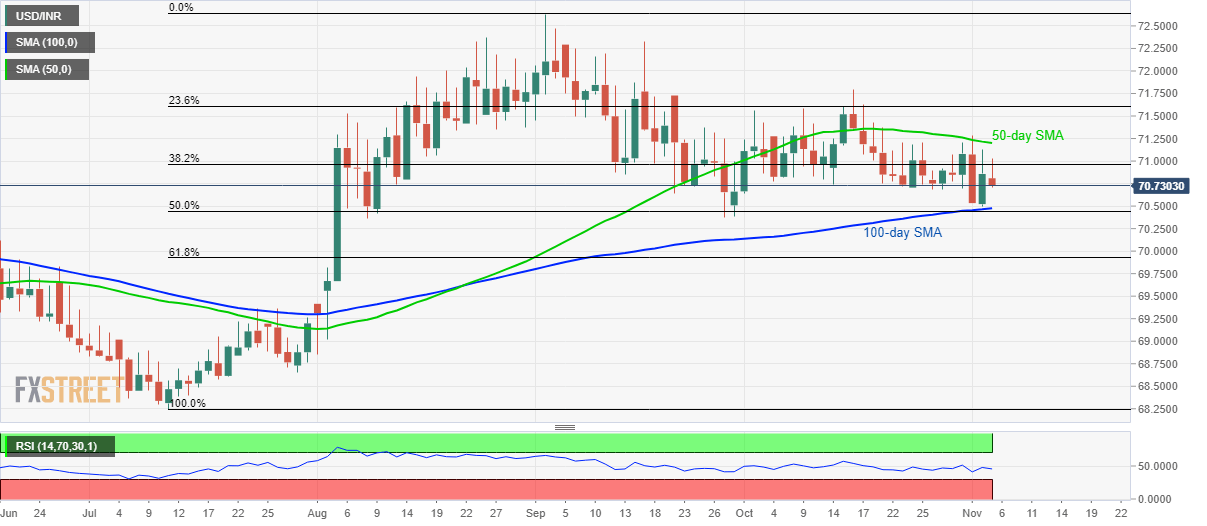
  • USD/INR witnesses pullback from 38.2% Fibonacci retracement.
  • 50% Fibonacci retracement, 70.36/35 add to support.

Following its trading range between the key moving averages, USD/INR declines to 70.72 while heading into the European session on Tuesday.

The quote recently took a U-turn from 38.2% Fibonacci retracement of July-September upside, at 70.96, indicating another visit to 100-day Simple Moving Average (SMA) level of 70.47. Also increasing the strength of the support is 50% Fibonacci retracement.

It should, however, be noted that pair’s declines below 70.47 will aim for 70.36/35 support-zone including lows marked since early August.

During pair’s extended weakness below 70.35, 61.8% Fibonacci retracement level of 69.92 and late-July highs close to 69.36 will become sellers’ favourites.

Meanwhile, pair’s sustained rise past-50-day SMA level of 71.20, can target October high surrounding 71.80 whereas 72.30 and 72.65 could please bulls afterward.

USD/INR daily chart
Trend: sideways

additional important levels

Overview
Today last price70.721
Today Daily Change-0.1355
Today Daily Change %-0.19%
Today daily open70.8565
 
Trends
Daily SMA2071.0006
Daily SMA5071.2158
Daily SMA10070.4638
Daily SMA20070.1961
 
Levels
Previous Daily High71.125
Previous Daily Low70.4975
Previous Weekly High71.2825
Previous Weekly Low70.5329
Previous Monthly High71.79
Previous Monthly Low70.6425
Daily Fibonacci 38.2%70.8853
Daily Fibonacci 61.8%70.7372
Daily Pivot Point S170.5277
Daily Pivot Point S270.1988
Daily Pivot Point S369.9002
Daily Pivot Point R171.1552
Daily Pivot Point R271.4538
Daily Pivot Point R371.7827

Author

Anil Panchal

Anil Panchal

FXStreet

Anil Panchal has nearly 15 years of experience in tracking financial markets. With a keen interest in macroeconomics, Anil aptly tracks global news/updates and stays well-informed about the global financial moves and their implications.


More from Anil Panchal
Share:

Editor's Picks

EUR/USD weakens as US jobs data trims Fed rate cut bets

The EUR/USD pair trades in negative territory for the third consecutive day near 1.1860 during the early European session on Thursday. Traders will keep an eye on the US weekly Initial Jobless Claims data. On Friday, the attention will shift to the US Consumer Price Index inflation report. 

GBP/USD bullish outlook prevails above 1.3600, UK GDP data looms

The GBP/USD pair gains ground near 1.3635, snapping the two-day losing streak during the early European session on Thursday. The preliminary reading of UK Gross Domestic Product for the fourth quarter will be closely watched later on Thursday. The UK economy is estimated to grow 0.2% QoQ in Q4, versus 0.1% in Q1. 

Gold remains on the defensive below two-week top; lacks bearish conviction amid mixed cues

Gold sticks to modest intraday losses through the Asian session on Thursday, though it lacks follow-through selling and remains close to a nearly two-week high, touched the previous day. The commodity currently trades above the $5,070 level, down just over 0.20% for the day, amid mixed cues.

UK GDP set to post weak growth as markets rise bets on March rate cut

Markets will be watching closely on Thursday, when the United Kingdom’s Office for National Statistics will release the advance estimate of Q4 Gross Domestic Product. If the data land in line with consensus, the UK economy would have continued to grow at an annualised pace of 1.2%, compared with 1.3% recorded the previous year. 

The market trades the path not the past

The payroll number did not just beat. It reset the tone. 130,000 vs. 65,000 expected, with a 35,000 whisper. 79 of 80 economists leaning the wrong way. Unemployment and underemployment are edging lower. For all the statistical fog around birth-death adjustments and seasonal quirks, the core message was unmistakable. The labour market is not cracking.

XRP sell-off deepens amid weak retail interest, risk-off sentiment

Ripple (XRP) is edging lower around $1.36 at the time of writing on Wednesday, weighed down by low retail interest and macroeconomic uncertainty, which is accelerating risk-off sentiment.