USD/INR scales fresh multi-month high amid oil rally, Middle East tensions, and steady US Dollar
- USD/INR trades near 86.57, marking its strongest level since April 9 as safe-haven flows lift the Dollar.
- Iran-Israel conflict intensifies; Trump demands Iran’s unconditional surrender, fueling global risk-off mood.
- RBI signals scope for more rate cuts if inflation undershoots; India’s Q4 GDP expands 7.4% while jobless rate ticks higher.
- A technical breakout above the triangle pattern points to further upside, with bulls eyeing the 87.00 mark next.

The Indian Rupee (INR) weakens against the US Dollar (USD) on Tuesday, giving up Monday’s modest rebound as heightened geopolitical tensions in the Middle East, stronger Crude Oil prices, and a resilient Greenback dampen sentiment ahead of the Federal Reserve’s (Fed) key interest rate decision.
The USD/INR pair climbed to an intraday high of 86.59 — a level last seen on April 9 — and was trading around 86.57 at the time of writing, up nearly 0.58% on the day. The US Dollar edged higher despite mixed Retail Sales figures and disappointing Industrial Production data.
Tensions between Iran and Israel flared further on Tuesday after Israel reportedly assassinated Iran’s wartime chief of staff, Ali Shadmani — the second senior commander killed within days. In response, Iran launched a new wave of missile and drone attacks targeting Tel Aviv and Herzliya, triggering air-raid sirens and chaos in Tehran. Adding to the sense of urgency, former US President Donald Trump called for an immediate civilian evacuation of Tehran and insisted he wants a “real end” to the conflict rather than a temporary ceasefire. The heightened geopolitical risk has fuelled risk-off flows across global markets.
Market Movers: Risk-off flows, steady US Dollar, and FII outflows pressure the Rupee
- The Rupee has now dropped to its weakest level in over two months, reflecting a steady downtrend so far this month. It has depreciated about 0.77% in June, widening its year-to-date decline to roughly 0.73% as persistent oil strength and global market jitters continue to weigh on the currency.
- According to Jateen Trivedi, Vice President and Research Analyst for Commodities and Currencies at LKP Securities, the Rupee remains vulnerable amid the escalating Middle East conflict. “Weakness in capital markets signals potential FII outflows, adding to Rupee pressure,” he noted in a report published by Business Standard.
- Equity markets mirrored the cautious mood. Broad-based selling dragged the BSE Sensex lower by 212.85 points to settle at 81,583.30, while the NSE Nifty shed 93.10 points to close at 24,853.40. Foreign institutional investors (FIIs) were net sellers on Monday, pulling out ₹2,539.42 crore worth of equities, according to exchange data.
- Reserve Bank of India Governor Sanjay Malhotra hinted that there could be scope for additional rate cuts if inflation softens more than anticipated. Speaking to Business Standard in an interview published Tuesday, Malhotra said the central bank remains focused on striking the right balance between supporting growth and keeping price pressures in check. “It wouldn’t be appropriate for me to pre-empt the Monetary Policy Committee, but if inflation stays below our projections, it will create more room for policy easing,” he noted.
- India’s economy remains remarkably resilient despite persistent global challenges, with real GDP growing by 7.4% in the fourth quarter of FY25. This robust performance lifted the overall growth for the fiscal year to 6.5%, comfortably surpassing earlier estimates, according to the latest CareEdge Economic Pathways report. On the fiscal front, the central government managed to keep the FY25 deficit at 4.8% of GDP. Despite a slight dip in direct tax collections, strong corporate tax receipts and restrained expenditure helped bridge the gap.
- India’s unemployment rate climbed to 5.6% in May 2025, up from 5.1% in April, according to the latest Periodic Labour Force Survey (PLFS) released by the Ministry of Statistics and Programme Implementation on Monday. This marks the second consecutive monthly report covering both urban and rural labour trends. Previously, employment data was shared quarterly for urban centres and only annually for nationwide estimates.
- US President Donald Trump ramped up his rhetoric, demanding Iran’s “unconditional surrender” while claiming that US forces now have “complete control” of Iranian airspace. He emphasized that his goal is a definitive end to the conflict, rather than another temporary ceasefire, underscoring Washington’s continued military presence in the region.
- Meanwhile, the US Dollar Index (DXY), which tracks the Greenback against a basket of six major currencies, remains firm above the 98.00 mark, trading around 98.39 after slipping to 97.68 on Monday due to weaker-than-expected factory data. The Empire State Manufacturing Index plummeted to -16.0 in June, down from -9.2 in May, falling significantly short of market forecasts and signaling a deeper contraction in regional factory activity.
- Latest figures from the United States painted a mixed macroeconomic picture. Retail sales dropped by 0.9% month-over-month in May 2025 — the sharpest decline in four months — as consumers curbed spending ahead of looming tariffs. However, the Retail Sales Control Group, which contributes to Gross Domestic Product (GDP), surprised to the upside with a 0.4% increase. Meanwhile, US industrial production slipped 0.2% in May, falling short of market forecasts for a modest increase, highlighting pockets of weakness in the manufacturing sector.
- Meanwhile, the Federal Reserve is still anticipated to hold rates steady at its policy meeting on Wednesday, with updated projections and Chair Jerome Powell’s comments in focus for guidance on the economic outlook.
Technical Outlook: Breakout targets 87.00 as momentum builds
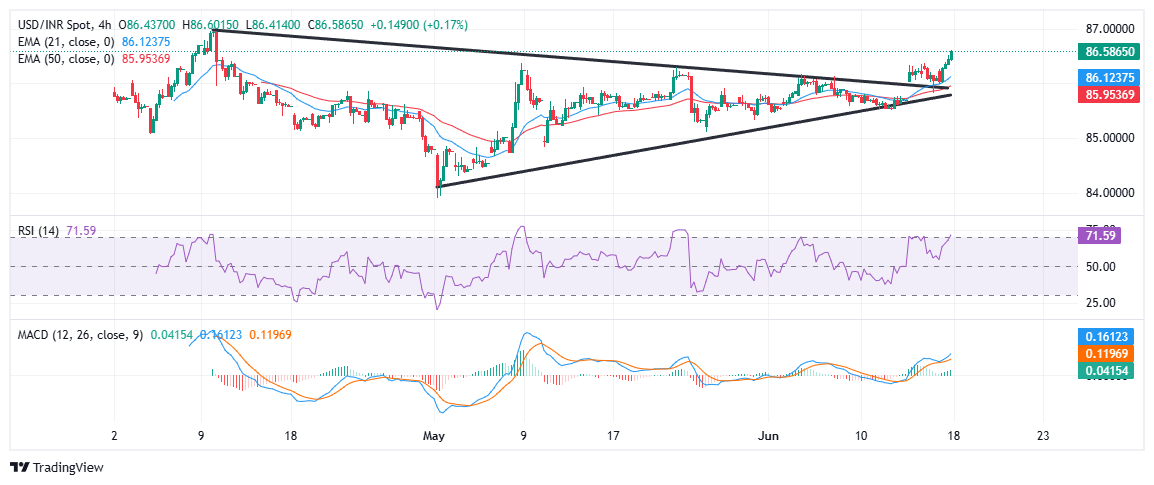
On the technical front, USD/INR has broken above a symmetrical triangle formation on the 4-hour chart, hinting at a continuation of the recent bullish momentum. The pair holds well above the 21-period EMA near 86.07, supporting the near-term positive bias. Momentum indicators remain encouraging, with the RSI hovering near 66 — below overbought territory — and the MACD histogram and signal lines building further upside traction. Sustained trade above the 86.20–86.30 zone could clear the path for a move toward the psychological 87.00 handle.
RBI FAQs
The role of the Reserve Bank of India (RBI), in its own words, is "..to maintain price stability while keeping in mind the objective of growth.” This involves maintaining the inflation rate at a stable 4% level primarily using the tool of interest rates. The RBI also maintains the exchange rate at a level that will not cause excess volatility and problems for exporters and importers, since India’s economy is heavily reliant on foreign trade, especially Oil.
The RBI formally meets at six bi-monthly meetings a year to discuss its monetary policy and, if necessary, adjust interest rates. When inflation is too high (above its 4% target), the RBI will normally raise interest rates to deter borrowing and spending, which can support the Rupee (INR). If inflation falls too far below target, the RBI might cut rates to encourage more lending, which can be negative for INR.
Due to the importance of trade to the economy, the Reserve Bank of India (RBI) actively intervenes in FX markets to maintain the exchange rate within a limited range. It does this to ensure Indian importers and exporters are not exposed to unnecessary currency risk during periods of FX volatility. The RBI buys and sells Rupees in the spot market at key levels, and uses derivatives to hedge its positions.
Author

Vishal Chaturvedi
FXStreet
I am a macro-focused research analyst with over four years of experience covering forex and commodities market. I enjoy breaking down complex economic trends and turning them into clear, actionable insights that help traders stay ahead of the curve.