USD/INR edges higher on persistent US Dollar strength, US PCE data looms
- The Indian Rupee softens in Friday’s early European session.
- More cautious stance from the Fed weigh on the INR, but lower crude oil prices and RBI’s intervention might cap its upside.
- The US Core PCE Price Index report will be the highlight on Friday.

The Indian Rupee (INR) edges lower on Friday after depreciating to an all-time low of 85.12 in the previous session. A hawkish rate cut from the US Federal Reserve (Fed) sparks the US Dollar (USD) broadly and exerts some selling pressure on emerging market currencies, including the INR.
However, the decline in crude oil prices might help limit the local currency’s losses as India is the world's third-largest oil consumer. Additionally, the Reserve Bank of India (RBI) could intervene in the market to prevent excess volatility. Looking ahead, traders will focus on the US Core Personal Consumption Expenditures (PCE) Price Index data, which is due later on Friday. Also, the US Michigan Consumer Sentiment Index for December will be released.
Indian Rupee loses ground amid multiple challenges
- "We expect the rupee to trade with a negative bias on global equities following a hawkish Fed and a strong dollar. Concerns over a slowdown in the economy may further weigh on the rupee," said Anuj Choudhary Research Analyst at Mirae Asset Sharekhan.
- India's foreign exchange reserves fell in nine out of the past 10 weeks, hitting a multi-month low. The reserves had been falling ever since reserves touched an all-time high of USD 704.89 billion in September, and now last week the forex stood at USD 654.857 billion, according to the RBI data.
- Foreign investors also contributed to the INR's woes, selling nearly $500 million worth of Indian stocks on Thursday.
- The US Gross Domestic Product (GDP) grew at a 3.1% annualized rate in the third quarter (GDP), compared to a previous projection of 2.8%, the third estimate of the figures from the Bureau of Economic Analysis showed Thursday.
- The weekly Initial Jobless Claims in the US declined to 220,000 in the week ending December 14, compared to the previous week's print of 242,000, and came in below the market consensus of 230,000.
USD/INR maintains a strong uptrend in the longer term
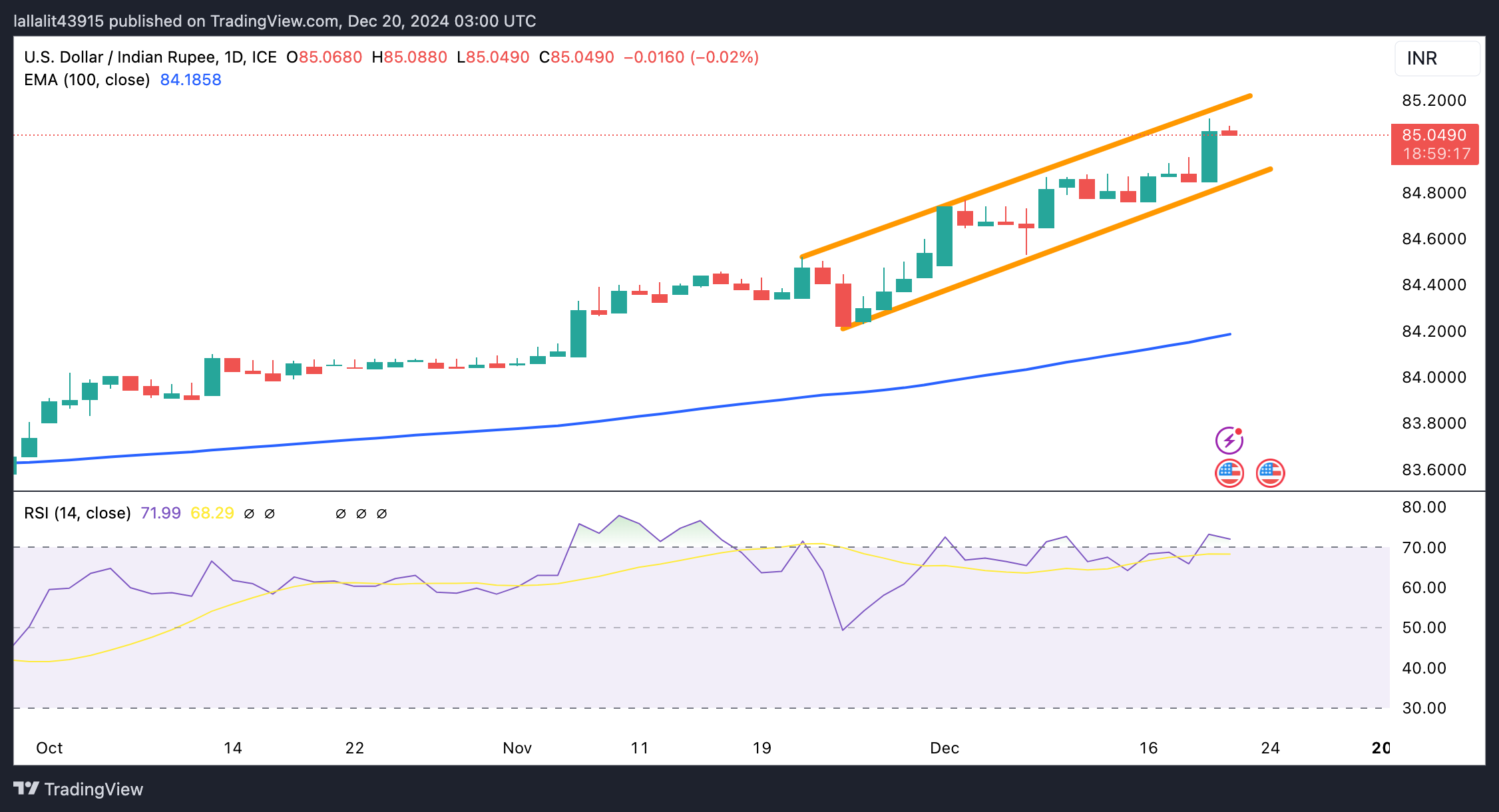
The Indian Rupee trades softer on the day. The constructive outlook of the USD/INR pair remains intact on the daily chart as the pair holds above the key 100-day Exponential Moving Average (EMA). Nonetheless, the 14-day Relative Strength Index (RSI) is over the midline near 70.95, suggesting an overbought condition. This means that additional consolidation should not be ruled out before positioning for any short-term USD/INR appreciation.
The ascending trend channel at 85.20 acts as an immediate resistance level for USD/INR. A decisive break above this level could see a rally to 85.50.
On the flip side, the first downside target is seen at 84.86, the lower boundary of the trend channel. A breach of this level could pave the way to 84.16, the 100-day EMA.
Fed FAQs
Monetary policy in the US is shaped by the Federal Reserve (Fed). The Fed has two mandates: to achieve price stability and foster full employment. Its primary tool to achieve these goals is by adjusting interest rates. When prices are rising too quickly and inflation is above the Fed’s 2% target, it raises interest rates, increasing borrowing costs throughout the economy. This results in a stronger US Dollar (USD) as it makes the US a more attractive place for international investors to park their money. When inflation falls below 2% or the Unemployment Rate is too high, the Fed may lower interest rates to encourage borrowing, which weighs on the Greenback.
The Federal Reserve (Fed) holds eight policy meetings a year, where the Federal Open Market Committee (FOMC) assesses economic conditions and makes monetary policy decisions. The FOMC is attended by twelve Fed officials – the seven members of the Board of Governors, the president of the Federal Reserve Bank of New York, and four of the remaining eleven regional Reserve Bank presidents, who serve one-year terms on a rotating basis.
In extreme situations, the Federal Reserve may resort to a policy named Quantitative Easing (QE). QE is the process by which the Fed substantially increases the flow of credit in a stuck financial system. It is a non-standard policy measure used during crises or when inflation is extremely low. It was the Fed’s weapon of choice during the Great Financial Crisis in 2008. It involves the Fed printing more Dollars and using them to buy high grade bonds from financial institutions. QE usually weakens the US Dollar.
Quantitative tightening (QT) is the reverse process of QE, whereby the Federal Reserve stops buying bonds from financial institutions and does not reinvest the principal from the bonds it holds maturing, to purchase new bonds. It is usually positive for the value of the US Dollar.
Author

Lallalit Srijandorn
FXStreet
Lallalit Srijandorn is a Parisian at heart. She has lived in France since 2019 and now becomes a digital entrepreneur based in Paris and Bangkok.