USD/INR flat lines as RBI keeps repo rates unchanged at 6.50%
- The Indian Rupee trades flat in Wednesday’s early European session.
- RBI’s MPC decided to keep the repo rate unchanged at 6.5% in its October meeting on Wednesday.
- Lower crude oil prices and potential RBI’s foreign exchange intervention might underpin the INR.
- Investors await the FOMC Minutes, which is due on Wednesday.


The Indian Rupee (INR) trades on a flat note on Wednesday. The Reserve Bank of India (RBI) Governor Shaktikanta Das announced its fourth bi-monthly monetary policy statement on Thursday. The Indian central bank maintained the status quo on the repo rate at 6.50% for the tenth consecutive meeting. However, the RBI Monetary Policy Committee (MPC) changed the policy stance to neutral from withdrawal of accommodation. The INR flat lines in immediate reaction to the rate decision.
A decline in crude oil prices, stronger Asian currencies and likely foreign exchange intervention from the RBI might provide some support to the INR. On the other hand, outflows from local equities and renewed US Dollar (USD) demand might cap the upside for the local currency. Later on Wednesday, the Federal Reserve's (Fed) September meeting minutes will be in the spotlight.
Daily Digest Market Movers: Indian Rupee remains steady after RBI rate decision
- RBI kept CPI Inflation estimate for FY25 unchanged at 4.5%, while maintain the Gross Domestic Product (GDP) growth estimates for FY25 at 7.2%.
- RBI Governor Shaktikanta Das stated that India’s growth story remains intact. There is a need for greater vigilance on inflation.
- RBI Deputy Governor Michael Patra said that the central bank wants to see off the current hump in inflation before considering next move on rates.
- RBI kept CPI Inflation estimate for FY25 unchanged at 4.5%, while maintaining the Gross Domestic Product (GDP) growth estimates for FY25 at 7.2%.
- “A rise in oil prices coinciding with dollar strength has increased inflation risks in India and put pressure on the rupee, such that the RBI has had to undertake significant FX intervention in recent days," noted J.P. Morgan analysts on Tuesday.
- India’s foreign exchange reserves rose to a record-breaking $704.89 billion as of September 27, marking an increase of $12.5 billion, according to the RBI.
- Federal Reserve Vice Chair Philip Jefferson said on Tuesday that risks to the central bank’s employment and inflation goals are now closer to equal, per Bloomberg.
- Boston Fed President Susan Collins noted on Tuesday that with inflation trends growing weaker, it is very probable that the Fed can deliver more interest rate cuts.
- The markets have priced in nearly an 87% chance of 25 basis points (bps) Fed rate cuts in November, up from 31.1% last week, according to the CME FedWatch Tool.
Technical Analysis: USD/INR’s positive outlook prevails
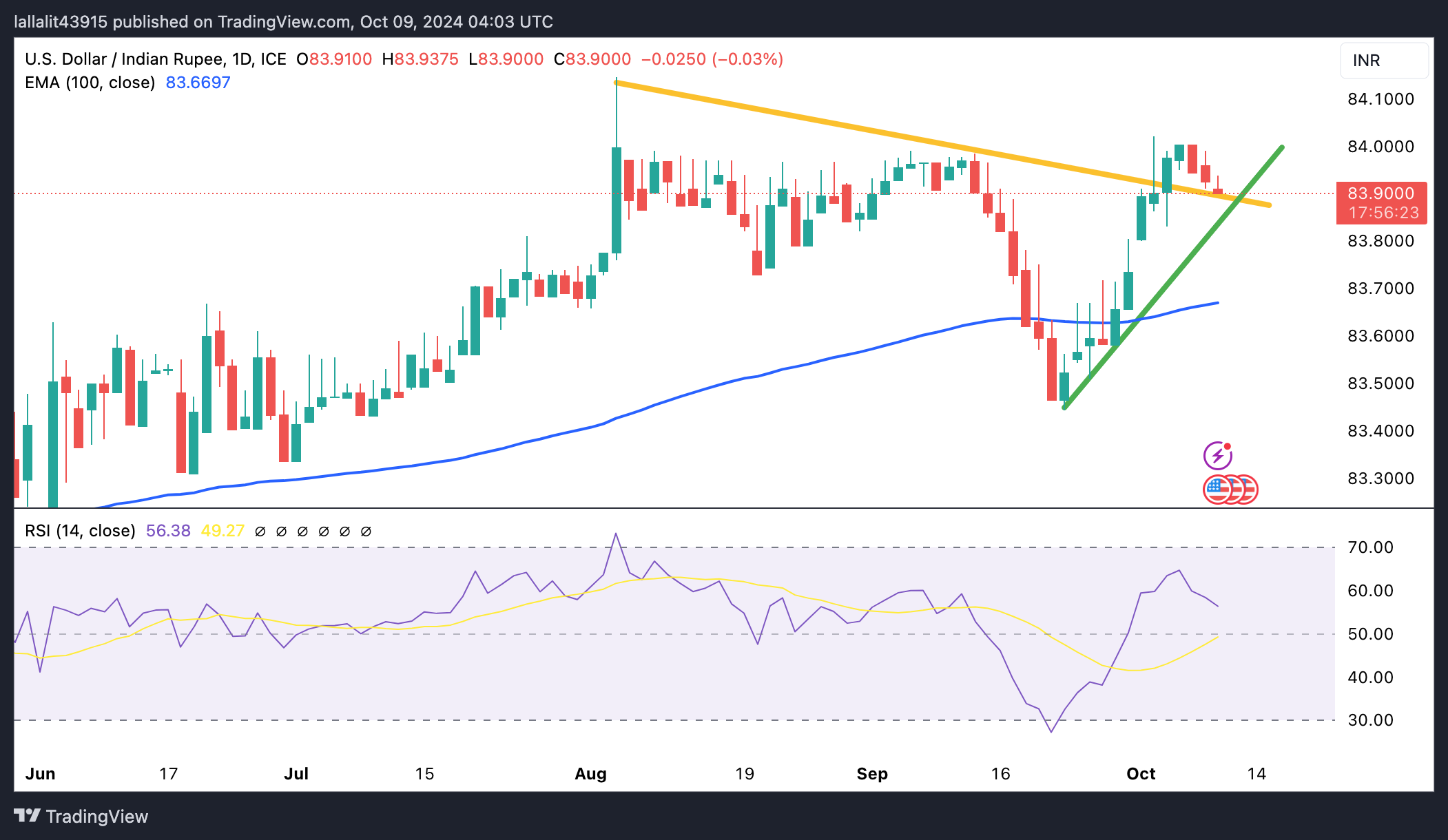
The Indian Rupee trades flat on the day. The USD/INR pair keeps the bullish vibe above the descending trend line and the key 100-day Exponential Moving Average (EMA) on the daily timeframe. The path of least resistance level appears to the upside as the 14-day Relative Strength Index (RSI) is located above the midline near 55.70.
The key resistance level for USD/INR emerges near the upper boundary of the rectangle and a psychological mark of 84.00. Further north, the next upside barrier is seen at the all-time high of 84.15, followed by 84.50.
On the flip side, the resistance-turned-support level at 83.90 acts as an initial support level for USD/INR. Extended losses could expose the 100-day EMA at 83.67. Any follow-through selling could see a drop to 83.00, representing the round mark and the low of May 24.
Interest rates FAQs
Interest rates are charged by financial institutions on loans to borrowers and are paid as interest to savers and depositors. They are influenced by base lending rates, which are set by central banks in response to changes in the economy. Central banks normally have a mandate to ensure price stability, which in most cases means targeting a core inflation rate of around 2%. If inflation falls below target the central bank may cut base lending rates, with a view to stimulating lending and boosting the economy. If inflation rises substantially above 2% it normally results in the central bank raising base lending rates in an attempt to lower inflation.
Higher interest rates generally help strengthen a country’s currency as they make it a more attractive place for global investors to park their money.
Higher interest rates overall weigh on the price of Gold because they increase the opportunity cost of holding Gold instead of investing in an interest-bearing asset or placing cash in the bank. If interest rates are high that usually pushes up the price of the US Dollar (USD), and since Gold is priced in Dollars, this has the effect of lowering the price of Gold.
The Fed funds rate is the overnight rate at which US banks lend to each other. It is the oft-quoted headline rate set by the Federal Reserve at its FOMC meetings. It is set as a range, for example 4.75%-5.00%, though the upper limit (in that case 5.00%) is the quoted figure. Market expectations for future Fed funds rate are tracked by the CME FedWatch tool, which shapes how many financial markets behave in anticipation of future Federal Reserve monetary policy decisions.
Author
Lallalit Srijandorn
FXStreet
Lallalit Srijandorn is a Parisian at heart. She has lived in France since 2019 and now becomes a digital entrepreneur based in Paris and Bangkok.