USD/INR jumps ahead of Fed rate decision
- The Indian Rupee loses ground in Thursday’s early Europan session.
- The strengthening of the USD and higher bond yields might cap the INR’s upside.
- The US Fed interest rate decision will take center stage on Thursday.

The Indian Rupee (INR) loses momentum on Thursday. A rally in the US Dollar (USD) and higher bond yields after Donald Trump’s victory in the US presidential elections support the pair. Market participants expect the INR to trade in the range on Thursday as the Reserve Bank of India (RBI) is expected to intervene in the market by selling the USD to avoid excess volatility.
Meanwhile, persistent foreign fund outflows amid bond and foreign exchange volatility could exert some selling pressure on the INR in the near term. Investors will closely monitor the US Federal Reserve (Fed) meeting on Thursday, which is expected to cut interest rates by 25 basis points (bps). Also, the US weekly Initial Jobless Claims will be released.
Daily Digest Market Movers: Indian Rupee edges lower, with all eyes on Fed meeting
- “The rupee was trading in a narrow range for the past two years, and was a bit overvalued too. But now given that the dollar index is rising and other Asian currencies are depreciating, there will be an impact on the rupee too,” noted Gopal Tripathi, head of treasury and capital markets, Jana Small Finance Bank.
- The HSBC India Services PMI rose to 58.5 in October from 57.7 in September, exceeding a preliminary estimate of 58.3.
- "During October, the Indian services sector experienced strong expansions in output and consumer demand, as well as job creation," noted Pranjul Bhandari, chief India economist at HSBC.
- A narrow majority of economists in a Reuters poll expected the RBI to cut rates by 25 bps to 6.25% in December.
- Financial markets are now pricing in nearly a 98% possibility of a quarter point reduction and near 70% odds of a similar-sized move in December, according to CME's FedWatch tool. However, traders have begun to trim bets for the number of rate cuts expected next year.
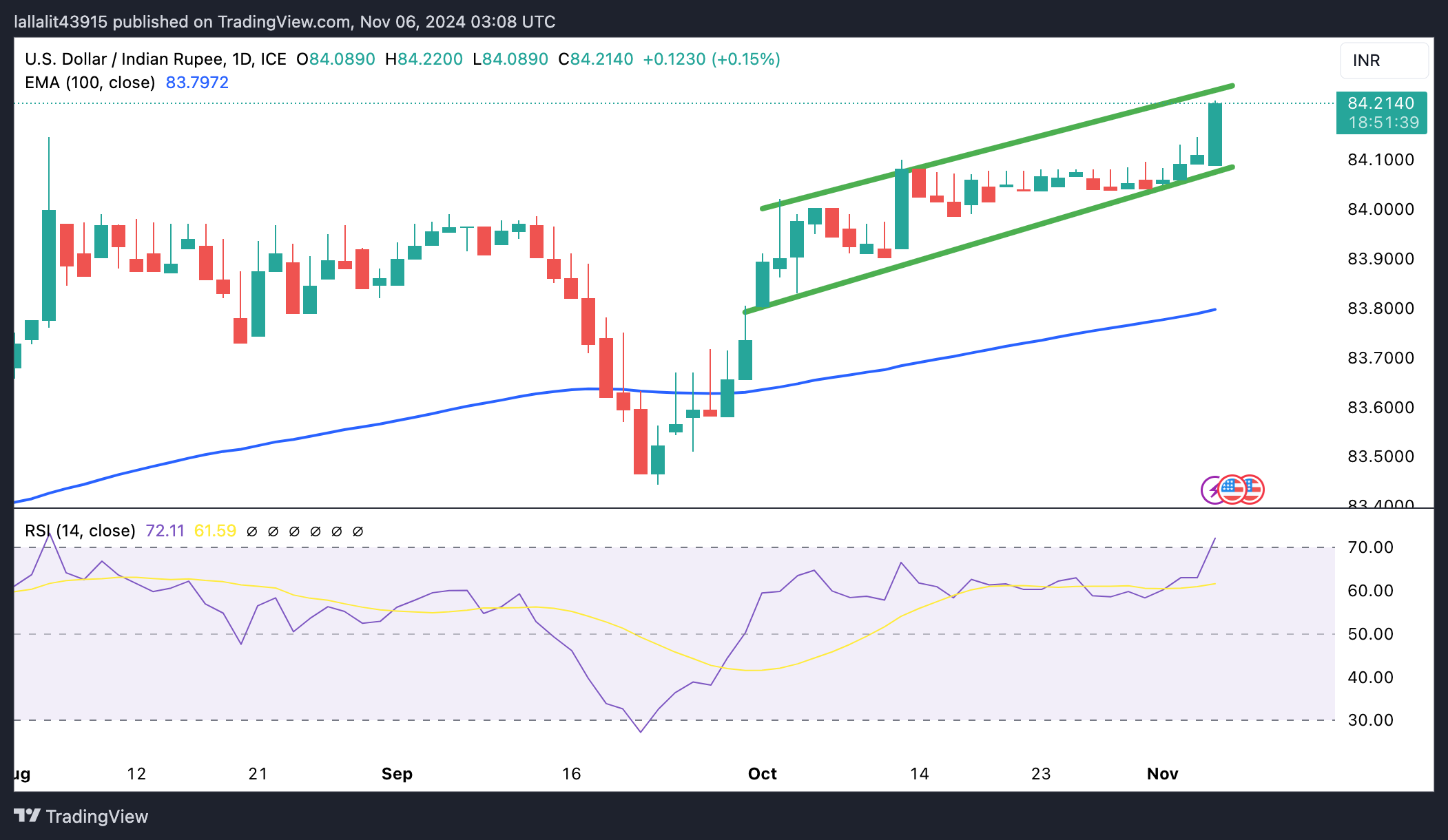
Technical Analysis: USD/INR’s constructive outlook remains unchanged, eyes on overbought RSI
The Indian Rupee recovers on the day. Technically, the positive view of the USD/INR pair prevails as the pair holds above the key 100-day Exponential Moving Average (EMA) on the daily timeframe. However, the 14-day Relative Strength Index (RSI) stands above the midline near 73.45, indicating the overbought RSI condition. This suggests that further consolidation cannot be ruled out before positioning for any near-term USD/INR appreciation.
The crucial resistance level for USD/INR emerges near the upper boundary of the ascending trend channel at 84.30. The additional upside filter to watch is 84.50, followed by the 85.00 psychological level.
On the flip side, the lower limit of the trend channel and the high of October 11 in the 84.05-84.10 zone act as an initial support level for the pair. A breach of this level could pave the way to 83.80, the 100-day EMA. Extended losses could see a drop to 83.46, the low of September 24.
RBI FAQs
The role of the Reserve Bank of India (RBI), in its own words, is "..to maintain price stability while keeping in mind the objective of growth.” This involves maintaining the inflation rate at a stable 4% level primarily using the tool of interest rates. The RBI also maintains the exchange rate at a level that will not cause excess volatility and problems for exporters and importers, since India’s economy is heavily reliant on foreign trade, especially Oil.
The RBI formally meets at six bi-monthly meetings a year to discuss its monetary policy and, if necessary, adjust interest rates. When inflation is too high (above its 4% target), the RBI will normally raise interest rates to deter borrowing and spending, which can support the Rupee (INR). If inflation falls too far below target, the RBI might cut rates to encourage more lending, which can be negative for INR.
Due to the importance of trade to the economy, the Reserve Bank of India (RBI) actively intervenes in FX markets to maintain the exchange rate within a limited range. It does this to ensure Indian importers and exporters are not exposed to unnecessary currency risk during periods of FX volatility. The RBI buys and sells Rupees in the spot market at key levels, and uses derivatives to hedge its positions.
Author

Lallalit Srijandorn
FXStreet
Lallalit Srijandorn is a Parisian at heart. She has lived in France since 2019 and now becomes a digital entrepreneur based in Paris and Bangkok.