USD/INR edges higher after RBI keeps repo rates and stance unchanged
- The Indian Rupee loses traction in Thursday’s early European session.
- RBI’s MPC decided to keep the repo rate unchanged at 6.5% in its August meeting on Thursday.
- The fear of wider Middle East conflicts, renewed US Dollar demand and higher crude oil prices undermine the INR.
- Investors will focus on the US weekly Initial Jobless, which is due later on Thursday.

The Indian Rupee (INR) weakens on the modest recovery of the Greenback on Thursday, snapping the two-day winning streak. The Reserve Bank of India (RBI) Governor Shaktikanta Das announced its bi-monthly monetary policy statement on Thursday. The Indian central bank maintained the status quo on the repo rate at 6.50% and the “withdrawal of accommodation” stance. The RBI Monetary Policy Committee (MPC) decided to hold the key policy rate for the ninth consecutive meeting in August 2024 and last changed the benchmark interest rate in February 2023. The INR remains on a softer note in immediate reaction to the rate decision.
The escalating geopolitical tensions in the Middle East, heightened US Dollar (USD) demand from local importers and a rise in crude oil prices all contribute to the INR’s downside. However, significant weakness might prompt intervention from the Reserve Bank of India (RBI) to stabilize the local currency. Investors will monitor the weekly US Initial Jobless Claims for confirmation of slowing economic numbers, particularly employment.
Daily Digest Market Movers: Indian Rupee remains sensitive to global factors
- The RBI’s Monetary Policy Committee (MPC) voted by a 4-2 majority to leave policy rates unchanged and decided to maintain its ‘Withdrawal of Accommodation" stance.
- RBI retains the real Gross Domestic Product (GDP) growth projection for FY25 at 7.2%, with "risks evenly balanced," and maintains the Consumer Price Index (CPI) inflation forecast for FY25 at 4.5%.
- RBI Governor Shaktikanta Das said that India’s domestic growth remains robust, bolstered by solid urban consumption, with manufacturing gaining traction as demand improves.
- RBI’s Das further stated that inflation is receding gradually across economies, while medium-term global growth faces significant challenges. However, food price pressures cannot be ignored due to their potential spillover effects.
- According to RBI's Das, overall economic growth in the United States is performing well, and the unemployment report is just one single month of data, so there is no need to jump to conclusions about a slowdown or recession. Das added it was premature to discuss the recession in the US, but the central bank will monitor all incoming data, both both domestic and external.
- The Indian Rupee and Taiwan Dollar remained bearish, with the INR under pressure from carry trade unwinding and equities sell-off, per a Reuters poll.
- State-run banks were offering Dollars, likely on behalf of the RBI, but the intervention was not aggressive, a foreign exchange trader at a large private bank said.
- Deloitte India forecasted India's economy to grow by 7.0-7.2% in the current fiscal year due to strong economic fundamentals and the continuation of domestic policy reforms.
- US officials are confident that Hezbollah’s and Iran’s response is imminent and initial assessment predicted an early week attack, but the most recent intelligence showed any response may be delayed until Thursday or Friday, per Al Arabiya.
- Rate markets have priced in a roughly 83% chance of a 50 basis points (bps) Fed rate cut in September, with a further two cuts expected through the rest of 2024, according to the CME’s FedWatch Tool.
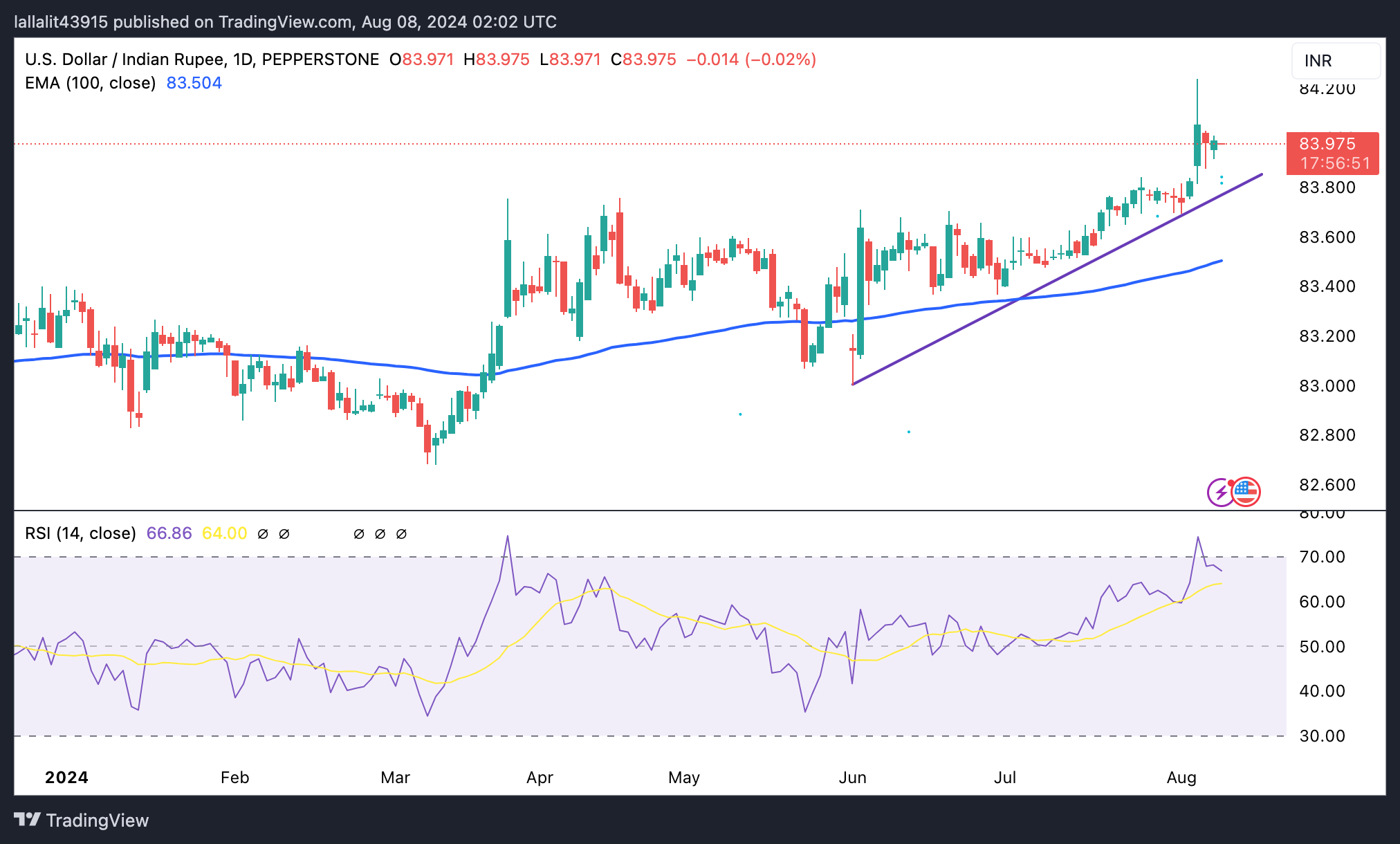
Technical analysis: USD/INR’s positive outlook remains intact
The immediate upside barrier for the pair emerges at the 84.00 psychological barrier. A decisive break above this level could draw in enough buying pressure to test the next hurdle at 84.50.
In the bearish case, the initial contention level to watch is the uptrend line around 83.80. If the price breaks below this level, it would signal a more significant downside towards the next support level near the 100-day EMA at 83.50.
US Dollar price this week
The table below shows the percentage change of US Dollar (USD) against listed major currencies this week. US Dollar was the strongest against the Pound Sterling.
| USD | EUR | GBP | CAD | AUD | JPY | NZD | CHF | |
| USD | -0.22% | 0.74% | -1.05% | -0.84% | 0.28% | -0.88% | 0.28% | |
| EUR | 0.22% | 0.96% | -0.83% | -0.60% | 0.50% | -0.66% | 0.51% | |
| GBP | -0.74% | -0.96% | -1.79% | -1.59% | -0.43% | -1.63% | -0.42% | |
| CAD | 1.04% | 0.83% | 1.77% | 0.21% | 1.36% | 0.17% | 1.36% | |
| AUD | 0.83% | 0.60% | 1.55% | -0.24% | 1.09% | -0.06% | 1.13% | |
| JPY | -0.34% | -0.49% | 0.40% | -1.38% | -1.15% | -1.21% | -0.04% | |
| NZD | 0.88% | 0.65% | 1.60% | -0.18% | 0.06% | 1.19% | 1.18% | |
| CHF | -0.31% | -0.54% | 0.44% | -1.37% | -1.14% | 0.00% | -1.20% |
The heat map shows percentage changes of major currencies against each other. The base currency is picked from the left column, while the quote currency is picked from the top row. For example, if you pick the Euro from the left column and move along the horizontal line to the Japanese Yen, the percentage change displayed in the box will represent EUR (base)/JPY (quote).
RBI FAQs
The role of the Reserve Bank of India (RBI), in its own words, is '..to maintain price stability while keeping in mind the objective of growth.” This involves maintaining the inflation rate at a stable 4% level primarily using the tool of interest rates. The RBI also maintains the exchange rate at a level that will not cause excess volatility and problems for exporters and importers, since India’s economy is heavily reliant on foreign trade, especially Oil.
The RBI formally meets at six bi-monthly meetings a year to discuss its monetary policy and, if necessary, adjust interest rates. When inflation is too high (above its 4% target), the RBI will normally raise interest rates to deter borrowing and spending, which can support the Rupee (INR). If inflation falls too far below target, the RBI might cut rates to encourage more lending, which can be negative for INR.
Due to the importance of trade to the economy, the Reserve Bank of India (RBI) actively intervenes in FX markets to maintain the exchange rate within a limited range. It does this to ensure Indian importers and exporters are not exposed to unnecessary currency risk during periods of FX volatility. The RBI buys and sells Rupees in the spot market at key levels, and uses derivatives to hedge its positions.
Author

Lallalit Srijandorn
FXStreet
Lallalit Srijandorn is a Parisian at heart. She has lived in France since 2019 and now becomes a digital entrepreneur based in Paris and Bangkok.















