USD/INR trades stronger ahead of RBI’s MPC Minutes
- The Indian Rupee weakens in Wednesday’s Asian session.
- Indian HSBC Manufacturing PMI eased to 57.9 in August, while services PMI rose to 60.4.
- Strong USD demand from importers and outflows from equities have weighed on the INR.
- Investors will monitor the RBI’s MPC Minutes and the advanced US August PMI data, which are due on Thursday.

The Indian Rupee (INR) loses ground on Thursday, pressured by concerns about importers' US Dollar (USD) demand and foreign equity outflows. Data released on Thursday showed that the preliminary HSBC India Manufacturing Purchasing Managers Index (PMI) declined to 57.9 in August from 58.1 in July. Meanwhile, the country’s Services PMI rose to 60.4 in August versus 60.3 prior. The mixed Indian PMI reports provide little to no reaction to the INR.
Nonetheless, the further decline of crude oil prices might underpin the INR as India is the world’s third-largest oil consumer and importer. The downside of the INR might also be limited amid the likely intervention from the Reserve Bank of India (RBI), which might sell USD to stabilize the Indian Rupee.
Traders will keep an eye on the RBI Monetary Policy Committee (MPC) Minutes on Thursday. On the US docket, the preliminary US S&P Global Purchasing Managers Index (PMI) for August will be published. Meanwhile, rising expectations of a Federal Reserve interest rate cut in September could drag the Greenback lower.
Daily Digest Market Movers: Indian Rupee remains vulnerable amid multiple challenges
- "India's flash composite PMI slipped slightly in August, though it remained significantly higher than the historical average," noted Pranjul Bhandari, chief India economist at HSBC.
- “Although new order growth for the manufacturing sector slowed to the weakest since February, the pace of expansion remained sharp, indicating continued strong demand and favorable market conditions,” added Bhandari.
- The Indian Rupee is down 0.2% against the US Dollar in August, making it the worst-performing Asian currency.
- The INR “faces persistent challenges — a widening trade deficit, ongoing foreign outflows, and relentless demand for USD from importers,” said Amit Pabari, managing director at FX advisory firm CR Forex in Mumbai.
- According to the minutes of the Federal Reserve’s (Fed) July meeting released Wednesday, “the vast majority” of participants observed that it would likely be appropriate to cut the interest rate in the September meeting if the data continued to come in about as expected.
- Markets are fully pricing in a September cut, with a full percentage point worth of rate cuts anticipated by the end of this year.
- The preliminary estimate of the benchmark revision indicated an adjustment to March 2024 total Nonfarm employment of -818,000 (-0.5%), the US Bureau of Labor Statistics showed on Wednesday.
Technical Analysis: USD/INR maintains its positive bias
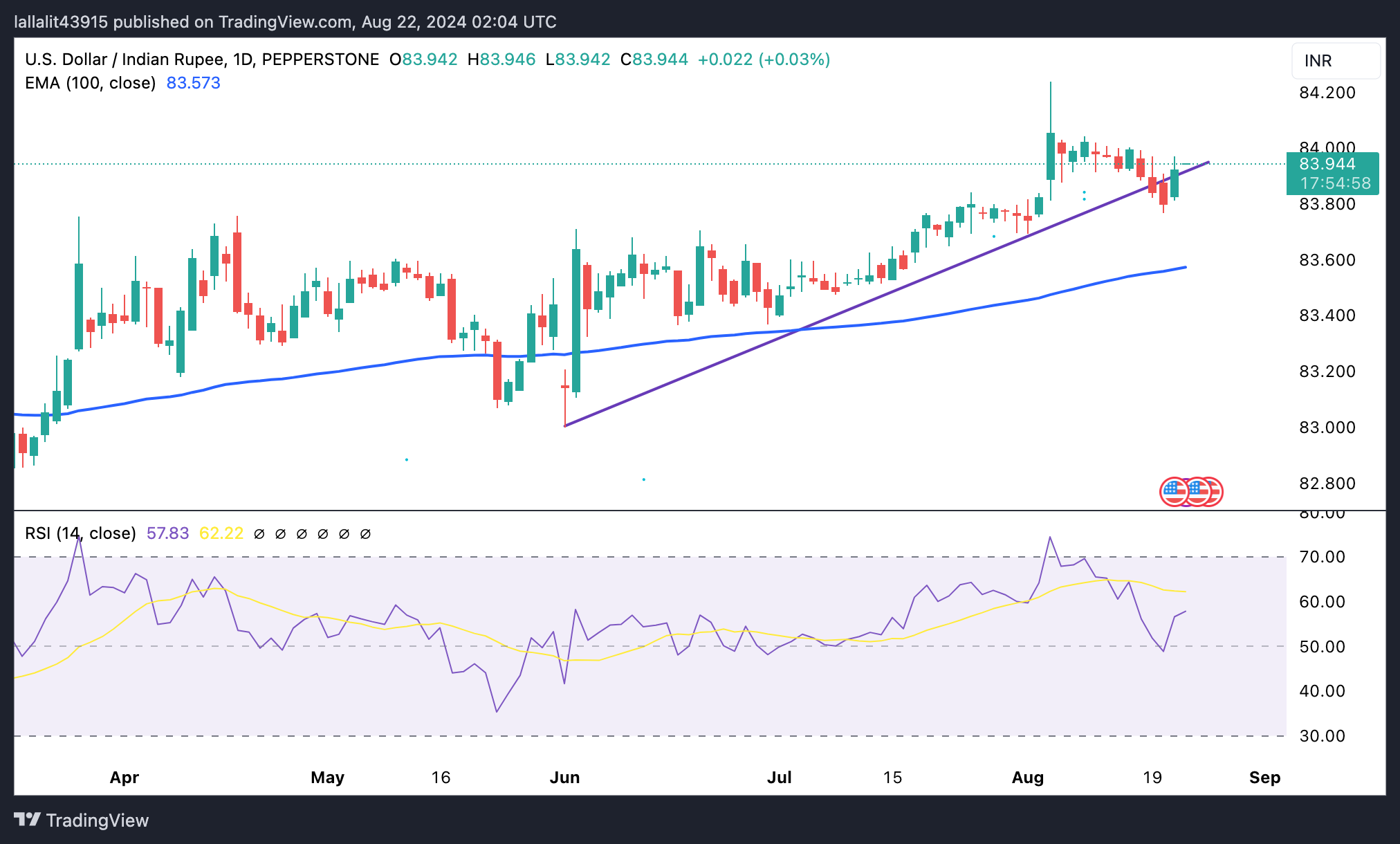
Indian Rupee edges lower on the day. The USD/INR keeps the bullish environment on the daily timeframe as the price is well-supported above the key 100-day Exponential Moving Average (EMA). The pair bounces back above the 11-week-old uptrend line, while the 14-day Relative Strength Index (RSI) points higher above the midline again, indicating there could still be room for further upward movement before the market potentially encounters resistance.
The crucial upside barrier for USD/INR emerges near the 84.00 psychological mark. Any follow-through buying could pave the way to the record high of 84.24 en route to 84.50.
On the downside, the low of August 20 at 83.77 acts as an initial support level for the pair. Extended losses will see a drop to the 100-day EMA at 83.56, followed by 83.36, the low of June 28.
US Dollar price in the last 7 days
The table below shows the percentage change of US Dollar (USD) against listed major currencies in the last 7 days. US Dollar was the strongest against the Canadian Dollar.
| USD | EUR | GBP | CAD | AUD | JPY | NZD | CHF | |
| USD | -1.24% | -2.08% | -1.00% | -2.21% | -1.38% | -2.67% | -1.69% | |
| EUR | 1.22% | -0.84% | 0.22% | -0.98% | -0.14% | -1.44% | -0.45% | |
| GBP | 2.04% | 0.84% | 1.07% | -0.13% | 0.70% | -0.57% | 0.39% | |
| CAD | 0.99% | -0.22% | -1.07% | -1.19% | -0.37% | -1.67% | -0.66% | |
| AUD | 2.15% | 0.95% | 0.11% | 1.17% | 0.80% | -0.46% | 0.51% | |
| JPY | 1.36% | 0.18% | -0.67% | 0.38% | -0.82% | -1.25% | -0.31% | |
| NZD | 2.62% | 1.40% | 0.57% | 1.62% | 0.46% | 1.25% | 0.97% | |
| CHF | 1.63% | 0.42% | -0.42% | 0.66% | -0.52% | 0.28% | -0.97% |
The heat map shows percentage changes of major currencies against each other. The base currency is picked from the left column, while the quote currency is picked from the top row. For example, if you pick the Euro from the left column and move along the horizontal line to the Japanese Yen, the percentage change displayed in the box will represent EUR (base)/JPY (quote).
RBI FAQs
The role of the Reserve Bank of India (RBI), in its own words, is '..to maintain price stability while keeping in mind the objective of growth.” This involves maintaining the inflation rate at a stable 4% level primarily using the tool of interest rates. The RBI also maintains the exchange rate at a level that will not cause excess volatility and problems for exporters and importers, since India’s economy is heavily reliant on foreign trade, especially Oil.
The RBI formally meets at six bi-monthly meetings a year to discuss its monetary policy and, if necessary, adjust interest rates. When inflation is too high (above its 4% target), the RBI will normally raise interest rates to deter borrowing and spending, which can support the Rupee (INR). If inflation falls too far below target, the RBI might cut rates to encourage more lending, which can be negative for INR.
Due to the importance of trade to the economy, the Reserve Bank of India (RBI) actively intervenes in FX markets to maintain the exchange rate within a limited range. It does this to ensure Indian importers and exporters are not exposed to unnecessary currency risk during periods of FX volatility. The RBI buys and sells Rupees in the spot market at key levels, and uses derivatives to hedge its positions.
Author

Lallalit Srijandorn
FXStreet
Lallalit Srijandorn is a Parisian at heart. She has lived in France since 2019 and now becomes a digital entrepreneur based in Paris and Bangkok.