USD/INR declines as RBI introduces special credit line for Oil buyers
- The Indian Rupee gains against the US Dollar as the RBI takes measures to curb Dollar buying.
- US President Trump says that Iran is willing to give up its nuclear ambitions.
- FIIs remained net buyers in the last two trading days.
The Indian Rupee (INR) trades higher against the US Dollar (USD) on Friday, as the opening of special credit lines for state-run Oil buyers to meet their foreign exchange needs has strengthened the Asian currency. The USD/INR pair declines to near 92.70 after remaining sideways in the last two trading days.
On Thursday, the Reserve Bank of India (RBI) urged state-run Oil refiners to curb spot US Dollar purchases and to tap a special credit line, in an attempt to reduce the impact of Dollar buying by state-run Oil refiners on the domestic currency, Reuters reported. This facility was also started by the RBI when the Russia-Ukraine war started.
The Indian central bank has been taking several measures to limit the downside in the Indian Rupee against the US Dollar. In late March, the RBI directed banks to cap their net open rupee positions in the foreign exchange market at $100 million by the end of each business day.
Trump seems confident of a deal with Iran
Oil prices remain capped, and the market sentiment is broadly risk-on as United States (US) President Donald Trump has expressed confidence that a deal with Iran is very likely. “We're very close to a deal with Iran,” Trump said in a press briefing on Thursday. However, he warned that military actions against Tehran would resume if a deal is not reached.
The overall commentary from Trump appeared to express optimism toward a permanent truce with Iran. Trump said that Iran is now “more willing to do things today they previously weren't”, such as giving up nuclear ambitions and handing over enriched uranium.
Upbeat market sentiment has diminished the safe-haven appeal of the US Dollar. As of writing, the US Dollar Index (DXY), which tracks the Greenback’s value against six major currencies, trades marginally higher to near 98.25, but is set for a consecutive negative weekly close.
Meanwhile, capped WTI Oil prices around $90 from the past few days after surging above $100 are also offering support to the Indian Rupee. Currencies from economies such as India, which rely heavily on Oil imports to meet their energy needs, take a recovery route when Oil prices start to correct.
FIIs start buying in Indian stock market
The response by Foreign Institutional Investors (FIIs) toward the Indian equity market appears to have started improving since the announcement of the two-week ceasefire between the US and Iran on April 8. Over the last two trading days, FIIs have remained net buyers and have raised their stake worth Rs. 1,048.51 crore. However, the amount of investment is significantly lower than the selling pressure seen before the temporary truce announcement.
Technical Analysis: USD/INR is expected to find support near 92.45
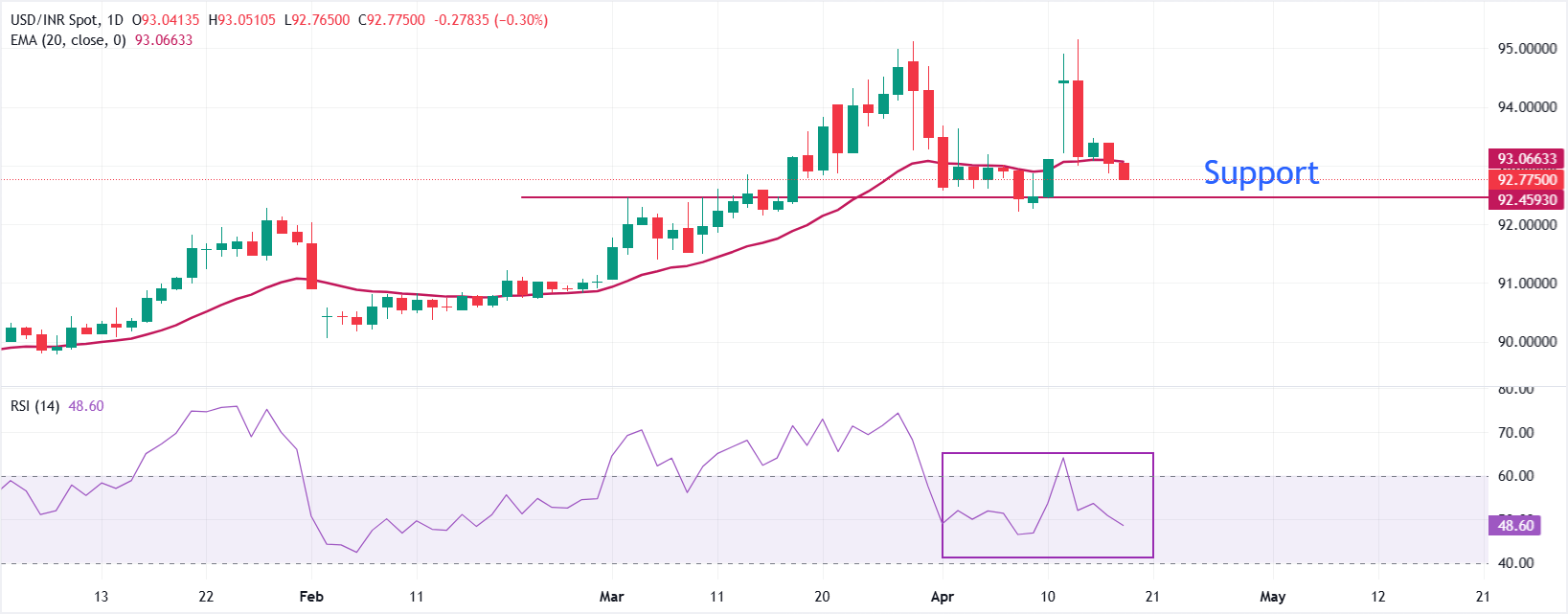
USD/INR trades lower at around 92.70, as of writing, holding a mildly bearish near-term bias as spot remains below the 20-period Exponential Moving Average (EMA) at 93.06. The recent pullback from last week’s highs has pushed the price under this short-term trend gauge, and the Relative Strength Index (RSI) at 48.6 has slipped just below the neutral 50 line, hinting that upside momentum is fading without yet signaling oversold conditions.
On the topside, initial resistance is now defined by the 20-day EMA at 93.07, where a daily close above would be needed to ease immediate downside pressure and reopen the path toward recent peaks above 95.00. As long as the pair holds beneath this moving average, rebounds are likely to struggle, leaving risks skewed toward additional consolidation or further slippage in the coming sessions toward the March 3 high of 92.46.
(The technical analysis of this story was written with the help of an AI tool.)
US Dollar FAQs
The US Dollar (USD) is the official currency of the United States of America, and the ‘de facto’ currency of a significant number of other countries where it is found in circulation alongside local notes. It is the most heavily traded currency in the world, accounting for over 88% of all global foreign exchange turnover, or an average of $6.6 trillion in transactions per day, according to data from 2022. Following the second world war, the USD took over from the British Pound as the world’s reserve currency. For most of its history, the US Dollar was backed by Gold, until the Bretton Woods Agreement in 1971 when the Gold Standard went away.
The most important single factor impacting on the value of the US Dollar is monetary policy, which is shaped by the Federal Reserve (Fed). The Fed has two mandates: to achieve price stability (control inflation) and foster full employment. Its primary tool to achieve these two goals is by adjusting interest rates. When prices are rising too quickly and inflation is above the Fed’s 2% target, the Fed will raise rates, which helps the USD value. When inflation falls below 2% or the Unemployment Rate is too high, the Fed may lower interest rates, which weighs on the Greenback.
In extreme situations, the Federal Reserve can also print more Dollars and enact quantitative easing (QE). QE is the process by which the Fed substantially increases the flow of credit in a stuck financial system. It is a non-standard policy measure used when credit has dried up because banks will not lend to each other (out of the fear of counterparty default). It is a last resort when simply lowering interest rates is unlikely to achieve the necessary result. It was the Fed’s weapon of choice to combat the credit crunch that occurred during the Great Financial Crisis in 2008. It involves the Fed printing more Dollars and using them to buy US government bonds predominantly from financial institutions. QE usually leads to a weaker US Dollar.
Quantitative tightening (QT) is the reverse process whereby the Federal Reserve stops buying bonds from financial institutions and does not reinvest the principal from the bonds it holds maturing in new purchases. It is usually positive for the US Dollar.
Author

Sagar Dua
FXStreet
Sagar Dua is associated with the financial markets from his college days. Along with pursuing post-graduation in Commerce in 2014, he started his markets training with chart analysis.