WTI blasts past $100 as Red Sea, Hormuz risks collide
- WTI clears $100 as Houthis threaten Bab al-Mandab control.
- Iran attacks and Hormuz restrictions intensify supply-disruption fears.
- China buying and lower US inventories deepen crude rally.

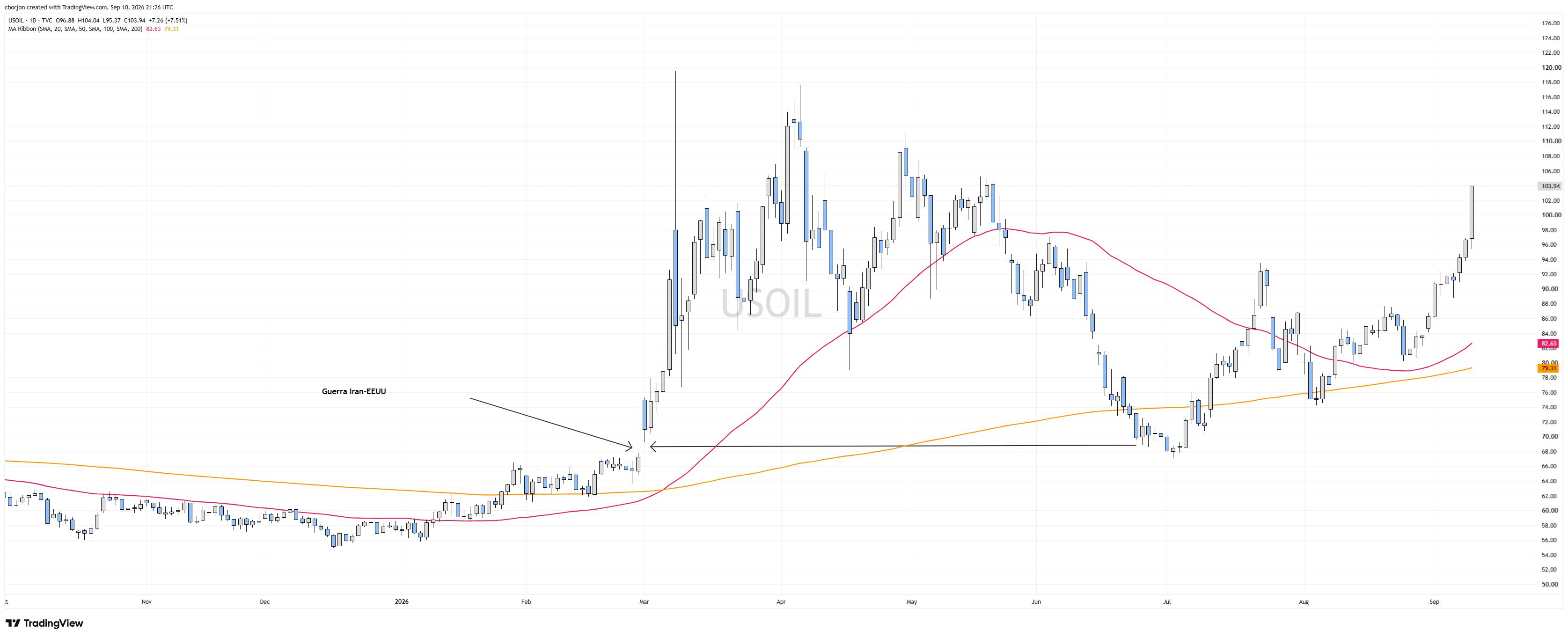
West Texas Intermediate (WTI), the US crude Oil benchmark, rises more than 7% as attacks in the Middle East intensify, driving WTI above the $ 100-per-barrel barrier for the first time since May 2026. At the time of writing, WTI trades at $103.86 after bouncing off lows of $95.37.
Crude surges as Middle East supply threats meet renewed Chinese demand
The escalation of the conflict keeps crude underpinned amid fears for a potential supply shortage. Yemen’s Houthis group, linked to Iran, said that they’re on the verge of controlling the Bab al-Mandab Strait. This is squeezing traffic in the Red Sea, putting pressure on the Saudis.
In other news, the traffic in Hormuz remains restricted, while US officials cited by the WSJ revealed that Iran has ramped up its ballistic missile production, again. Tehran reportedly attacked 10 ships near the Strait on Wednesday, following US attacks on five Iranian tankers
Meanwhile, US President Donald Trump revealed that the US may attack Pickaxe Mountain, near Iran’s heavily damaged Natanz uranium enrichment facility, saying that the war would likely last after November’s mid-term elections.
China increases crude buying; US inventories fall
Another reason behind Oil’s rally past $100 is that China is back, to reclaim the title of the world’s largest crude importer. ING said in a note that China has stepped up purchases in recent weeks, as domestic stockpiles have taken a hit. The analyst wrote that if Chinese buying continues to recover, it could amplify the impact of supply disruptions, keeping crude prices higher.
Aside from this US crude Oil inventories dropped by 391K barrels to 424.1 million barrels last week, according to the EIA. The agency noted that refining activity continued to show strength.
WTI Price Chart – Daily
WTI Oil FAQs
WTI Oil is a type of Crude Oil sold on international markets. The WTI stands for West Texas Intermediate, one of three major types including Brent and Dubai Crude. WTI is also referred to as “light” and “sweet” because of its relatively low gravity and sulfur content respectively. It is considered a high quality Oil that is easily refined. It is sourced in the United States and distributed via the Cushing hub, which is considered “The Pipeline Crossroads of the World”. It is a benchmark for the Oil market and WTI price is frequently quoted in the media.
Like all assets, supply and demand are the key drivers of WTI Oil price. As such, global growth can be a driver of increased demand and vice versa for weak global growth. Political instability, wars, and sanctions can disrupt supply and impact prices. The decisions of OPEC, a group of major Oil-producing countries, is another key driver of price. The value of the US Dollar influences the price of WTI Crude Oil, since Oil is predominantly traded in US Dollars, thus a weaker US Dollar can make Oil more affordable and vice versa.
The weekly Oil inventory reports published by the American Petroleum Institute (API) and the Energy Information Agency (EIA) impact the price of WTI Oil. Changes in inventories reflect fluctuating supply and demand. If the data shows a drop in inventories it can indicate increased demand, pushing up Oil price. Higher inventories can reflect increased supply, pushing down prices. API’s report is published every Tuesday and EIA’s the day after. Their results are usually similar, falling within 1% of each other 75% of the time. The EIA data is considered more reliable, since it is a government agency.
OPEC (Organization of the Petroleum Exporting Countries) is a group of 12 Oil-producing nations who collectively decide production quotas for member countries at twice-yearly meetings. Their decisions often impact WTI Oil prices. When OPEC decides to lower quotas, it can tighten supply, pushing up Oil prices. When OPEC increases production, it has the opposite effect. OPEC+ refers to an expanded group that includes ten extra non-OPEC members, the most notable of which is Russia.
Author

Christian Borjon Valencia
FXStreet
Markets analyst, news editor, and trading instructor with over 14 years of experience across FX, commodities, US equity indices, and global macro markets.