|

ECB recap: A hawkish hike despite downside growth risks

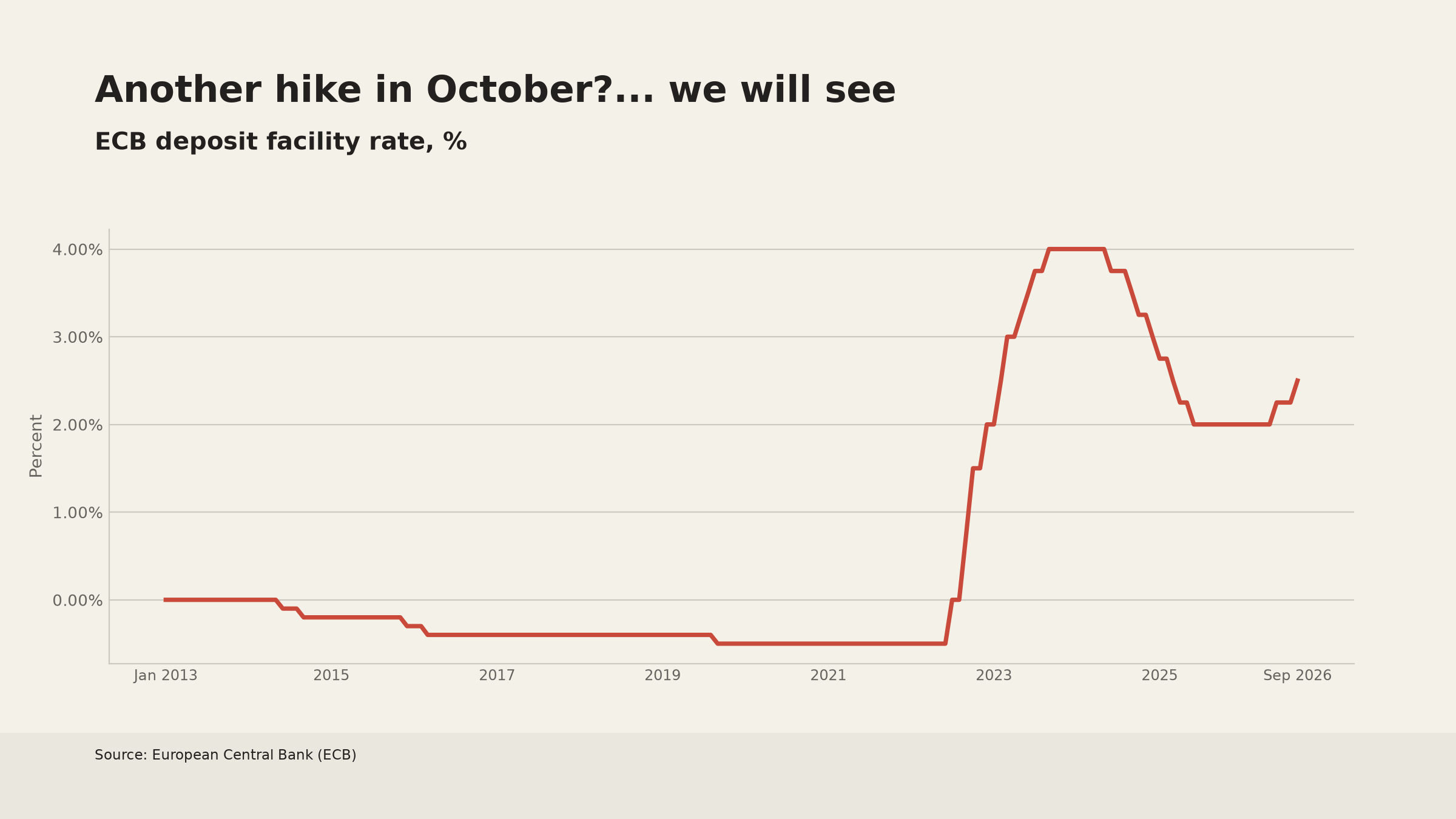
The European Central Bank (ECB) increased the Deposit Facility Rate to 2.50%, the Refinancing Rate to 2.65% and the Marginal Lending Facility to 2.90%, effective from September 16. The decision was accompanied by a clear warning that the outlook remains highly uncertain, with risks tilted to the upside for inflation and to the downside for growth.

The new staff projections see headline inflation averaging 3% in 2026, 2.5% in 2027 and 2.1% in 2028. The 2026 forecast was unchanged from June, but projections for 2027 and 2028 were revised higher. Inflation excluding energy and food is expected to remain above target, averaging 2.5% in 2026, 2.6% in 2027 and 2.3% in 2028.

ECB President Christine Lagarde said the economy was proving resilient, supported by consumption, public investment and a recovery in services. In addition, manufacturing remains solid, consumer confidence has rebounded and the labour market is robust, although employment growth is slowing. The near-term growth outlook has improved, with business and housing investment expected to provide further support.

The central bank nevertheless faces a difficult energy shock: higher prices are expected to feed through to core inflation and food costs, while a worsening conflict, supply disruptions or an unusually cold winter could push gas prices higher still. The ECB will therefore remain data-dependent and meeting-by-meeting (as per usual), without pre-committing to a particular rate path (as per usual).
Overall

This is a hawkish hike, but stagflationary risks remain. The ECB raised rates because it expects inflation to remain above target for longer, even as growth risks have increased. The combination of resilient domestic demand, higher inflation forecasts and the possibility of second-round effects leaves the door open to further tightening, although the Governing Council will wait for evidence on how persistent the energy shock becomes.

Following today's event, the probability of another quarter-point rate hike at the bank's October 29 gathering sits just above 61%, while markets pencil in nearly 35 basis points of tightening by year-end.

Author

Pablo Piovano

Born and bred in Argentina, Pablo has been carrying on with his passion for FX markets and trading since his first college years.


More from Pablo Piovano
Share:

Editor's Picks

AUD/USD extends the range play above 0.7200 as traders await US inflation data

AUD/USD is seen extending its consolidative price move above 0.7200 during the Asian session on Thursday amid mixed cues. Rising RBA rate-hike bets keep the Aussie close to its highest level since May 14. However, hawkish Fed expectations and escalating US-Iran tensions offer some support to the US Dollar, capping the currency pair as traders await US inflation figures.


USD/JPY consolidates around 153.50 as bears turn cautious ahead of US inflation

USD/JPY stabilizes above 153.50 during the Asian session on Thursday, but remains near a seven-month low set earlier this week as hawkish BoJ repricing continues to underpin the Japanese Yen. Meanwhile, rising September Fed rate-hike bets and escalating US-Iran tensions help ease US Dollar selling pressure, offering some support to the currency pair ahead of US inflation figures.

Gold remains weak, retargets $4,350

Gold keeps the choppy price action on Thursday, now slipping back toward the $4,350 region per troy ounce amid the robust bounce in the US Dollar as well as rising US Treasury yields across the curve, particularly following US Producer Prices and ahead of Friday’s more relevant US CPI data.

XRP slides amid a fragile crypto market structure
Ripple (XRP) falls for the second straight day, trading at $1.37 on Thursday. The broader cryptocurrency market remains fragile as investors weigh the impact of geopolitical tensions in the Middle East, which triggered persistent increases in Crude Oil prices while restricting shipping through the Straight of Hormuz and the Red Sea.
Jobs opened the door for the Fed — inflation decides whether it walks through
The latest US jobs report did not end the debate over the Federal Reserve’s (Fed) next move. It may have done something more subtle: it gave policymakers permission to keep their options open. After months of softer labour market signals, August delivered a stronger-than-expected rebound.
Venezuela’s 65-billion-barrel Oil deal could reshape America’s inflation fight
The United States (US) has secured unprecedented access to part of Venezuela’s vast Oil reserves. The timing is particularly significant as the war with Iran is disrupting Middle Eastern supplies, keeping energy prices elevated and reviving concerns about inflation.