USD/INR posts modest gains, eyes on likely RBI intervention
- The Indian Rupee edges lower in Friday’s early European session.
- Substantial equity outflows, higher crude oil prices might drag the INR down, but possible RBI intervention might cap its downside.
- Investors await the US housing data and FedSpeaks later on Friday.

The Indian Rupee (INR) loses ground to an all-time low on Friday, pressured by foreign fund outflows, a negative trend in domestic equities and the recent spike in crude oil prices. Additionally, the rising expectations the Federal Reserve (Fed) would cut rates less aggressively might strengthen the Greenback and weigh on the INR.
Nonetheless, the routine foreign exchange interventions by the Reserve Bank of India (RBI) through USD sales could help limit the INR’s losses. Looking ahead, the US Building Permits and Housing Starts are due later on Friday. The Fed’s Raphael Bostic, Neel Kashkari and Christopher Waller are scheduled to speak on the same day.
Daily Digest Market Movers: Indian Rupee weakens amid sustained outflows from equities
- Foreign investors have sold $8.4 billion worth of domestic stocks over October so far, the highest monthly outflow since at least 2002.
- "The opening looks almost flat with a close watch on RBI who has been selling near 84.09 for now,” said Anil Kumar Bhansali, Head of Treasury and Executive Director, Finrex Treasury Advisors LLP.
- The US Retail Sales climbed by 0.4% MoM in September from a 0.1% rise in August, beating the estimations of 0.3%, the US Census Bureau showed Thursday. Retail sales excluding autos arrived at 0.5% MoM in September versus 0.2% prior (revised from 0.1%), stronger than the 0.1% expected.
- The US Initial Jobless Claims for the week ending October 11 rose to 241K. The figure came in below the market consensus and the previous week's of 260K (revised from 258K).
- According to the CME FedWatch tool, traders have priced in a nearly 90.3% chance of a 25 basis points (bps) Fed rate cut in November.
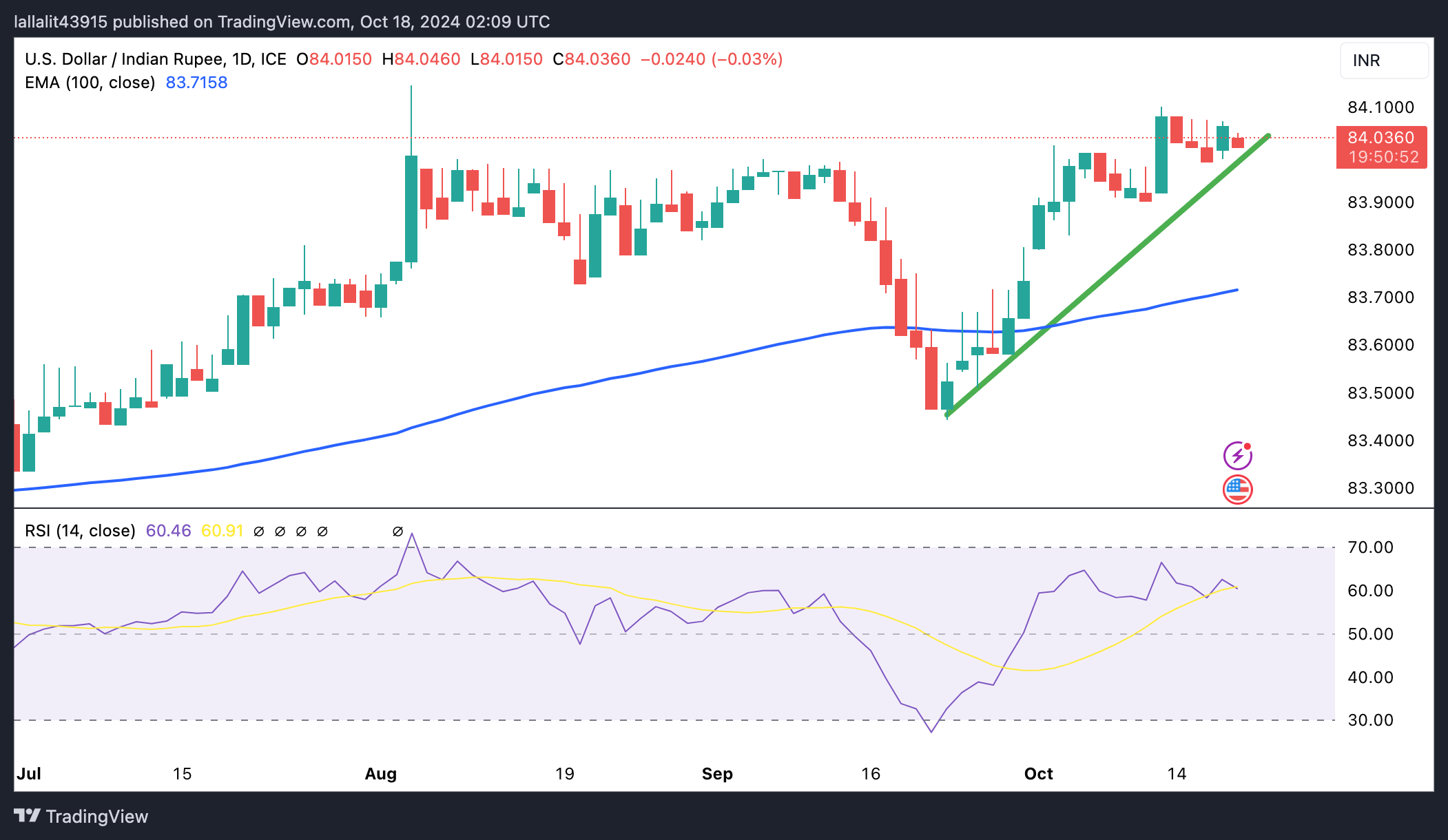
Technical Analysis: USD/INR keeps the bullish vibe in the longer term
The immediate resistance level for the pair emerges near the all-time high of 84.15. Further north, the next upside barrier is seen at 84.50, en route to the 85.00 psychological level.
On the flip side, a decisive break below the rising trend line could pave the way to 83.90, the low of October 10. The key contention level is located at 83.71, the 100-day EMA. The additional downside filter to watch is 83.00, representing the round mark and the low of May 24.
RBI FAQs
The role of the Reserve Bank of India (RBI), in its own words, is "..to maintain price stability while keeping in mind the objective of growth.” This involves maintaining the inflation rate at a stable 4% level primarily using the tool of interest rates. The RBI also maintains the exchange rate at a level that will not cause excess volatility and problems for exporters and importers, since India’s economy is heavily reliant on foreign trade, especially Oil.
The RBI formally meets at six bi-monthly meetings a year to discuss its monetary policy and, if necessary, adjust interest rates. When inflation is too high (above its 4% target), the RBI will normally raise interest rates to deter borrowing and spending, which can support the Rupee (INR). If inflation falls too far below target, the RBI might cut rates to encourage more lending, which can be negative for INR.
Due to the importance of trade to the economy, the Reserve Bank of India (RBI) actively intervenes in FX markets to maintain the exchange rate within a limited range. It does this to ensure Indian importers and exporters are not exposed to unnecessary currency risk during periods of FX volatility. The RBI buys and sells Rupees in the spot market at key levels, and uses derivatives to hedge its positions.
Author

Lallalit Srijandorn
FXStreet
Lallalit Srijandorn is a Parisian at heart. She has lived in France since 2019 and now becomes a digital entrepreneur based in Paris and Bangkok.

















