USD/INR weakens despite India's May Services PMI cools to five-month low
- Indian Rupee (INR) trades on a stronger note on Wednesday.
- The final Indian HSBC Services PMI for May declined to 60.2 in May from 60.8 in April, weaker than expected.
- Lower oil prices and optimism about foreign fund inflows support the INR after facing the uncertainty surrounding Indian election.
- Traders will closely watch the Indian HSBC Services PMI and US ISM Services PMI for May, which are due on Wednesday.
Indian Rupee (INR) trims losses on Wednesday after facing some selling pressure in the previous session. On Tuesday, the uncertainty surrounding a majority win for the BJP-led government triggered a significant sell-off in Indian equities and the INR. The recent Indian economic data showed that growth in India's services activity slowed to a five-month low in May. The figure, however, had little to no impact to the INR. The HSBC India Services PMI came in at 60.4 in May from the final 60.8 in the previous month. This was the 34th consecutive month of expansion in services activity although at the slowest pace since December 2023.
Nevertheless, the decline in crude oil prices and optimism about foreign fund inflows due to India's inclusion in the JPMorgan bond indices are likely to support the Indian Rupee.
Investors will keep an eye on the Indian HSBC Services PMI, which is expected to rise to 61.4 in May from 60.8 in April. On the US docket, the US ISM Services PMI will be published, along with the ADP Employment Change. In case of the stronger-than-expected reading, this might boost the US Dollar (USD) and create a tailwind for the USD/INR pair.
Daily Digest Market Movers: Indian Rupee remains strong amid the uncertainties
- Modi’s National Democratic Alliance (NDA) alliance won 292 seats combined, out of which his Bharatiya Janata Party (BJP) alone secured 240, per CNN.
- Modi is set to negotiate with coalition partners in order to form a government. The BJP and its political allies, known as the National Democratic Alliance (NDA), have enough seats to form a majority government to rule for the next five years and return Modi to office for a third term, per the Guardian.
- The NSE Nifty 50 closed down nearly 6% at 21,884.5 points on Tuesday, its steepest fall since India's first Covid lockdowns in March 2020. The S&P BSE Sensex also fell sharply, closing 5.7% lower at 72,079.05.
- The biggest fall for over four years for Indian stocks came after vote counting in India's general election indicated Prime Minister Narendra Modi's party might not be able to form a majority government, per BBC.
- "USD-INR to stabilize around current levels in the near term; strong service exports, index flows and FX reserves to support INR," said Standard Chartered Economist and FX Analyst Jonathan Koh
- The US JOLTs Job Openings declined from 8.355 million to 8.059 million in April, below the market consensus of 8.34 million.
- The final reading US ISM Services PMI is estimated to improve to 50.5 in May from 49.4 in April.
Technical analysis: USD/INR jumps above the descending trend channel on the daily chart
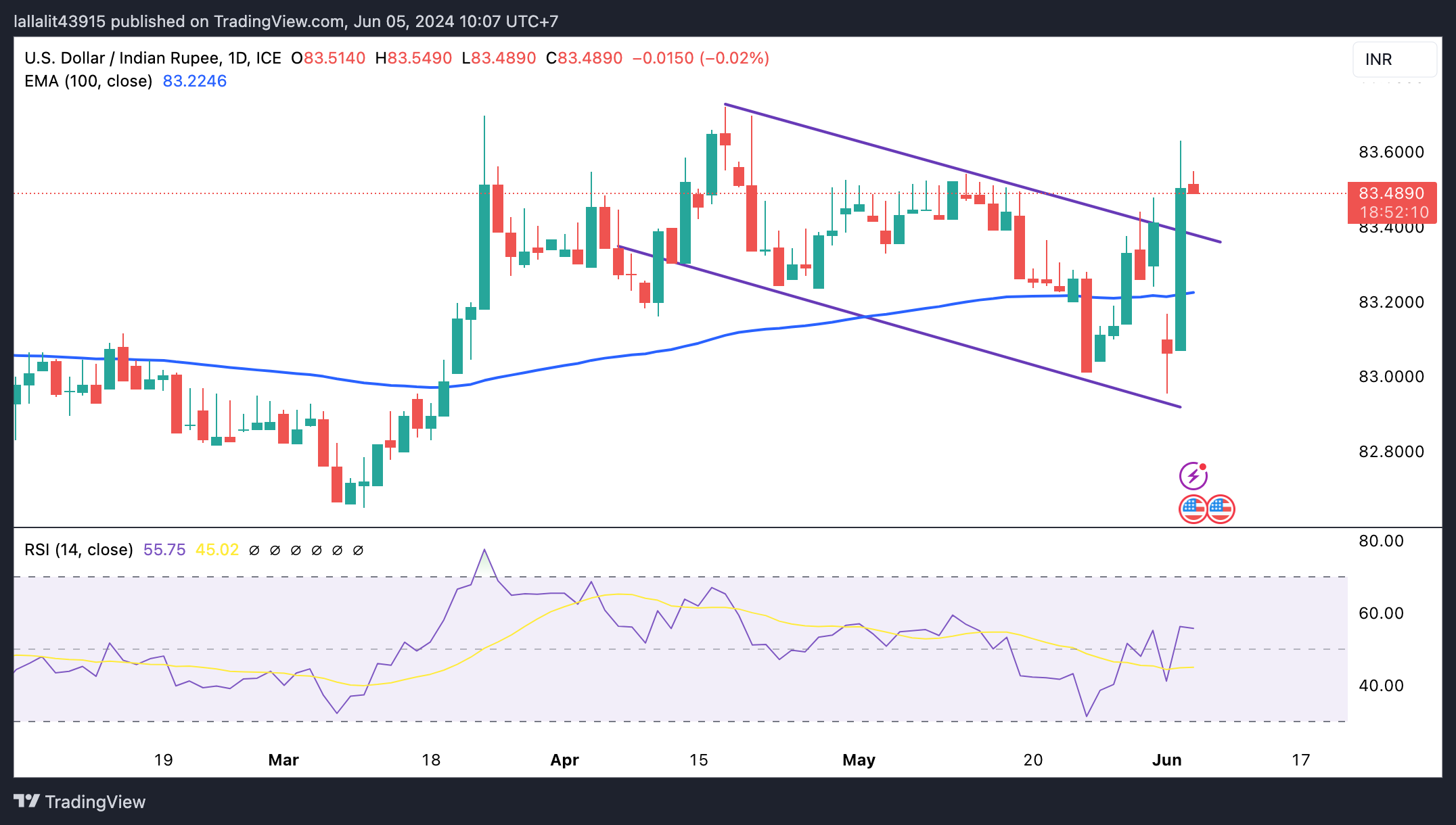
The Indian Rupee trades firmer on the day. The USD/INR pair has broken above the descending trend channel that has been established since mid-April and crossed back above the key 100-day Exponential Moving Average (EMA) on the daily chart, turning the outlook to the upside. Additionally, the 14-day Relative Strength Index (RSI) stands in bullish territory at around 55.80, and it supports buyers for the time being.
A high of June 4 at 83.62 acts as an immediate resistance level for the pair. Any follow-through buying will see a rally to a high of April 17 at 83.72 en route to the 84.00 psychological level.
On the downside, the resistance-turned-support level of 83.40 will be the first downside target for USD/INR. The next contention level to watch is the 100-day EMA at 83.20. A breach of this level will see a drop to the 83.00 round mark, followed by a low of January 15 at 82.78.
RBI FAQs
The role of the Reserve Bank of India (RBI), in its own words, is '..to maintain price stability while keeping in mind the objective of growth.” This involves maintaining the inflation rate at a stable 4% level primarily using the tool of interest rates. The RBI also maintains the exchange rate at a level that will not cause excess volatility and problems for exporters and importers, since India’s economy is heavily reliant on foreign trade, especially Oil.
The RBI formally meets at six bi-monthly meetings a year to discuss its monetary policy and, if necessary, adjust interest rates. When inflation is too high (above its 4% target), the RBI will normally raise interest rates to deter borrowing and spending, which can support the Rupee (INR). If inflation falls too far below target, the RBI might cut rates to encourage more lending, which can be negative for INR.
Due to the importance of trade to the economy, the Reserve Bank of India (RBI) actively intervenes in FX markets to maintain the exchange rate within a limited range. It does this to ensure Indian importers and exporters are not exposed to unnecessary currency risk during periods of FX volatility. The RBI buys and sells Rupees in the spot market at key levels, and uses derivatives to hedge its positions.
Author

Lallalit Srijandorn
FXStreet
Lallalit Srijandorn is a Parisian at heart. She has lived in France since 2019 and now becomes a digital entrepreneur based in Paris and Bangkok.