USD/INR extends rally on spike in US Dollar demand
- The Indian Rupee tumbles in Monday’s early European session.
- A firmer USD, Donald Trump's trade policies and India's economic challenges weigh on the INR.
- The possible RBI intervention might prevent the local currency from depreciating significantly.

The Indian Rupee (INR) remains under pressure on Monday after hitting a historic low of 81.00 in the previous session. The stronger US Dollar (USD) due to month-end demand, uncertainties from the incoming Donald Trump, and concerns about India's slowing growth and widening trade deficit create a tailwind for the pair.
The Reserve Bank of India's (RBI) intervention by selling the USD might help limit the local currency’s losses in the near term. However, the markets are likely to be muted as the year-end could keep it rangebound. Later on Monday, traders will keep an eye on India’s Fiscal Deficit, which is due on Monday. On Tuesday, the Indian Trade Deficit for the third quarter (Q3) and Infrastructure Output data for November will be released.
Indian Rupee faces challenges after reaching record lows
- "Rupee volatility seems to be back, and we should see bigger movements in the (USD/INR) currency pair as we move forward," noted Anil Bhansali, head of treasury at Finrex Treasury Advisors.
- "The excessive positions are being flushed out now that the RBI has intervened with intent," a currency dealer at a mid-sized private bank said.
- Foreign portfolio investors have sold over $10 billion of local stocks and bonds over this quarter on a net basis, according to stock depository data.
- India's economy is estimated to grow at around 6.5% in fiscal year 2024/25, closer to the lower end of its 6.5%-7% projection, the government said on Thursday.
- India's economy is likely to expand at 6.5-6.8% this fiscal year and slightly higher between 6.7-7.3% in FY2026, boosted by domestic consumption, according to Deloitte Sunday.
USD/INR’s bullish outlook remains in play
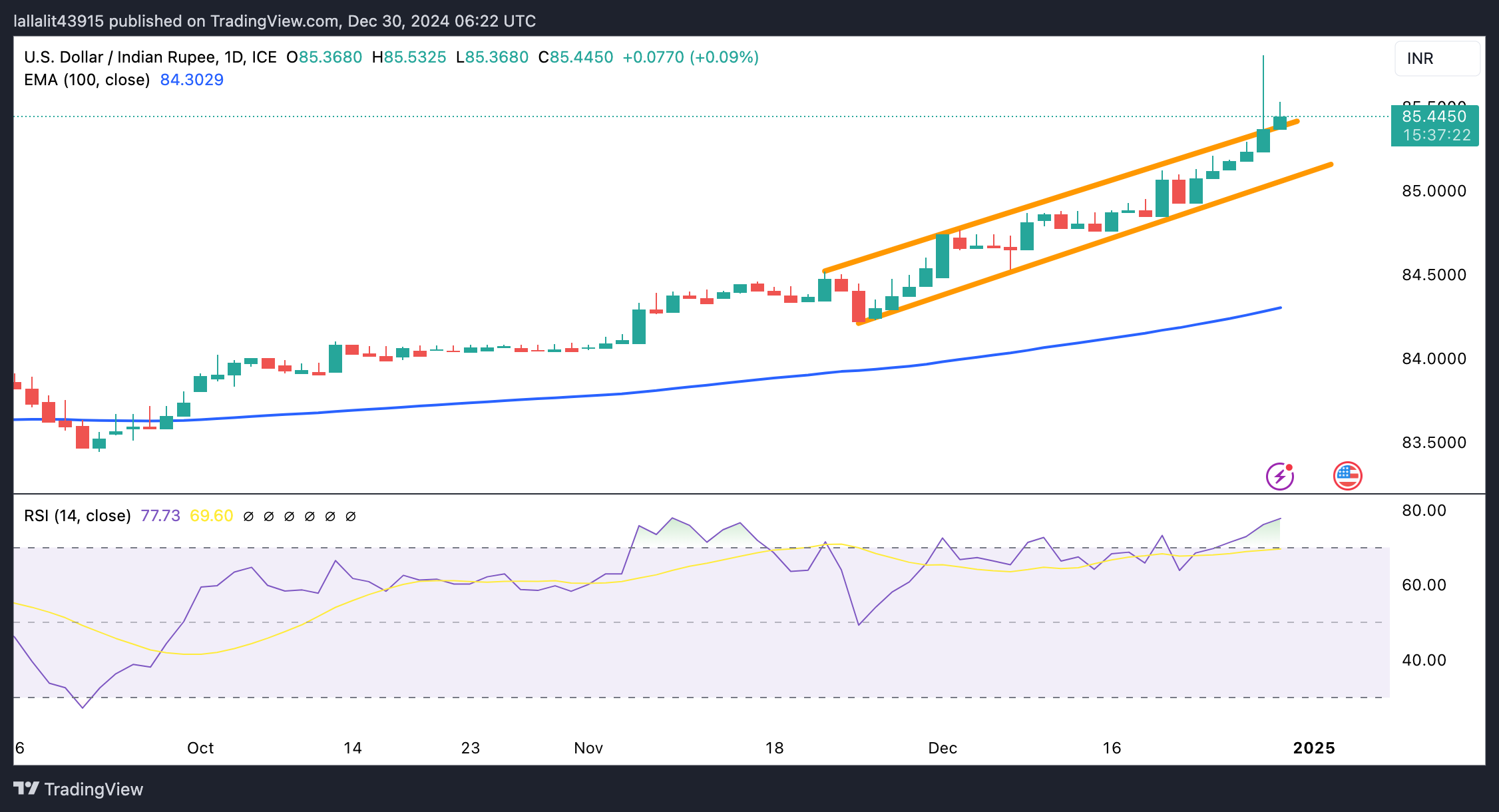
The Indian Rupee trades on a weaker note on the day. According to the daily chart, the USD/INR pair holds above the key 100-day Exponential Moving Average (EMA), suggesting bulls still have control of the medium-term trend. Nonetheless, further consolidation cannot be ruled out before positioning for any near-term USD/INR appreciation as the 14-day Relative Strength Index (RSI) stands near 76.10, indicating an overbought condition.
If bulls manage to push above the ascending channel upper boundary at 85.35 and can sustain trade up there, that may attract technical buyers to 85.50, en route to the 86.00 psychological level.
If bearish momentum forms, we could see a move back toward the crucial support level in the 85.10-85.00 zone, where the lower boundary of the trend channel and the round mark meet. A breach of this level could see a drop to 84.30, the 100-day EMA.
Indian economy FAQs
The Indian economy has averaged a growth rate of 6.13% between 2006 and 2023, which makes it one of the fastest growing in the world. India’s high growth has attracted a lot of foreign investment. This includes Foreign Direct Investment (FDI) into physical projects and Foreign Indirect Investment (FII) by foreign funds into Indian financial markets. The greater the level of investment, the higher the demand for the Rupee (INR). Fluctuations in Dollar-demand from Indian importers also impact INR.
India has to import a great deal of its Oil and gasoline so the price of Oil can have a direct impact on the Rupee. Oil is mostly traded in US Dollars (USD) on international markets so if the price of Oil rises, aggregate demand for USD increases and Indian importers have to sell more Rupees to meet that demand, which is depreciative for the Rupee.
Inflation has a complex effect on the Rupee. Ultimately it indicates an increase in money supply which reduces the Rupee’s overall value. Yet if it rises above the Reserve Bank of India’s (RBI) 4% target, the RBI will raise interest rates to bring it down by reducing credit. Higher interest rates, especially real rates (the difference between interest rates and inflation) strengthen the Rupee. They make India a more profitable place for international investors to park their money. A fall in inflation can be supportive of the Rupee. At the same time lower interest rates can have a depreciatory effect on the Rupee.
India has run a trade deficit for most of its recent history, indicating its imports outweigh its exports. Since the majority of international trade takes place in US Dollars, there are times – due to seasonal demand or order glut – where the high volume of imports leads to significant US Dollar- demand. During these periods the Rupee can weaken as it is heavily sold to meet the demand for Dollars. When markets experience increased volatility, the demand for US Dollars can also shoot up with a similarly negative effect on the Rupee.
Author

Lallalit Srijandorn
FXStreet
Lallalit Srijandorn is a Parisian at heart. She has lived in France since 2019 and now becomes a digital entrepreneur based in Paris and Bangkok.