USD/INR trades with bearish bias, Fed Chair Powell’s speech looms
- The Indian Rupee strengthens in Friday’s early European session.
- Fed's dovish remarks, decline of crude oil prices and RBI intervention continue to underpin the INR.
- Investors will closely monitor Fed Chair Jerome Powell’s speech on Friday.

The Indian Rupee (INR) attracts some buyers on Friday as the dovish US Federal Reserve (Fed) minutes and lower crude oil prices support the local currency. Traders also expect the INR’s downside might be limited as the Reserve Bank of India (RBI) might step in to sell the USD and prevent the INR from breaching the key 84.00 level.
Nonetheless, the relentless Greenback demand from importers and ongoing foreign fund outflows might dampen investor sentiments and drag the Indian Rupee lower. The Fed Chair Jerome Powell's speech at the Jackson Hole Symposium will take center stage on Friday, which could offer some insight into the future US interest rate path.
Daily Digest Market Movers: Indian Rupee rebounds, but potential upside seems limited
- The Reserve Bank of India (RBI) released the minutes of the Monetary Policy Committee (MPC) meeting on Thursday, highlighting that the policy must continue to be actively disinflationary to ensure anchoring of inflation to its target level.
- The Indian central bank noted that headline inflation has seen upward movement in June to 5.1% as food inflation pressures increased and offset the impact of subdued core inflation and deflation in the fuel group.
- RBI Governor Shaktikanta Das noted that "Inflation is gradually trending down, but the pace is slow and uneven. Durable alignment of inflation to the target of 4.0 percent is still some distance away. Persistent food inflation is imparting stickiness to headline inflation.”
- The preliminary HSBC India Manufacturing Purchasing Managers Index (PMI) declined to 57.9 in August from 58.1 in July. Services PMI rose to 60.4 in August from the previous reading of 60.3.
- The US S&P Global Composite PMI fell slightly to 54.1 in August's flash estimate from 54.3 in July, better than the expectation of 53.5. Meanwhile, Manufacturing PMI dropped to 48 in the same period from 49.6. Services PMI rose to 55.2 in August versus 55 prior.
- Federal Reserve Bank of Boston President Susan Collins stated that it will soon be appropriate to begin cutting rates, adding that incoming data will guide the pace of rate cuts.
- Kansas City Fed President Jeff Schmid noted Thursday that he was looking more closely at the dynamics behind the increase in the unemployment rate and would let data guide his decision on whether to support a rate reduction next month.
- Investors are now pricing in around 76% odds of a 25 basis points (bps) Fed rate cut in its September meeting, according to the CME FedWatch Tool.
Technical Analysis: USD/INR’s constructive outlook remains in place
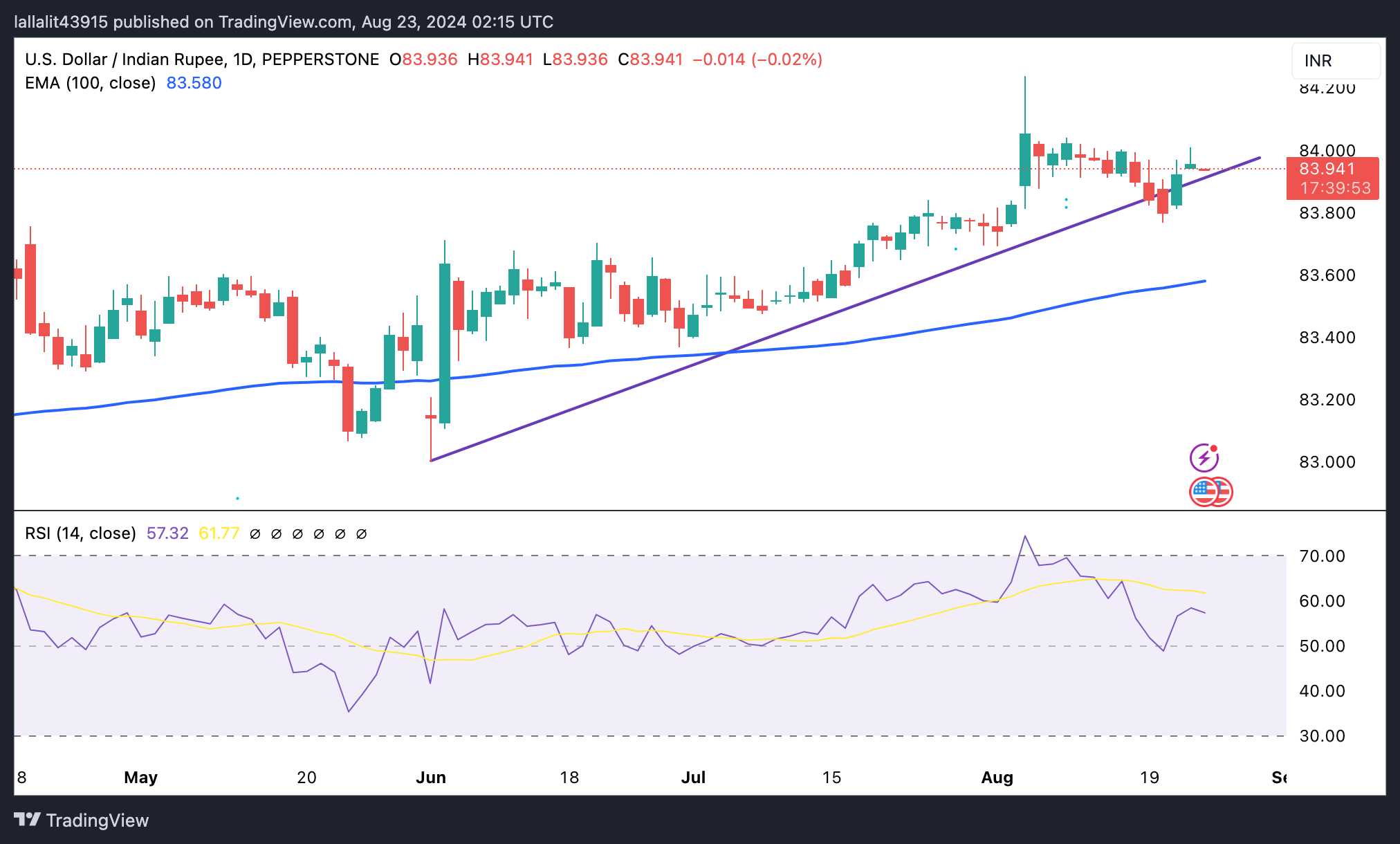
If USD/INR pops up bullish pressure above the 84.00 psychological mark, the pair could retest the record high of 84.24. A decisive break above this level may attract buyers to 84.50.
Sustained trading below the ascending trendline around 83.92 could draw in sellers and drag the pair to 83.77, the low of August 20. The next contention level to watch is the 100-day EMA at 83.57.
US Dollar price in the last 7 days
The table below shows the percentage change of US Dollar (USD) against listed major currencies in the last 7 days. US Dollar was the weakest against the New Zealand Dollar.
| USD | EUR | GBP | CAD | AUD | JPY | NZD | CHF | |
| USD | -1.38% | -2.00% | -1.05% | -1.68% | -2.49% | -2.95% | -2.50% | |
| EUR | 1.37% | -0.61% | 0.35% | -0.28% | -1.14% | -1.54% | -1.13% | |
| GBP | 1.96% | 0.61% | 0.94% | 0.33% | -0.54% | -0.94% | -0.53% | |
| CAD | 1.03% | -0.37% | -0.97% | -0.62% | -1.48% | -1.89% | -1.48% | |
| AUD | 1.64% | 0.29% | -0.32% | 0.62% | -0.80% | -1.26% | -0.82% | |
| JPY | 2.45% | 1.12% | 0.50% | 1.47% | 0.83% | -0.42% | -9898.10% | |
| NZD | 2.87% | 1.52% | 0.91% | 1.85% | 1.25% | 0.40% | 0.40% | |
| CHF | 2.47% | 1.12% | 0.51% | 1.46% | 0.84% | -0.01% | -0.40% |
The heat map shows percentage changes of major currencies against each other. The base currency is picked from the left column, while the quote currency is picked from the top row. For example, if you pick the Euro from the left column and move along the horizontal line to the Japanese Yen, the percentage change displayed in the box will represent EUR (base)/JPY (quote).
RBI FAQs
The role of the Reserve Bank of India (RBI), in its own words, is '..to maintain price stability while keeping in mind the objective of growth.” This involves maintaining the inflation rate at a stable 4% level primarily using the tool of interest rates. The RBI also maintains the exchange rate at a level that will not cause excess volatility and problems for exporters and importers, since India’s economy is heavily reliant on foreign trade, especially Oil.
The RBI formally meets at six bi-monthly meetings a year to discuss its monetary policy and, if necessary, adjust interest rates. When inflation is too high (above its 4% target), the RBI will normally raise interest rates to deter borrowing and spending, which can support the Rupee (INR). If inflation falls too far below target, the RBI might cut rates to encourage more lending, which can be negative for INR.
Due to the importance of trade to the economy, the Reserve Bank of India (RBI) actively intervenes in FX markets to maintain the exchange rate within a limited range. It does this to ensure Indian importers and exporters are not exposed to unnecessary currency risk during periods of FX volatility. The RBI buys and sells Rupees in the spot market at key levels, and uses derivatives to hedge its positions.
Author

Lallalit Srijandorn
FXStreet
Lallalit Srijandorn is a Parisian at heart. She has lived in France since 2019 and now becomes a digital entrepreneur based in Paris and Bangkok.