USD Index climbs to three-week highs just below 107.00, focus on US data, ECB
- The index extends the advance and approaches 107.00.
- The march north in the dollar appears bolstered by US yields.
- US flash Q3 GDP, weekly Claims, Durable Goods Orders next on tap.

The greenback, when gauged by the USD Index (DXY), maintains the bullish bias well in place and already trades at shouting distance from the key 107.00 barrier.
USD Index now looks at key US data
The index advances for the third consecutive session on Thursday, always propped up by the persistent weakness in the risk complex and the intense rally in US yields across different timeframes.
On the latter, the relentless sell-off in the US bond market comes pari passu with expectations of another pause at the Fed’s November 1 meeting, while speculation of a December rate hike remains steady for the time being.
In the meantime, all the attention is expected to be on the release of advanced prints of the Q3 GDP figures, as the resilience of the economy has been closely watched by the Fed and remains one of the pillars of the anticipated tighter-for-longer stance from the central bank.
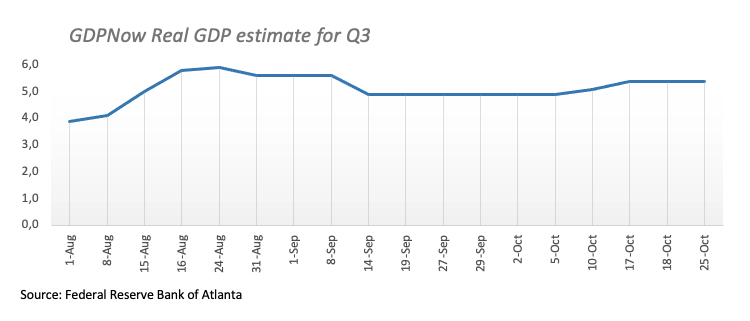
Additional data will include the usual weekly Initial Claims, Pending Home Sales, Durable Goods Orders and preliminary Goods Trade Balance.
Other than the US calendar, market participants are expected to watch the interest rate decision by the ECB, which is predicted to maintain its rates intact according to the broad consensus.
What to look for around USD
The index keeps the recovery well and sound and retargets the key 107.00 hurdle in the near term.
In the meantime, support for the dollar keeps coming from the good health of the US economy and still elevated inflation, which morphs into higher yields and underpins the renewed tighter-for-longer narrative from the Federal Reserve.
Key events in the US this week: Initial Jobless Claims, Durable Goods Orders, Advanced Goods Trade Balance, Flash Q4 GDP Growth Rate (Thursday) – PCE, Core PCE, Personal Income, Personal Spending, Final Michigan Consumer Sentiment (Friday).
Eminent issues on the back boiler: Persevering debate over a soft or hard landing for the US economy. Incipient speculation of rate cuts in early 2024. Geopolitical effervescence vs. Russia and China and the Middle East.
USD Index relevant levels
Now, the index is up 0.23% at 106.78 and the breakout of 106.88 (weekly high October 26) could expose 107.34 (2023 high October 3) and finally 107.99 (weekly high November 21 2022). On the downside, the next support emerges at 105.36 (monthly low October 24) ahead of 104.42 (weekly low September 11) and then 103.37 (200-day SMA).
Author

Pablo Piovano
FXStreet
Born and bred in Argentina, Pablo has been carrying on with his passion for FX markets and trading since his first college years.
















