USD/CNH Price Forecast: Bullish tone remains in play near 7.3150
- USD/CNH extends the rally to near 7.3140 in Monday’s Asian session.
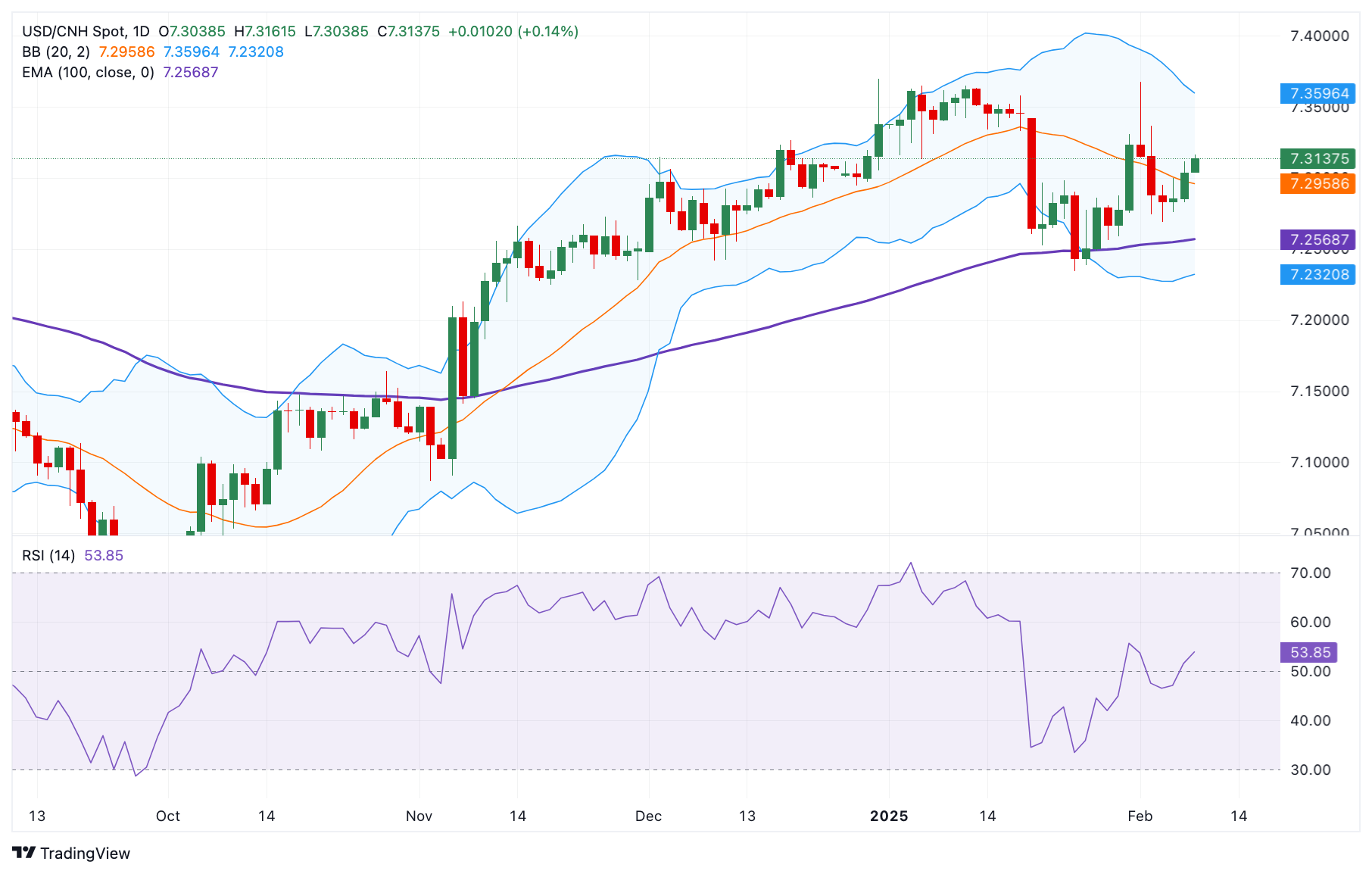
- The positive view of the pair prevails above the key 100-day EMA with the bullish RSI indicator.
- The first upside barrier is seen at 7.3595; the initial support level is located at 7.2688.

The USD/CNH pair gains ground to around 7.3140 during the Asian trading hours on Monday. The US Dollar (USD) edges higher after US President Donald Trump said that he plans to announce reciprocal tariffs on many countries by Tuesday or Wednesday, without specifying which countries. Additionally, Trump stated on Sunday that he was set to impose new 25% tariffs on all steel and aluminum imports.
According to the daily chart, the bullish outlook of USD/CNH remains intact, with the price holding above the key 100-period Exponential Moving Average (EMA). The upward momentum is supported by the Relative Strength Index (RSI), which stands above the midline near 55.00, suggesting the path of least resistance is to the upside.
The upper boundary of the Bollinger Band of 7.3595 acts as an upside barrier for the pair. A decisive break above this level could pave the way to 7.3673, the high of February 3.
On the flip side, the initial support level for USD/CNH emerges at 7.2688, the low of February 5. Extended losses could see a drop to 7.2568, the 100-day EMA. The additional downside filter to watch is 7.2320, the lower limit of the Bollinger Band.
USD/CNH daily chart
US-China Trade War FAQs
Generally speaking, a trade war is an economic conflict between two or more countries due to extreme protectionism on one end. It implies the creation of trade barriers, such as tariffs, which result in counter-barriers, escalating import costs, and hence the cost of living.
An economic conflict between the United States (US) and China began early in 2018, when President Donald Trump set trade barriers on China, claiming unfair commercial practices and intellectual property theft from the Asian giant. China took retaliatory action, imposing tariffs on multiple US goods, such as automobiles and soybeans. Tensions escalated until the two countries signed the US-China Phase One trade deal in January 2020. The agreement required structural reforms and other changes to China’s economic and trade regime and pretended to restore stability and trust between the two nations. However, the Coronavirus pandemic took the focus out of the conflict. Yet, it is worth mentioning that President Joe Biden, who took office after Trump, kept tariffs in place and even added some additional levies.
The return of Donald Trump to the White House as the 47th US President has sparked a fresh wave of tensions between the two countries. During the 2024 election campaign, Trump pledged to impose 60% tariffs on China once he returned to office, which he did on January 20, 2025. With Trump back, the US-China trade war is meant to resume where it was left, with tit-for-tat policies affecting the global economic landscape amid disruptions in global supply chains, resulting in a reduction in spending, particularly investment, and directly feeding into the Consumer Price Index inflation.
Author

Lallalit Srijandorn
FXStreet
Lallalit Srijandorn is a Parisian at heart. She has lived in France since 2019 and now becomes a digital entrepreneur based in Paris and Bangkok.