USD/CHF tests back into 0.8700 as SNB eases off the gas
- USD/CHF sees a limited rebound on Friday after hitting four-month lows on Thursday.
- SNB no longer focusing on forex sales after latest rate decision.
- Coming up next week: SNB Quarterly Bulletin, US GDP & PCE.

The USD/CHF is drifting back towards the 0.8700 handle on Friday after a tense week that saw the Swiss Franc (CHF) gain another one and a quarter percent on the US Dollar (USD) from Monday's opening bids.
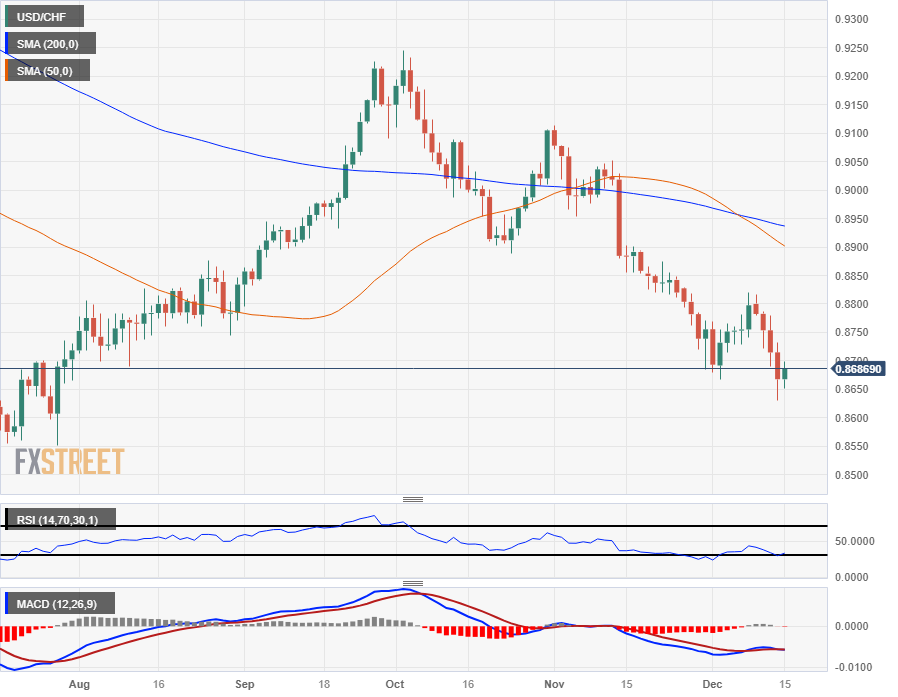
The pair is down nearly 1.5% from last week's peak bids near 0.8820, and Friday's limited gains are barely pulling the pair off the floor after closing down for the last four consecutive trading days.
The Swiss National Bank (SNB) is caught in the middle, holding interest rates in place for the second consecutive rate call, with inflation drifting towards the SNB's targets and Swiss Gross Domestic Product (GDP) growth projected to slow.
SNB's Jordan: We are no longer focusing on forex sales
SNB Chairman Thomas Jordan noted on Thursday that the SNB is no longer focusing directly on forex operations to try and keep the CHF from appreciating further. Despite markets ratcheting up expectations of rate cuts as soon as next March, the SNB Chair noted that when it comes to monetary policy, the SNB is more likely to resume selling currency reserves directly before looking at beginning rate cuts.
US economic data mixed on Friday, With the S&P Global Manufacturing Purchasing Managers' Index (PMI) for December missing expectations to print at 48.2 versus November's 49.4, missing the median market forecast of a slight decline to 49.3.
Read More: SNB softened its language on FX reserve sales - Nomura
The US Services PMI firmly surprised to the upside, coming in at a robust 51.3, completely stepping over the market's forecast backslide to 50.6 from the previous month's 50.8.
Coming up next week, the SNB posts its Quarterly Bulletin for the fourth quarter of 2023 on Wednesday, followed by US GDP figures on Thursday. The Federal Reserve's policy pivot and updated dot plot of interest rate expectations faces its first challenge, when US Personal Consumption Expenditure (PCE) numbers for November print next Friday.
Annualized US GDP for the third quarter is expected to hold steady at 5.2%, while median market forecasts are calling for a slightly decline in PCE for the year into November from 3.5% to 3.4%.
USD/CHF Technical Outlook
USD/CHF's Friday rebound is on the anemic side, barely keeping the US Dollar within Thursday's daily range as short pressure remains. Bidders will need to adjust their expectations and celebrate recapturing the 0.8700, assuming buyers are able to muscle the pair over the target price level before markets wrap up trading action for the week.
The pair is down over two percent peak-to-trough from last weak's top bids at 0.8816, and the USD/CHF is in the red nearly five percent from November's high of 0.9112.
The 50-day and 200-day Simple Moving Averages (SMA) have completed a bearish crossover near the 0.8950 price level, and potential topside momentum will be capped off by the 50-day SMA descending into the 0.8900 handle.
USD/CHF Daily Chart
USD/CHF Technical Levels
Author

Joshua Gibson
FXStreet
Joshua joins the FXStreet team as an Economics and Finance double major from Vancouver Island University with twelve years' experience as an independent trader focusing on technical analysis.














