|

USD/CHF Price Analysis: Bulls fail to conquer the 200-day SMA, further downside on the horizon

  • The USD/CHF reversed its course after jumping to a daily high of 0.9032 and then settling slightly above 0.9000.
  • The USD is struggling to gather momentum on a positive market mood.
  • The US reported strong economic activity figures from September.
  • Rising US Treasury yields may limit the downside for the pair.

In Tuesday’s session, the USD/CHF saw volatility, and after initially rising to a high above the 200-day Simple Moving Average (SMA) of 0.9032, it retreated towards 0.9000, still holding some daily gains. The  market movers for the pair included US economic activity figures from September, while the Swiss economic calendar had nothing relevant to offer.

The US Census Bureau reported that Retail Sales came in at 0.7% MoM in September, higher than the 0.3% expected but decelerated from 0.8%. Furthermore, Industrial Production rose by 0.3% MoM in the same month versus the 0% expected, and both data points suggest that the US economy is resilient despite the Federal Reserve's (Fed) contractive monetary policy. 

As a reaction, US yields continued rising, and the 2, 5, and 10-year rates rose to 5.22%, 4.88%, and 4.85%, respectively, with all three seeing more than 1.50% increases and approaching multi-week highs. In line with that, investors may be gearing up for another hike by the Federal Reserve as the combination of strong economic activity and inflation accelerating in September may justify one more 25 basis point (bps) increase in 2023. According to the CME FedWatch tool, the odds of a 25 bps hike in the December meeting rose to nearly 42%, while a pause in September is nearly to be priced in. For the rest of the week, the Federal Reserve’s Beige Book will provide further clues on Wednesday's US economic outlook and the weekly Jobless Claims report on Thursday.


USD/CHF Levels to watch 

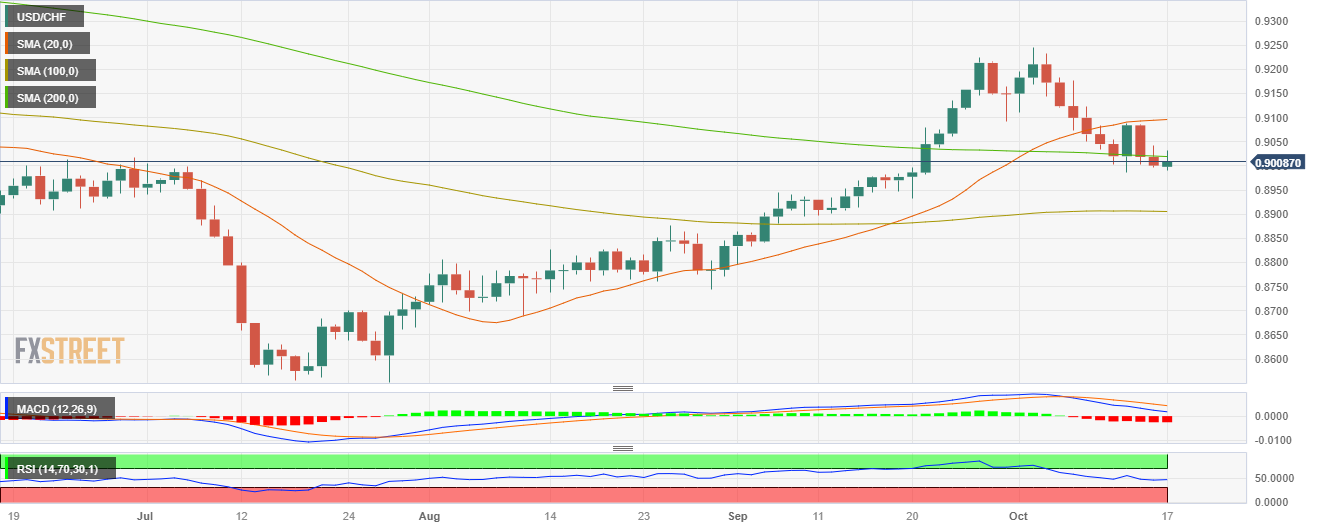
Observing the daily chart, the outlook is starting to tilt in favour of the bears, but they still have some work to do. The Relative Strength Index (RSI) has a negative slope below its midline, while the Moving Average Convergence (MACD) histogram presents bigger red bars. Additionally, the pair is below the 20 and 200-day Simple Moving Averages (SMAs) but above the 100-day SMA, indicating that the bulls still have some gas left in the tank in the broader picture.


Support levels: 0.8980, 0.8950, 0.8930.

Resistance levels: 0.9018 (200-day SMA), 0.9040, 0.9070.


USD/CHF Daily Chart
USD/CHF

Overview
Today last price0.901
Today Daily Change0.0009
Today Daily Change %0.10
Today daily open0.9001
 
Trends
Daily SMA200.9094
Daily SMA500.8945
Daily SMA1000.8906
Daily SMA2000.902
 
Levels
Previous Daily High0.9042
Previous Daily Low0.8996
Previous Weekly High0.9124
Previous Weekly Low0.8987
Previous Monthly High0.9225
Previous Monthly Low0.8795
Daily Fibonacci 38.2%0.9014
Daily Fibonacci 61.8%0.9025
Daily Pivot Point S10.8983
Daily Pivot Point S20.8966
Daily Pivot Point S30.8937
Daily Pivot Point R10.903
Daily Pivot Point R20.906
Daily Pivot Point R30.9077

Author

Patricio Martín

Patricio is an economist from Argentina passionate about global finance and understanding the daily movements of the markets.


More from Patricio Martín
Share:

Editor's Picks

AUD/USD bulls seem hesitant below 0.7050 ahead of RBA on Tuesday

AUD/USD reverses an Asian session dip on Monday as renewed optimism over Iran diplomacy boosts investor confidence, keeping a lid on the safe-haven US Dollar and supporting the risk-sensitive Aussie. Spot prices, however, remain below the one-month high, touched last Thursday, as bulls wait for the crucial RBA decision before taking fresh positions.


USD/JPY climbs to 158.00 neighborhood as BoJ uncertainty weighs on the JPY

The USD/JPY pair gains some positive traction at the start of a new week, recovering further from Friday's post-Bank of Japan (BoJ) swing low to sub-157.00 levels. The momentum lifts spot prices to the 158.00 neighborhood during the Asian session and seems unaffected by fresh intervention warning from Japan's Finance Minister Satsuki Katayama.

Gold finds relief from Oil’s decline as traders await key US economic data

Gold retains a positive bias during American trading hours on Monday after sliding to a fresh yearly low of $3,870 on Friday and ending October down 6.87%. A pullback in Oil prices amid diplomatic efforts between the US and Iran supports the precious metal. However, the rebound lacks conviction as the fundamental backdrop continues to raise doubts over a sustained recovery.

Dogecoin risks deeper slide as whales diverge

Dogecoin hovers around $0.075 on Monday after falling for the fifth consecutive week since the end of September. Santiment data shows diverging whale activity, as large holders reduce their positions while smaller whale wallets accumulate tokens. Meanwhile, weakening on-chain metrics and a deteriorating technical outlook suggest that DOGE could remain vulnerable to further losses.

Why strong US growth could not stop the bond rally and AI selloff

The US economy grew at a 3.4% annual rate, yet Treasury yields fell and the Nasdaq ended October with its worst monthly performance since March 2025. The market is no longer rewarding capital expenditure simply because it supports growth. Investors are testing whether that expenditure can produce cash flow and returns above the cost of capital.


The 2% inflation target came from a throwaway remark. It now moves trillions
The Federal Reserve's 2% inflation goal grew out of an off-the-cuff remark by a New Zealand politician in 1988. Bond investors still price long-term US debt as if 2% holds, so a change in how the Fed measures inflation would move markets.