USD/CAD stabilizes as Carney-Trump summit, Fed outlook, and economic data loom
- Markets await Carney-Trump meeting focused on trade and security.
- US ISM Services surprises to the upside; Canadian Ivey PMI due Tuesday
- USD/CAD remains technically fragile as bearish pressure builds below the 20-day SMA

USD/CAD is treading water as investors weigh the geopolitical significance of Tuesday’s scheduled meeting between Canadian Prime Minister Mark Carney and US President Donald Trump, alongside a series of high-impact economic releases expected to shape monetary policy outlooks.
At the time of writing, the pair is trading near 1.3819, holding just above key support as market participants adopt a cautious stance ahead of political and macroeconomic catalysts.
Canada–US talks: A pivotal moment for bilateral relations
Although news of the upcoming Carney-Trump meeting has temporarily eased tensions stemming from recent tariff disputes, Prime Minister Carney’s remarks on Friday suggest a fundamental reassessment of the Canada–US relationship is underway.
Speaking at a press conference in Ottawa, Carney stated he anticipates “difficult but constructive” discussions with President Trump, aiming to redefine cooperation in trade, defense, and continental strategy.
“Our old relationship, based on steadily increasing integration, is over,” Carney declared. “The era of automatic alignment is behind us. We are going to Washington with a clear-eyed view — we will protect Canadian jobs, and we’ll press for fairness.”
Tuesday’s summit is expected to address two major domains: the restructuring of trade arrangements amid rising US protectionism and the future of shared security commitments, particularly in the context of the North Atlantic Treaty Organization (NATO) and North American defense. “There are shared security and economic interests,” Carney noted, “but the path forward needs to be redefined.” The meeting’s outcome may have immediate implications for cross-border trade expectations and could weigh on Canadian Dollar (CAD) sentiment depending on the tone and progress of negotiations.
Policy outlook and economic indicators shape USD/CAD sentiment
Beyond geopolitics, USD/CAD is being shaped by a series of forthcoming economic releases and commodity price trends. In Canada, investors are awaiting the April Ivey Purchasing Managers Index (PMI), due Tuesday. The index will provide a timely snapshot of business activity, and any deviation from expectations could influence near-term outlooks for the Canadian economy and Bank of Canada policy guidance.
In the US, the Institute for Supply Management (ISM) Services Purchasing Managers Index (PMI) surprised to the upside on Monday, posting a reading of 51.6 for April. This exceeded the consensus forecast of 50.6 and marked an improvement from the prior month’s 50.8. The figure reflects moderate expansion in the services sector, which comprises the majority of the US Gross Domestic Product, and may temper dovish speculation ahead of Wednesday’s Federal Reserve (Fed) policy announcement.
Additionally, subdued oil prices continue to exert modest downward pressure on the Canadian Dollar, given the commodity’s critical role in Canada’s export economy. With no single dominant narrative, these variables are collectively reinforcing a narrow, indecisive trading range in USD/CAD.
Bearish momentum builds as USD/CAD hovers above Fibonacci support
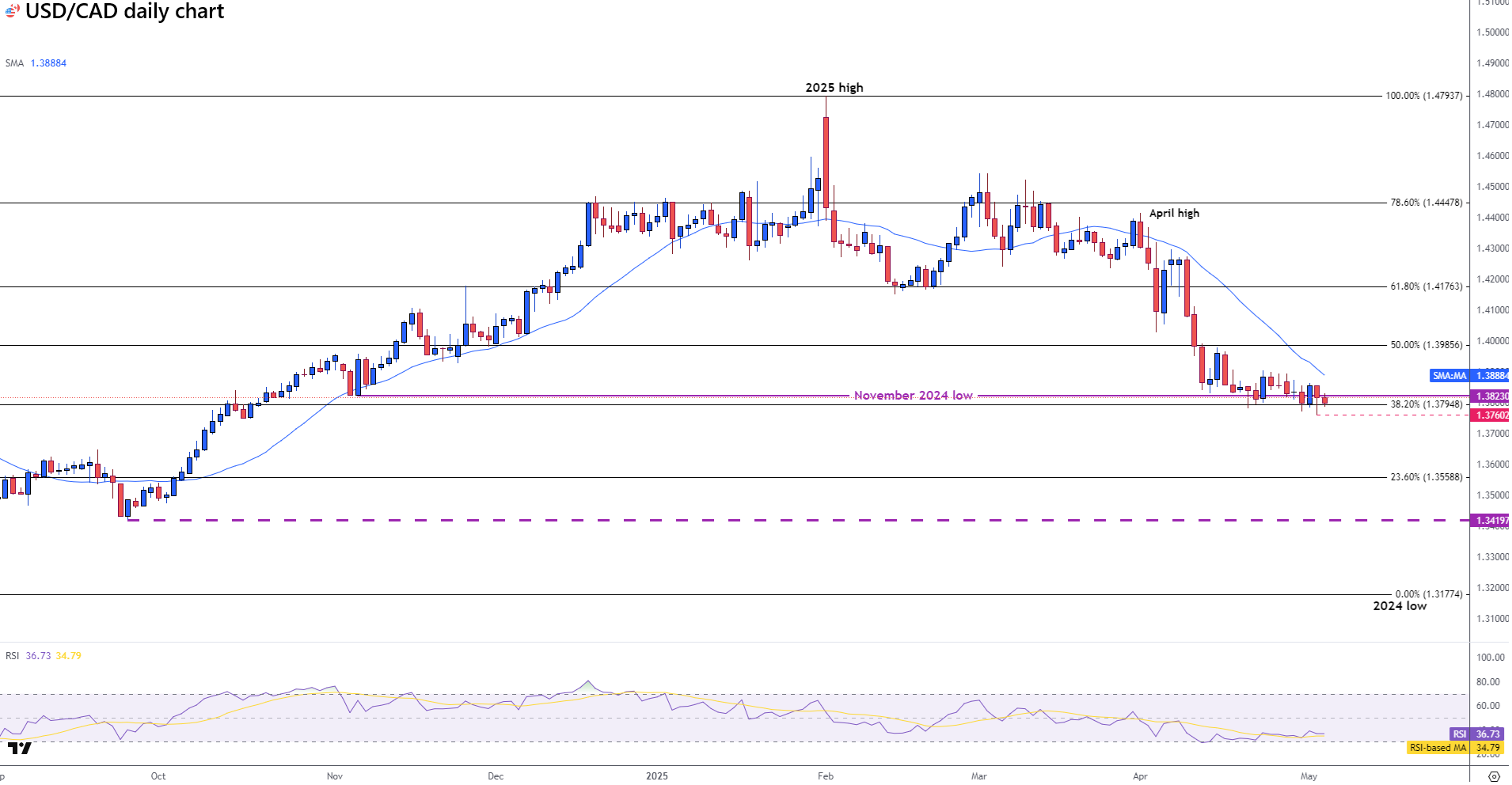
USD/CAD is currently consolidating above 1.3794, the 38.2% Fibonacci retracement level derived from the September low to the March high.
This zone represents a key technical threshold within the broader corrective move. The pair has repeatedly tested this level without a convincing rebound, indicating deteriorating bullish momentum and growing risk of a deeper pullback.
The 20-day Simple Moving Average (SMA), currently at 1.3888, continues to cap price action and reinforce short-term bearish pressure. Since mid-April, USD/CAD has remained below this moving average, with each rally attempt failing to break or close above it, a sign that sellers remain in control of the near-term trend.
Immediate downside support lies at 1.3760, which has acted as a pivot during past consolidation phases. A clean break below this would likely expose the next major support area near 1.3420, corresponding to the November 2024 swing low and marking a more substantial retracement of the prior bullish leg.
Momentum indicators reinforce the cautious tone. The Relative Strength Index (RSI) is tracking near 36, suggesting that downside momentum persists, but the pair is not yet in oversold territory. This leaves room for further selling without requiring a technical bounce, particularly if fundamental catalysts, such as the Carney-Trump summit or the Federal Reserve policy statement, drive renewed volatility.
In summary, the technical landscape favors a bearish bias while price remains below the 20-day SMA and fails to reclaim key resistance near 1.3880. A break below 1.3760 would likely confirm bearish continuation, while any move above the 20-day average could signal a potential recovery back toward the 50% Fibonacci level at 1.3985.
USD/CAD daily chart
Canadian Dollar FAQs
The key factors driving the Canadian Dollar (CAD) are the level of interest rates set by the Bank of Canada (BoC), the price of Oil, Canada’s largest export, the health of its economy, inflation and the Trade Balance, which is the difference between the value of Canada’s exports versus its imports. Other factors include market sentiment – whether investors are taking on more risky assets (risk-on) or seeking safe-havens (risk-off) – with risk-on being CAD-positive. As its largest trading partner, the health of the US economy is also a key factor influencing the Canadian Dollar.
The Bank of Canada (BoC) has a significant influence on the Canadian Dollar by setting the level of interest rates that banks can lend to one another. This influences the level of interest rates for everyone. The main goal of the BoC is to maintain inflation at 1-3% by adjusting interest rates up or down. Relatively higher interest rates tend to be positive for the CAD. The Bank of Canada can also use quantitative easing and tightening to influence credit conditions, with the former CAD-negative and the latter CAD-positive.
The price of Oil is a key factor impacting the value of the Canadian Dollar. Petroleum is Canada’s biggest export, so Oil price tends to have an immediate impact on the CAD value. Generally, if Oil price rises CAD also goes up, as aggregate demand for the currency increases. The opposite is the case if the price of Oil falls. Higher Oil prices also tend to result in a greater likelihood of a positive Trade Balance, which is also supportive of the CAD.
While inflation had always traditionally been thought of as a negative factor for a currency since it lowers the value of money, the opposite has actually been the case in modern times with the relaxation of cross-border capital controls. Higher inflation tends to lead central banks to put up interest rates which attracts more capital inflows from global investors seeking a lucrative place to keep their money. This increases demand for the local currency, which in Canada’s case is the Canadian Dollar.
Macroeconomic data releases gauge the health of the economy and can have an impact on the Canadian Dollar. Indicators such as GDP, Manufacturing and Services PMIs, employment, and consumer sentiment surveys can all influence the direction of the CAD. A strong economy is good for the Canadian Dollar. Not only does it attract more foreign investment but it may encourage the Bank of Canada to put up interest rates, leading to a stronger currency. If economic data is weak, however, the CAD is likely to fall.
Author

Tammy Da Costa, CFTe®
FXStreet
Tammy is an economist and market analyst with a deep passion for financial markets, particularly commodities and geopolitics.

















