USD/CAD Price Forecast: Remains depressed around 1.4430-1.4425; downside seems limited
- USD/CAD ticks lower on Friday, though it lacks follow-through and manages to hold above 1.4400.
- The optimism over US-Canada trade talks exerts pressure, while a modest USD uptick lends support.
- The range-bound price action also warrants some caution before placing aggressive directional bets.

The USD/CAD pair struggles to capitalize on the previous day's positive move and trades with a mild negative bias during the Asian session on Friday. Spot prices, however, manage to hold above the 1.4400 mark amid a modest US Dollar (USD) uptick, though the upside seems capped amid some positive news coming out of the US-Canada trade talks on Thursday.
Moreover, expectations that the Federal Reserve (Fed) will cut interest rates several times this year amid worries about a tariff-driven US economic slowdown, signs of easing inflationary pressure, and a cooling labor market might limit the USD gains. Apart from this, an uptick in Crude Oil prices could underpin the commodity-linked Loonie and further contribute to keeping a lid on the USD/CAD pair.
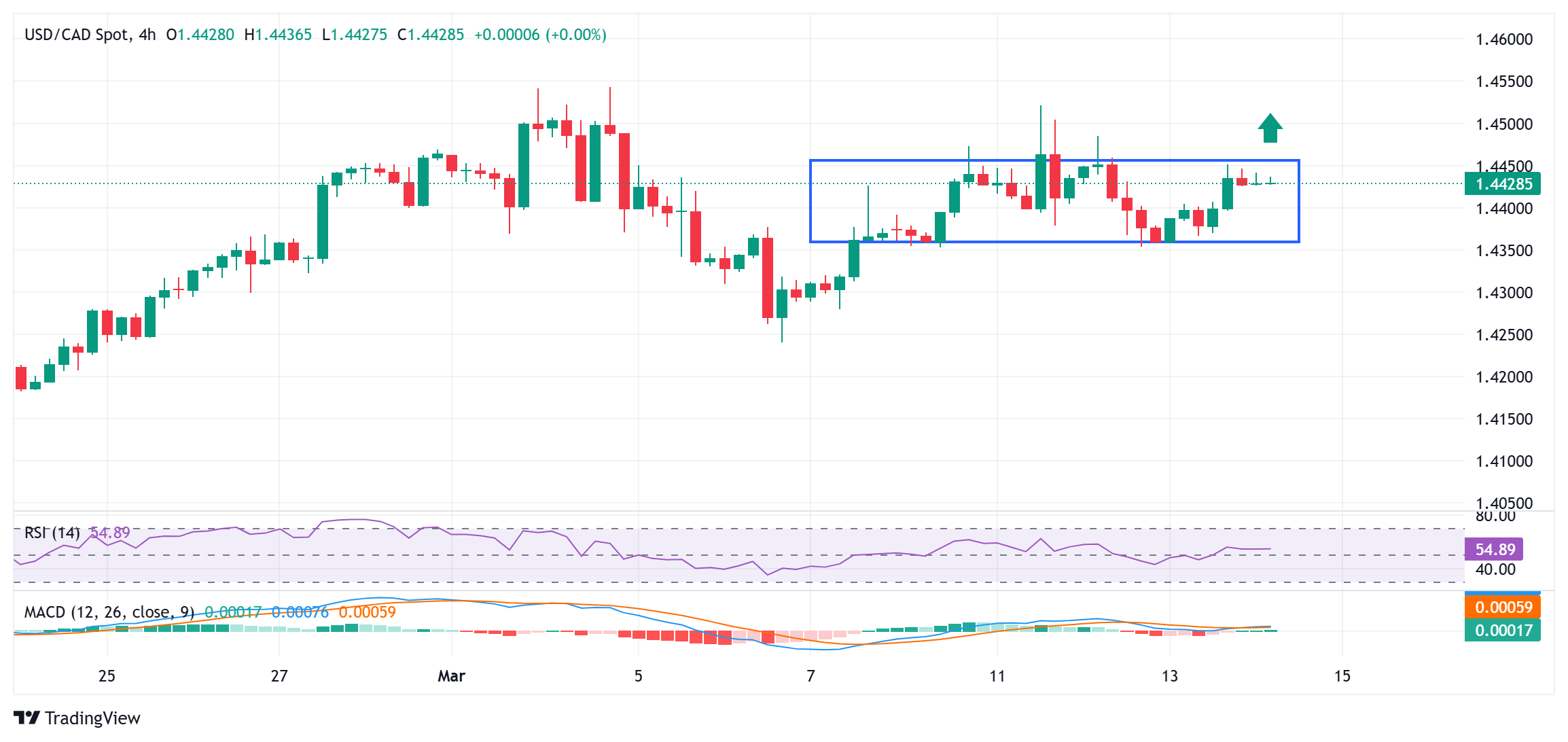
Meanwhile, spot prices, barring a knee-jerk spike on Tuesday, have been oscillating in a range since the beginning of this week. This comes on top of the recent repeated failures to find acceptance above the 1.4500 psychological mark and warrants some caution for bullish traders. However, positive technical indicators on the daily chart support prospects for an eventual breakout to the upside.
From current levels, the 1.4470-1.4475 region could act as an immediate hurdle ahead of the 1.4500 mark and the weekly swing high, around the 1.4520 area. This is followed by the monthly top, around the 1.4545 zone, above which the USD/CAD pair could reclaim the 1.4600 mark and climb further to the 1.4670 region en route to 1.4700 and the 1.4800 neighborhood, or over a two-decade high.
On the flip side, weakness below the 1.4400 round figure could find some support near the 1.4355-1.4350 area. A convincing break below could drag the USD/CAD pair to the 1.4300 mark en route to the monthly low, around the 1.4240-1.4235 region. This is followed by the 100-day Simple Moving Average (SMA), currently pegged near the 1.4215 area, which should act as a strong base.
USD/CAD 4-hour chart
Tariffs FAQs
Tariffs are customs duties levied on certain merchandise imports or a category of products. Tariffs are designed to help local producers and manufacturers be more competitive in the market by providing a price advantage over similar goods that can be imported. Tariffs are widely used as tools of protectionism, along with trade barriers and import quotas.
Although tariffs and taxes both generate government revenue to fund public goods and services, they have several distinctions. Tariffs are prepaid at the port of entry, while taxes are paid at the time of purchase. Taxes are imposed on individual taxpayers and businesses, while tariffs are paid by importers.
There are two schools of thought among economists regarding the usage of tariffs. While some argue that tariffs are necessary to protect domestic industries and address trade imbalances, others see them as a harmful tool that could potentially drive prices higher over the long term and lead to a damaging trade war by encouraging tit-for-tat tariffs.
During the run-up to the presidential election in November 2024, Donald Trump made it clear that he intends to use tariffs to support the US economy and American producers. In 2024, Mexico, China and Canada accounted for 42% of total US imports. In this period, Mexico stood out as the top exporter with $466.6 billion, according to the US Census Bureau. Hence, Trump wants to focus on these three nations when imposing tariffs. He also plans to use the revenue generated through tariffs to lower personal income taxes.
Author

Haresh Menghani
FXStreet
Haresh Menghani is a detail-oriented professional with 10+ years of extensive experience in analysing the global financial markets.

















