USD/CAD Price Forecast: Extends winning streak amid risk-off mood
- USD/CAD strengthens as the direct involvement of the US in Middle East tensions has increased the safe-haven demand.
- US President Trump confirmed that Washington’s military forces have launched airstrikes on Iran.
- The Oil price is expected to benefit from rising Oil prices.

The USD/CAD pair extends its winning streak for the fifth trading day on Monday. The Loonie pair gains as demand for safe-haven assets, such as the US Dollar (USD), has increased after the direct involvement of the United States (US) into the aerial war between Israel and Iran over the weekend.
The US Dollar Index (DXY), which tracks the Greenback’s value against six major currencies, jumps to near 99.10.
US President Donald Trump stated in a post on Truth.Social that Washington’s military forces struck three nuclear facilities of Iran successfully, aiming to stop Tehran from fulfilling its ambition of building nuclear weapons.
Meanwhile, investors brace for retaliation from Iran who has threatened to choke the Strait of Hormuz, the gateway from which almost quarter of world’s total Oil is supplied.
On the Loonie front, higher Oil prices are expected to strengthen the Canadian Dollar (CAD) against its other peers, given that Canada is the largest oil exporter to the US.
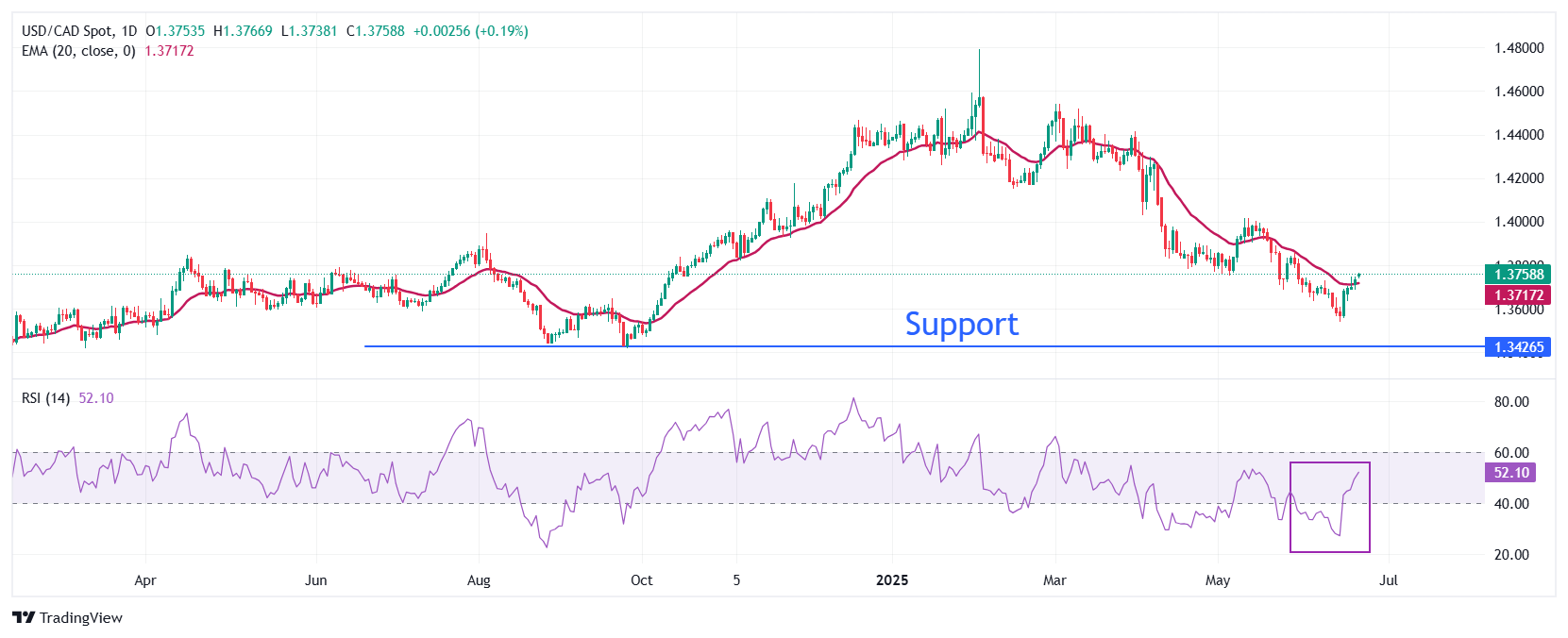
USD/CAD gains for five trading days in a row after posting a fresh eight-month low around 1.3540 on June 16. The Loonie pair recovers above the 20-day Exponential Moving Average (EMA), indicating that the near-term trend has turned bullish.
The 14-day Relative Strength Index (RSI) jumps sharply to near 50.00, exhibiting signs of bullish reversal.
A further recovery move above the May 29 high of 1.3820 by the pair would open the door towards the May 21 high of 1.3920, followed by the May 15 high of 1.4000.
On the contrary, the asset could slide towards the psychological level of 1.3500 and the September 25 low of 1.3420 if it breaks below Monday’s low of 1.3540.
USD/CAD daily chart
in
Risk sentiment FAQs
In the world of financial jargon the two widely used terms “risk-on” and “risk off'' refer to the level of risk that investors are willing to stomach during the period referenced. In a “risk-on” market, investors are optimistic about the future and more willing to buy risky assets. In a “risk-off” market investors start to ‘play it safe’ because they are worried about the future, and therefore buy less risky assets that are more certain of bringing a return, even if it is relatively modest.
Typically, during periods of “risk-on”, stock markets will rise, most commodities – except Gold – will also gain in value, since they benefit from a positive growth outlook. The currencies of nations that are heavy commodity exporters strengthen because of increased demand, and Cryptocurrencies rise. In a “risk-off” market, Bonds go up – especially major government Bonds – Gold shines, and safe-haven currencies such as the Japanese Yen, Swiss Franc and US Dollar all benefit.
The Australian Dollar (AUD), the Canadian Dollar (CAD), the New Zealand Dollar (NZD) and minor FX like the Ruble (RUB) and the South African Rand (ZAR), all tend to rise in markets that are “risk-on”. This is because the economies of these currencies are heavily reliant on commodity exports for growth, and commodities tend to rise in price during risk-on periods. This is because investors foresee greater demand for raw materials in the future due to heightened economic activity.
The major currencies that tend to rise during periods of “risk-off” are the US Dollar (USD), the Japanese Yen (JPY) and the Swiss Franc (CHF). The US Dollar, because it is the world’s reserve currency, and because in times of crisis investors buy US government debt, which is seen as safe because the largest economy in the world is unlikely to default. The Yen, from increased demand for Japanese government bonds, because a high proportion are held by domestic investors who are unlikely to dump them – even in a crisis. The Swiss Franc, because strict Swiss banking laws offer investors enhanced capital protection.
Author

Sagar Dua
FXStreet
Sagar Dua is associated with the financial markets from his college days. Along with pursuing post-graduation in Commerce in 2014, he started his markets training with chart analysis.


![How Wall Street rigs the game [Video]](https://editorial.fxsstatic.com/images/i/market-chaos-01.jpg)