|

USD/CAD Price Analysis: Seesaws between 61.8% Fibonacci retracement, 100-day EMA

  • USD/CAD steps back from 100-day EMA, still positive on a day above the weekly low of 1.3728.
  • 200-day EMA offers additional support below 61.8% Fibonacci retracement.
  • May 19 low, 50% Fibonacci retracement can challenge the buyers.

USD/CAD drops from the intraday high of 1.3785 to 1.3773 amid the initial hour of Tokyo trading on Friday. In doing so, the pair retreats from 100-day EMA but stays above 61.8% Fibonacci retracement level of February-March upside.

Even so, the bearish MACD and a failure to carry the bounce off 1.3728 favors the sellers.

As a result, odds of the pair’s drop to a 200-day EMA level of 1.3585 become brighter if it breaks the immediate supports surrounding 1.3765 and 1.3730.

On the contrary, an upside clearance of a 100-day EMA level of 1.3780 might not help the bulls regain the throne as May 19 low near 1.3865/70 and 50% Fibonacci retracement level of 1.3940 stand all as near-term key resistances.

USD/CAD daily chart
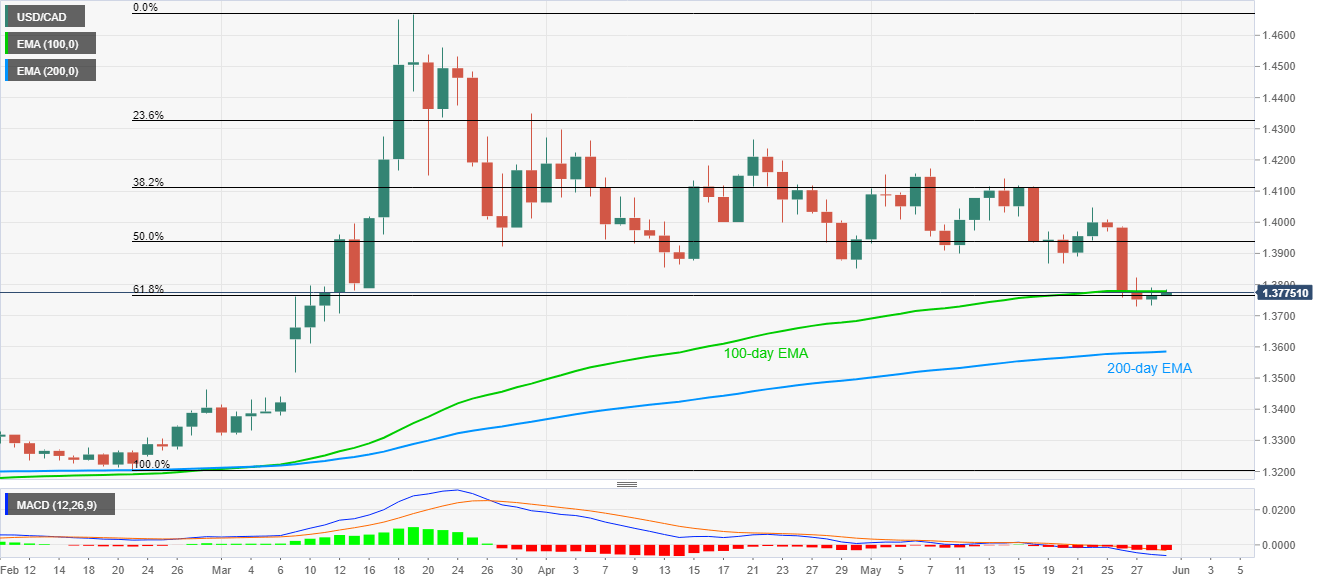
Trend: Bearish

Additional important levels

Overview
Today last price1.3774
Today Daily Change11 pips
Today Daily Change %0.08%
Today daily open1.3763
 
Trends
Daily SMA201.3982
Daily SMA501.405
Daily SMA1001.3712
Daily SMA2001.3456
 
Levels
Previous Daily High1.379
Previous Daily Low1.3734
Previous Weekly High1.4114
Previous Weekly Low1.3867
Previous Monthly High1.4299
Previous Monthly Low1.385
Daily Fibonacci 38.2%1.3769
Daily Fibonacci 61.8%1.3755
Daily Pivot Point S11.3735
Daily Pivot Point S21.3707
Daily Pivot Point S31.3679
Daily Pivot Point R11.3791
Daily Pivot Point R21.3818
Daily Pivot Point R31.3846

Author

Anil Panchal

Anil Panchal

FXStreet

Anil Panchal has nearly 15 years of experience in tracking financial markets. With a keen interest in macroeconomics, Anil aptly tracks global news/updates and stays well-informed about the global financial moves and their implications.


More from Anil Panchal
Share:

Editor's Picks

AUD/USD bulls regain control above 0.6950 amid USD retreat

AUD/USD regains traction and extends the previous day's bounce from the weekly low, aiming for 0.7000 in Asia on Friday. The overnight pullback in US bond yields keeps the US Dollar below an 18-month high, which in turn offers some support to the pair. Meanwhile, hawkish RBA expectations also keep the major underpinned.

USD/JPY holds gains near 158.00 after Japan's weak Household Spending data

USD/JPY clings to gains around 158.00 after data showed on Friday that Japan's Household Spending fell for the ninth straight month, undermining the Japanese Yen. Meanwhile, the US Dollar remains depressed as the overnight fall in US bond yields counters a hawkish Fed and geopolitical uncertainties, could cap any downside in the pair.

Gold firms up toward $4,200 as USD pulls back

Gold trades with a positive bias for the second straight day on Friday, though it remains range-bound in the range it has traded in over the past two weeks or so. The overnight decline in US bond yields keeps the US Dollar depressed below an 18-month high, allowing the non-yielding bullion to recover further from a two-month low in a bid to retest the $4,200 level.

Ethereum drops below $2,500 as rising Treasury yields trigger selling pressure​
Ethereum (ETH) fell below $2,500 on Thursday, down nearly 4% and extending losses for a third consecutive day. The decline follows rising Oil prices and US Treasury yields over the past few days. The 10Y Note Yield reached a 24-year high at 5.35%, and the 30Y Note Yield climbed above 5.70% earlier on the day, sparking major distributions in the crypto market.
The inflation illusion: How government formulas shape the data
Every month, the government releases a barrage of economic statistics. Employment, inflation, consumer spending, economic growth, and countless other measurements are presented as objective facts that policymakers, investors, and the public can use to understand the economy. But what happens when the methodology used to produce those numbers changes?
The UK 30-year gilt just hit a 1998 high. Is that good or bad for the British Pound?
The yield on the UK's 30-year government bond, or gilt, went through 6% on October 1 for the first time since early 1998, and on Monday the Pound was at its strongest against the Euro since June 2025. The gilt market's 28-year high is mostly someone else's. Since early May, the 30-year gilt yield has risen about 0.15 of a percentage point and the US 30-year about 0.7.