|

USD/CAD Price Analysis: Potentially beginning new leg higher within range

  • USD/CAD is probably beginning a new up leg within a range. 
  • The MACD has crossed over its signal line adding further credence to the bullish thesis. 
  • A mini Bull Flag may also have formed at the range lows.
     

USD/CAD has been trading in a range since the start of May. At first it looked like the pair had formed a Symmetrical Triangle pattern but the pattern failed to evolve. 

The pair’s lack of directionality means the short-term trend is probably now sideways. Given the “trend is your friend” the odds favor a continuation of USD/CAD’s sideways oscillations.

USD/CAD 4-hour Chart 
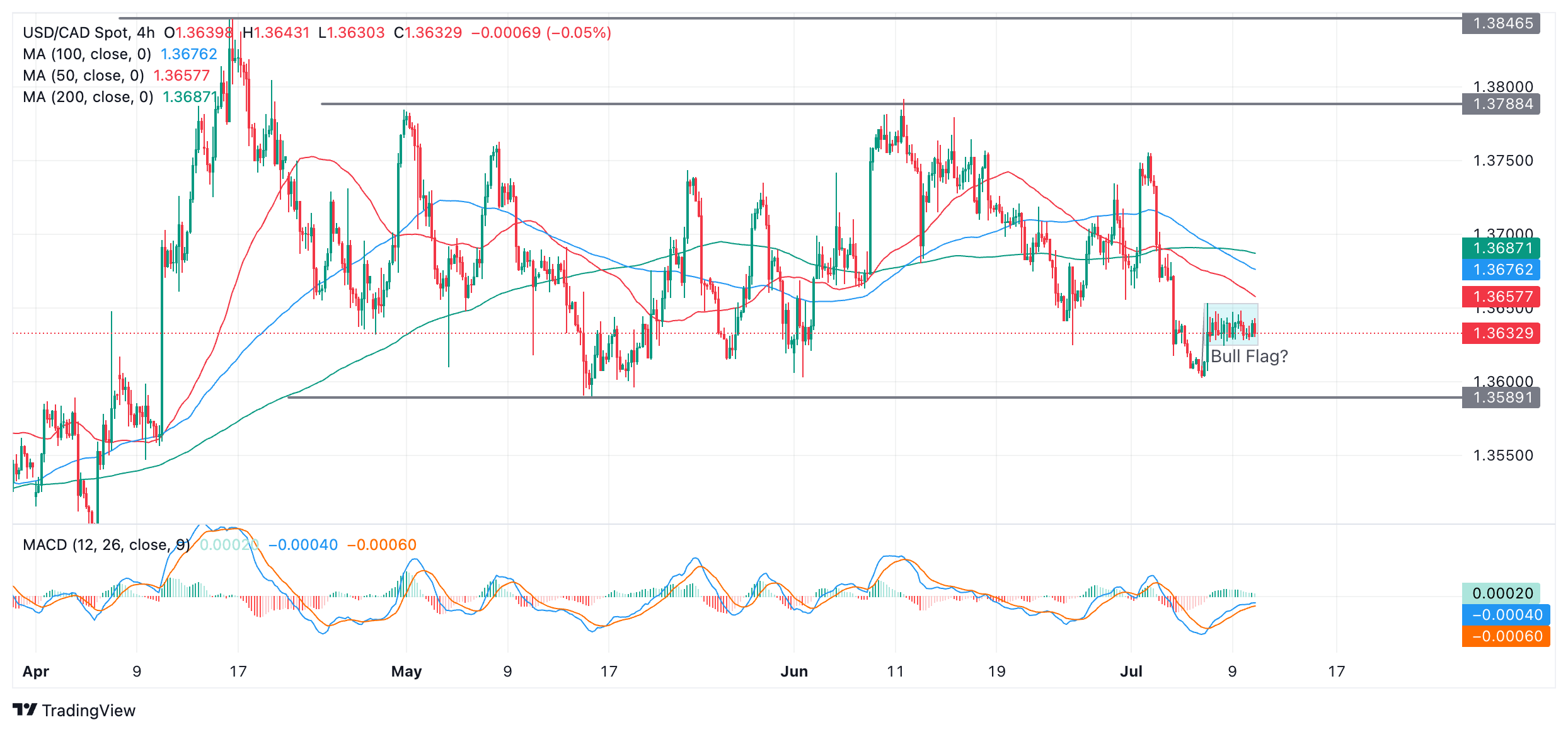
More recently USD/CAD has found support near the range’s floor at roughly 1.3589 and bounced. As it is in a sideways trend it will probably start moving up towards the range ceiling now at roughly 1.3788. 

The Moving Average Convergence Divergence (MACD) indicator crossed above its red signal line on July 5 after the initial bounce. This is a bullish sign and suggests the next leg higher within the range is about to unfold. Note how in the past, crossovers of the MACD and signal line coincided with price turns within the range.

USD/CAD has been trading in a mini-sideways consolidation (light blue shaded area on chart above) since July 5. This might be the “flag square” part of a small Bull Flag Pattern. Such a pattern promises further upside if price breaks out of the top of the rectangular consolidation phase. The target for the follow-through higher after the breakout is situated at 1.3764, the length of the initial bounce or “flag pole” extrapolated higher.

Author

Joaquin Monfort

Joaquin Monfort is a financial writer and analyst with over 10 years experience writing about financial markets and alt data. He holds a degree in Anthropology from London University and a Diploma in Technical analysis.


More from Joaquin Monfort
Share:

Editor's Picks

AUD/USD consolidates above 0.7000; remains close to monthly top

AUD/USD holds steady above 0.7000 during the Asian session on Friday, trading just below the previous day's monthly low amid diverging forces. A hawkish RBA continues to support the Aussie, while the recent decline in US bond yields keeps the US Dollar depressed near a three-week low. However, oil-driven inflation fears reinforce Fed hike bets, which, along with geopolitical risks, could benefit the safe-haven buck and cap the currency pair.

USD/JPY drops to an over one-month low, around 156.00 after Japan's CPI report

USD/JPY attracts heavy follow-through selling on Friday, dropping to the 156.00 neighborhood, a one-month low, as Japan's National CPI report reaffirms bets for an imminent BoJ rate hike and boosts the Japanese Yen. Moreover, the recent steep fall in US bond yields counters hawkish Fed expectations and geopolitical risks, undermining the US Dollar and exerting additional pressure on the currency pair.

Gold seems vulnerable near August lows; eyes $4,000 break amid Fed hike bets

Gold touches a fresh low since early August during the Asian session on Friday, eyeing the key $4,000 psychological mark. Oil-driven inflation fears reinforce December Fed hike bets and continue to undermine the non-yielding bullion, which fails to benefit from the recent steep fall in US bond yields and the prevailing US Dollar selling bias. Moreover, the overnight breakdown below a trading-range support backs the case for further depreciation.


Bitcoin falls 4% as chip stocks plunge 6.7% and oil surges
Bitcoin (BTC) fell below $82,000 on Thursday as the crypto market joined a broader market sell-off driven by concerns over artificial intelligence (AI) spending, rising oil prices and escalating geopolitical tensions involving the US and Iran. The top crypto fell 4% to $81,130 as macro fears weighed on prices across the digital asset market.
The Bank of England just got its clearest reason to hike. Here's what it's really watching

UK inflation as measured by the CPI accelerated to 3.5% YoY in September, up from 3.1% in August, according to the Office for National Statistics. This is the highest level since October 2025, exceeding economists' expectations of 3.4% and pushing inflation further from the BoE's 2% target.

What November 3 means for the Fed's rate path and the US Dollar

The USD faces a decisive period ahead of the November 3 midterm elections. While markets anticipate another interest rate increase from the Fed in December, the battle for control of Congress could reshape fiscal policy expectations and, indirectly, the path of US monetary policy in 2027.















