|

USD/CAD marches firmly towards 1.2600, post-NFP/ISM PMI

  • The USD/CAD to finish the week with losses of 1.09%, despite Friday's recovery.
  • Sentiment remains negative as fears of a US recession mount.
  • May’s US Nonfarm Payrolls crushed expectations and further cemented the case of an aggressive Fed.
  • USD/CAD Price Forecast: To consolidate, unless the USD/CAD breaks below 1.2458, that would expose the YTD low around 1.2400.

The USD/CAD edges up during the New York session, though earlier seesawed between minimal gains/losses of 0.01-0.03%, but remains above the weekly low of 1.2551, amidst investors’ risk-off mood. At 1.2572, the USD/CAD remains steady after the Bank of Canada’s (BoC) 50 bps rate hike earlier in the week.

Upbeat US NFP lifts the greenback

Friday’s US calendar remains busy. Earlier, the US Nonfarm Payrolls for May, showed that the economy added 390K new jobs, far more than the 318K estimated. Financial analysts’ chatter about the US labor market still supports the view that the US Federal Reserve will tighten aggressively after receiving the green light.

Sources cited by Bloomberg commented that May’s solid job growth showed further evidence that the US economy was not in a recession in the spring. In the meantime, Average Hourly Earnings on its YoY reading remained unchanged at 5.2%, reflecting the tight labor market though easing worries of a wage-price spiral.

Of late, the Institute for Supply Management (ISM) unveiled that the Non-Manufacturing PMI increased by 55.9, lower than the 56.4 expected. It shows businesses’ resilience, after last week’s Q1 GDP contraction of 1.5%, according to the second estimate from the Bureau of Economic Analysis.

In the meantime, the USD/CAD was unchanged on the release, but of late, it regains some control and is aiming up toward the June 1 low at 1.2605. Also, it’s worth noting that oil prices remain high, a headwind for the USD/CAD. WTI is exchanging hands at $118.23 per barrel.

Meanwhile, the US Dollar Index, a measure of the buck’s value against six currencies, recovers some of Thursday’s losses, up by 0.36%, sitting at 102.106, boosted by US Treasury yields, particularly the 10-year benchmark note rate at 2.955%, gaining four bps.

Next week’s calendar, the Canadian docket, would feature the Balance of Trade, Ivey PMI, the Canadian employment report, and Bank of Canada speakers. 

On the US front, the Federal Reserve officials begin their blackout period. However, investors’ eyes would be on the inflation report alongside the UoM June’s Consumer Sentiment.

USD/CAD Price Forecast: Technical outlook

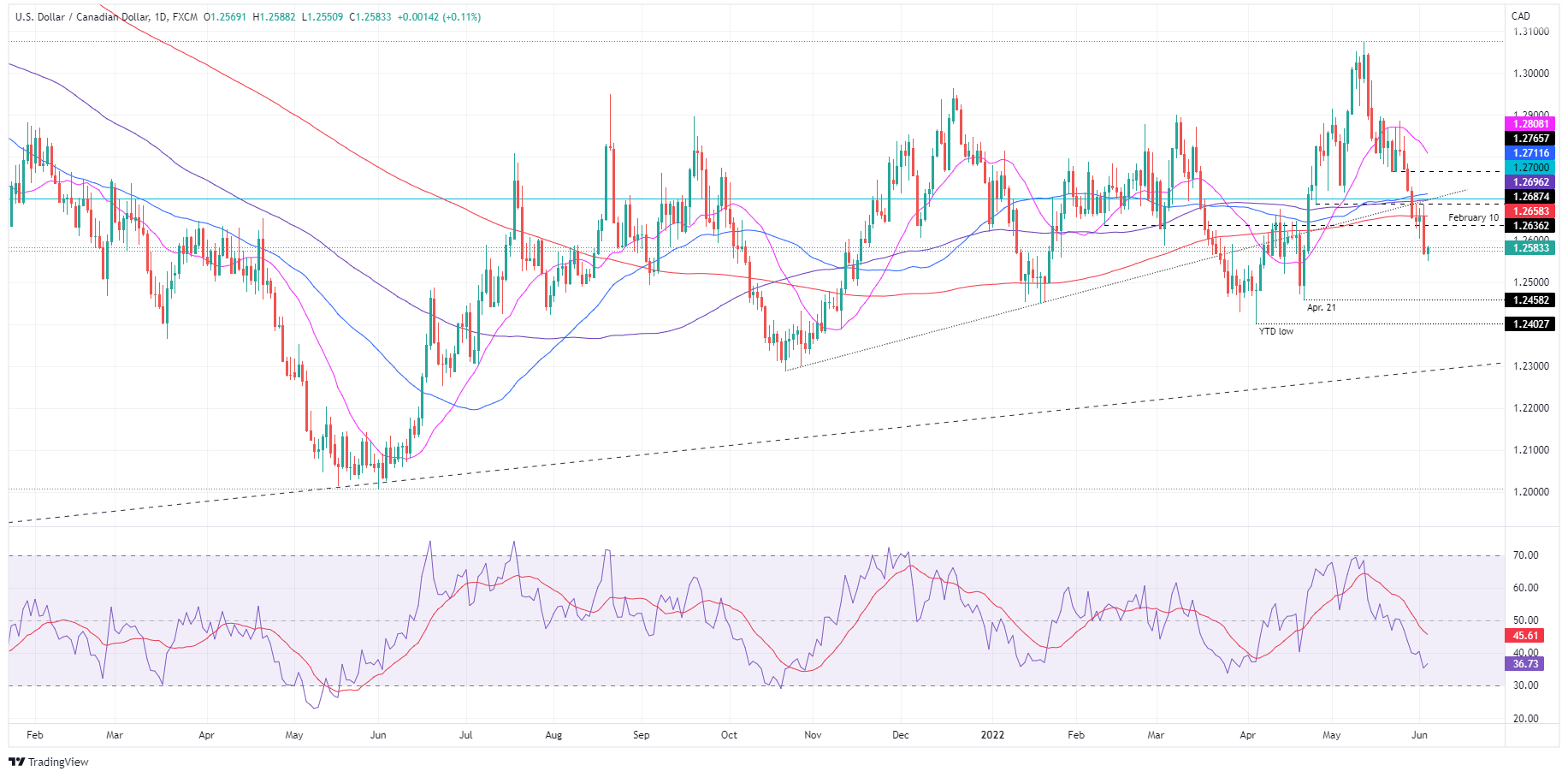
From the daily chart perspective, the USD/CAD remains downward biased, but the RSI’s reading at 36.65, moving slightly up, suggests a correction might occur in the near term. Nevertheless, if the USD/CAD continues downwards and breaks below April’s 21 low at 1.2458, then a retest of the YTD lows at 1.2402 is on the cards.

Otherwise, the USD/CAD might head upwards to test the 1.2600. Failure of a daily close above the figure would keep the major in the 1.2550-1.2600 range.
USD/CAD

Overview
Today last price1.2583
Today Daily Change0.0014
Today Daily Change %0.11
Today daily open1.257
 
Trends
Daily SMA201.2827
Daily SMA501.2712
Daily SMA1001.2699
Daily SMA2001.2662
 
Levels
Previous Daily High1.2686
Previous Daily Low1.2564
Previous Weekly High1.2885
Previous Weekly Low1.2718
Previous Monthly High1.3077
Previous Monthly Low1.2629
Daily Fibonacci 38.2%1.2611
Daily Fibonacci 61.8%1.264
Daily Pivot Point S11.2528
Daily Pivot Point S21.2485
Daily Pivot Point S31.2406
Daily Pivot Point R11.2649
Daily Pivot Point R21.2729
Daily Pivot Point R31.2771

Author

Christian Borjon Valencia

Markets analyst, news editor, and trading instructor with over 14 years of experience across FX, commodities, US equity indices, and global macro markets.


More from Christian Borjon Valencia
Share:

Editor's Picks

AUD/USD drops to two-week low, further below 0.7000 after RBA's less hawkish rate hike

AUD/USD drifts lower for the second straight day on Tuesday, hitting a fresh two-week low during the Asian session after the Reserve Bank of Australia's (RBA) widely expected 25 bps rate hike. The decision was far from unanimous, with three members preferring to hold rates at 4.60%. This tempers expectations of further tightening, which, along with modest US Dollar strength, weighs on the currency pair.


USD/JPY fails near 159.00 amid weak USD, intervention risks

USD/JPY edges lower during Tuesday’s Asian session, reversing part of the previous day's gains to 158.00 as the US Dollar remains depressed amid hopes for Iran diplomacy and ahead of US midterm elections. Meanwhile, intervention risks support the Japanese Yen, though the uncertainty over the timing of the next BoJ rate hike caps gains. This keeps the pair confined within a familiar range and warrants caution before placing directional bets.


Gold struggles below $3,950 amid Fed hike bets, ahead of US midterm elections

Gold weakens further below $3,950 during the Asian session, reversing part of the previous day's recovery from a one-year low set last week. Data released on Monday showed that US manufacturing sector business activity expanded for the 10th straight month in October. The Institute for Supply Management's Manufacturing PMI came in higher than consensus estimates and rose to 55.5 in October from 54.5 in the previous month. This reaffirms hawkish US Federal Reserve expectations, which along with rebounding US bond yields, prompt fresh selling around the non-yielding yellow metal.

Cardano extends losses as sellers stay in control

Cardano (ADA) extends correction, trading below $0.189 on Tuesday after losing key support zone the previous day. Mixed derivatives data and cautious on-chain metrics continue to weigh on bullish sentiment, while weakening technical indicators suggest further downside risks for ADA.

What a split Congress means for the US Dollar

The United States is going to the polls on Tuesday, and much is at stake. The mid-term elections mean the renovation of roughly one-third of the Senate and all 435 of the House seats. Additionally, special elections in Florida and Ohio will be held to fill the seats vacated by US Secretary of State Marco Rubio and Vice President JD Vance.

The 2% inflation target came from a throwaway remark. It now moves trillions
The Federal Reserve's 2% inflation goal grew out of an off-the-cuff remark by a New Zealand politician in 1988. Bond investors still price long-term US debt as if 2% holds, so a change in how the Fed measures inflation would move markets.